
Sometimes, the most compelling artistry emerges from the spaces we least expect—like a Brooklyn bedroom where Paula Tartell has spent the past five years quietly weaving together her unique sound. Once a concert pianist with a repertoire steeped in classical tradition, Tartell has evolved into a boundary-pushing producer, singer, and songwriter. Now, with the release of her debut single Canary under the moniker PAULA T, she’s stepping out of her sanctuary and into the public eye.
Canary is vibrant, a live-wire debut that bursts with the restless energy of punk while retaining the tender intricacy of bedroom production. It transforms vulnerability into a bold artistic statement. Tartell’s sweet, unpretentious vocals thread through manipulated bird calls and drum-driven layers, creating a song that’s as textured as it is fearless. And yet, beneath the playful tones lies a striking emotional depth—a meditation on love, rejection, and the courage it takes to expose yourself to the world. In our conversation, Tartell is both candid and disarmingly thoughtful, reflecting on the fears that shaped this project and the symbolism behind her titular canary. She also shares her commitment to sustainability, from her DIY costume design to her collaborative approach to music-making. Pull up a seat and prepare to meet PAULA T, an emerging voice with much to say—and even more to sing.

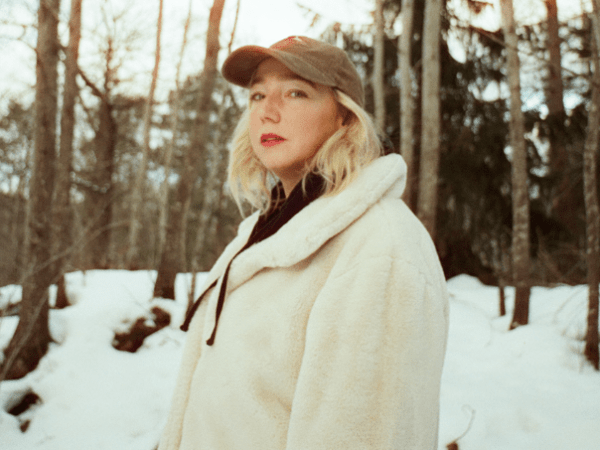
photo Vivian Wang
Hey, Paula. Let’s start at the beginning, where all the best things do. You’ve described “Canary” as a song that poured out of you in 20 minutes, almost as if it had a will of its own. I love that. Some songs, it seems, grab you by the collar and demand to be made. Do you remember what you were feeling in that exact moment? Was it frustration, freedom—maybe a little bit of both?
Hey! I think Canary is defined by the hodgepodge of feelings I had that day: some perceptible at the time and others more latent. I wrote the song a few weeks after a breakup on a park bench, spurred by my asking him if he could open up more to me. ‘You want to know me inside and out?,” he reflected, “I’m not even sure I want to know myself inside and out…” And that was that.
While writing Canary, there was frustration and exasperation at an emerging pattern: I kept opening myself up and falling for people afraid of vulnerability or accountability. But I also remember feeling a visceral tenderness and care for this particular person as I wrote, and wanting his happiness (“Oh won’t you nestle in my wings?”). I think that care made the song sound warmer. Additionally in the mix, you can hear some good old existential dread at the prospect of being unlovable! I recorded the vocals and further developed the sonic world of the song a long time after that initial songwriting moment, so the lyrics that essentially birthed from my subconscious that day had more time to steep with me. Amidst new turbulence in my love life, I found myself really feeling the despair of the question: am I too much for someone to love?! I think I was owning that dread and turning it into an anthem for myself.
There’s something poetic about transforming bird chirps—essentially noise—into something melodic, even beautiful. It’s like reclaiming something overlooked, reshaping it into art. What made you want to experiment with National Geographic samples in the first place? Did the birds “sing back” to you, or was it more of a happy accident?
You’ve really captured how I relate to sound, in general! Birds are more obvious because they literally sing, but there’s music in everything. The mundane deserves to be noticed, examined, and celebrated. Often easier said than done, but if that’s how you approach everyday life, things will feel more beautiful and meaningful. I have a practice of recording sounds on my phone, throwing them into a Digital Audio Workstation (DAW) file, and seeing what frequencies or rhythms emerge. Oftentimes they won’t make it into a final idea, but they might jumpstart a songwriting process. By disfiguring, saturating, and distorting the bird chirps, I unearthed a driving rhythmic quality so interesting to me that they demanded to be placed in the spotlight of the mix.
Alright, so let’s talk about that guitar solo. I swear, when I heard it, I had this WTF moment—in the best way. It’s short, punchy, and honestly one of the best solos I’ve heard in ages. And then something—your voice?—just cuts through right after, like a battle cry. Was that actually you, or some sort of bird sample snuck into the chaos? Either way, it’s genius. Did you give any direction for the solo, or was it pure magic in the room?
Oh, I KNOW! That solo is the best part of the song. It was my second time meeting guitarist, Jake Ford, ever, and I feel like he understood the assignment in a deep way! At the recording session in the bedroom studio of my dear friend and collaborator, Eli Heath (producer, recording and mix engineer, bass guitar), I was so nervous about having my music performed for the first time. I mostly just sat on the floor fiddling with the microphone while Eli directed the session. Other than playing my demo for Jake and drummer Addie Vogt, my only directive to my fellow musicians was, ‘make it weird and glitchy, think of a hummingbird’s flight.” Also, to their displeasure: “It needs to be this tempo, no slower.”
That’s my voice at the end of the solo! The solo died a little towards the end because Jake’s string broke (we were only able to do three full takes because the song is so treacherously fast!). But I wanted the chaos of the solo break to escalate—not die—into the final chorus, so I recorded a kooky phrase with my voice and processed it with similar effects as the bird calls. I suppose it was also my way of melding myself and my own identity with the canary!
Okay, so here’s the thing—this is your debut, and I’m already hooked. “Canary” is wild, fresh, and over way too soon. I need more. Like, immediately. Are you already cooking up the next track? Or are you planning to keep us on the edge of our seats for a while?
That makes my heart flutter! It seriously means so much, and so do these questions! I’m working towards a full length album, but I want to release at least two more singles in the next few months. The next one’s a pop banger (I truly can’t wait to share that one), and the following I think is going to be a little slower and more touchy-feely? In this stretch, I also really want to put together a band and start performing my songs around Brooklyn. I’ve only recently come to appreciate how long it takes to make and release music—especially with a full-time job—but hopefully I’ll get more efficient at it! I have a lot of ideas, so I better improve!
You talk about the vulnerability of sharing your art as being far more terrifying than falling in love. That’s a big statement. And honestly, I get it—art lives forever; love is fleeting. What pushed you over the edge to finally share “Canary”? Was there a single moment where you said, “Okay, it’s time,” or was it more of a slow unraveling of fear?
It’s deep! It’s like, my music is such a true expression of me. While I’m certain I’ve yet to create my best music, if there’s one thing I’m proud of with this project, it’s that it is truly Paula Music. But if my music is an expression of me, then I feel like if people reject my music, then they must be rejecting me as a human being – and it’s not easy to work through that fear!
On the other hand, I have a deep desire to be part of the creative dialogue of the universe. Every expression of art reverberates outward in so many ways—we can’t possibly enumerate them—and I crave to be a part of that ecosystem-community that ultimately makes me proud to be human. So while I’ve been relentless with myself and in the past might have refused to release anything unless it’s my absolute best, or fully represents my project, I eventually realized I must start somewhere if I want to join that dialogue! And Canary is the perfect song to dive in, because honestly it gives me strength to share my heart with the world: even if it means rejection!

photo Vivian Wang
The canary is such a powerful symbol—both delicate and resilient. Traditionally, it’s a bird that would warn miners of danger, sacrificing itself for the group. What does the canary symbolize for you, and why did you feel it was the right image for your first release?
Yes, exactly! So, as per the “canary in the coalmine” expression, canaries are more sensitive than humans to the presence of toxic gases in the environment, and they’re delicate and gentle, but they’re also a persevering force that keeps singing! Especially as someone with ADHD, I am very sensitive, feel emotions very strongly, am susceptible to being consumed by the world’s injustices, have a hypervigilant nervous system…and I fall in love very easily! It can be a tiring existence, but ultimately I wouldn’t change it. The canary represents anyone who feels a lot and puts their heart out there time and time again, and who honors and voices their feelings: even if it often means hurting. The canary is an invocation to celebrate yourself for feeling and expressing, to keep going, and to keep loving… Like I said, perfect for a first release! It’s ultimately just a hype song for myself!
Let’s talk about your vibrant canary costume. You’re bringing sustainability into the mix here, designing with recycled materials—liberation through creation. There’s something so tactile and refreshing about that approach. How does wearing that costume transform your performance? Is it more for your audience, or does it feel like a ritual for yourself?
Yes, so tactile and refreshing! There’s a real lesson about consumerism in that costume. I collaborated on it with my friend: artist and musician Nikolai Mishler (Grass Future Society). Through his multimedia performance project, YES theater, he designs spectacular folk masks and costumes with recycled objects. The idea is to practice sustainability as fuel for creations that highlight collective liberation. This costume is made out of cereal boxes, an old shower curtain, chopped worn-out t-shirts, and secondhand clothing otherwise acquired at Big Reuse in Brooklyn. I feel so connected to the costume because I spent hours toiling over it and had the opportunity to develop a relationship with every inch of each material. Way more meaningful and gratifying than breaking the bank at the fabric store, or buying a costume!
When I perform Canary live, I want to go ham in the canary costume! Like, run around the stage and make my friends clap for me. I will wear the canary costume as an invocation for my fellow cutie canaries in the audience to liberate themselves of fear, to keep going, to lean into joy, and to feel!
You’re a conservatory-trained pianist turned “synthbug”—from classical to experimental, it’s a pretty wild leap. But it seems like both worlds still live in your music. Do you ever feel like you’re blending opposites—like the sweet vocals in “Canary” laid over chaotic, punky textures—or do you think those elements naturally belong together?
They belong together! Classical music is all about contrast, and I’m grateful for the instincts it’s given me. If you’re playing a Beethoven sonata, the silences are just as present as the notes you’re playing. Tension, release. I think in some regards, Canary does that extremely effectively, and in others, there’s room for improvement. I believe both worlds—and all the music through which I’ve grown–- live in my music, and I hope that’s apparent to listeners!
“Romance means wanting to know someone inside and out,” you told someone on a Brooklyn park bench, only to hear that they weren’t sure they even wanted to know themselves. That hit me. It’s so raw, so human. How do you think that moment shaped “Canary”—and, honestly, your perspective on love?
That moment is the heart of the song! It made me realize that, no matter how you show up to a relationship, you cannot force the other person to work on themselves or meet you where you’re at. I had been trying to convince him to be with me so we could grow together, but suddenly I came to my senses—even if my intentions were good, my pushing was wrong and dangerous for both of us. Relationships are amazing avenues for growth, but sometimes you just have to say, “I’m not going to stop chirping away, but I can’t force others to sing: for themselves or for me!” And instead of succumbing to the rejection and dimming your own light, you just have to keep loving and feeling in that unique way you do. I really, truly believe that’s how you’ll grow and lead a beautiful life! And the right people will receive you and your care.
Your single comes out on January 8. That’s soon—excitingly soon. For an artist putting their first song into the world, there’s often a kind of electricity, equal parts terror and hope. What do you hope listeners take away from “Canary”? And what would make you feel like it was a success, on your terms?
I’m definitely feeling the terror – a couple days ago I called Eli to ask if I should pull the plug on the release! I hope listeners feel powerful and want to bop their heads from start to finish. I hope someone finds themselves humming the tune, “I can’t make canaries sing!” in a moment they’re trying to cling onto a relationship that’s not nourishing them, or to think of my song in a moment they regret expressing their feelings. I want listeners to keep loving and feeling! In terms of my definition of success, I still don’t really know. I know I want strangers to hear it, and I want the song to resonate somewhere, with someone! I hope someone wants to listen to it more than once, or for someone to share it with a friend. I hope this song connects me to others, as it already has connected me to you! Thank you so much for this interview. Now that I think about it, this alone has made me feel like Canary was a success!
*Promoted content. All information provided is prepared in accordance with editorial standards and is intended to offer useful insights for readers.



 Indie Boulevard Magazine