
When you sit across from Lacy Rose, you don’t get the sense you’re speaking to a singer or even a composer. You’re in conversation with someone who’s been through a fire and decided to write the blaze into music. Rose’s new album ‘LISPECTOR’ is a carefully stitched patchwork of pain, light, fire, and language, sung by someone who’s truly been through it.
And when she says she made this record to save herself — you believe her, because what you hear in these songs is a fragile human life burning, not a concept. Rose doesn’t pretend to know who this album is for or how it should be received — she simply lived it. And even if you’ve never read Clarice Lispector, that’s not a problem: Rose conveys Lispector’s essence not through references, but through a state — painful, radiant, almost prayerful. At the center of it all is Rose’s voice, which defies familiar labels. Before Lacy takes the stage to perform the full cycle live, we spoke with her about where it all began, what really remains of Lispector in this work, and the strange, almost mythical force of survival that art can offer when everything else falls apart.
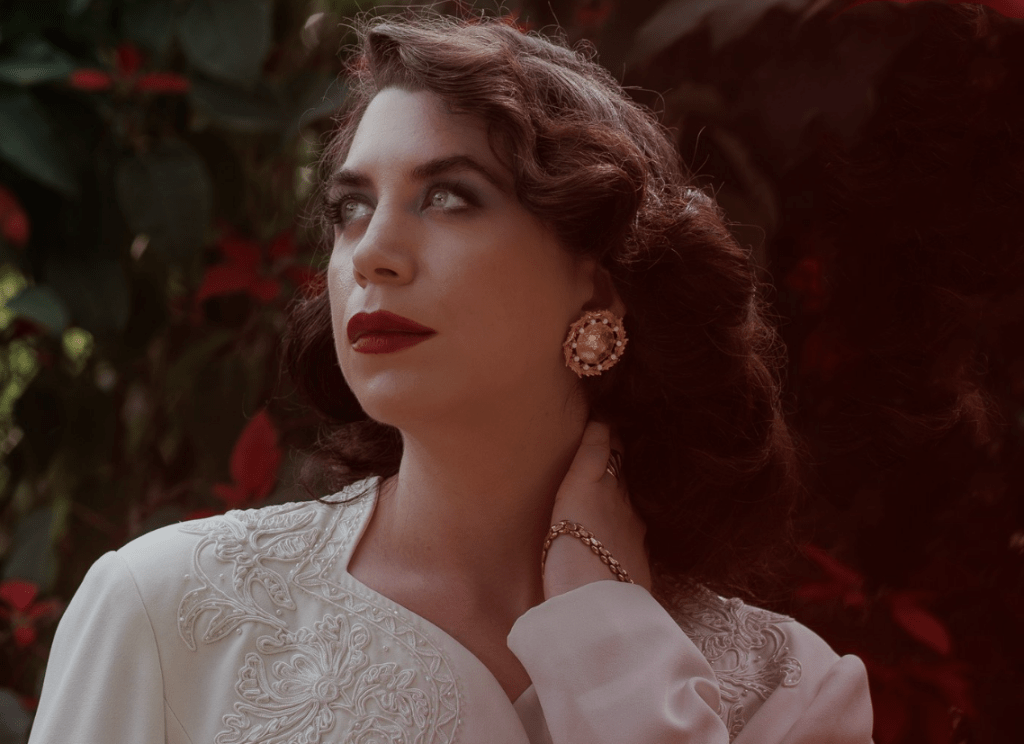
photo by BISPO
Hi Lacy — lovely to be speaking with you. You spoke in detail about how working on LISPECTOR coincided with a series of life-altering events — losses, trauma, solitude, premonitions. Interviews usually go for the “how did it influence you” angle, but I’m more curious about something else: when you listen to your own songs now, do you return to that emotional terrain, or do you find yourself observing it from a distance? What does it feel like when the album becomes something external, rather than an inner process?
I think something miraculous happens when an artist releases their art into the world: It no longer belongs to them. I certainly feel this way now that I’ve shared LISPECTOR. It’s metamorphosed into something else that transcends all the great many events, sufferings, triumphs and traumas that shaped the making of this record. Unfortunately, the release follows the recent death of my father, but somehow the process of sharing my songs has been almost spiritual. My father was a jazz trumpet player, and I can’t help but see this album as a continuation of his legacy. It’s funny because his mother was an opera singer in the Ziegfeld Follies and his father was a concert violinist, and my music is a mixture of all the songs that my grandmother, grandfather and father would have performed. For the first time since my dad’s passing and its release, I see LISPECTOR more than anything as part of my musical genealogy and the continued budding of my Rose family tree.
Your album’s been called “genre-blurring,” “uncategorisable,” even a “marketing nightmare” — and you’ve acknowledged that yourself. But there’s strength in that hybridity. You seem to deliberately avoid giving listeners the usual signposts — where the verse is, where the chorus sits, where the genre comfort zone might be. How important is that resistance to form for you, and do you think that now — in an increasingly algorithm-driven music landscape — projects like this might be finding a new kind of space to exist?
I think what I am trying to do is make an emotional cinema. I never think about form. I never begin with form, so there is no form to resist. I always begin with a feeling and the world I’m trying to express. More often than not, I start with composing a melody, but the melody is simply the score to the images and emotions I am trying to translate into sound. The poetry I write is also always imagistic and an aspect of expressing the narrative. I have always listened to a diverse range of music (from Vivaldi to Tom Waits, from Billie Holiday to John Dowland), but I would say that Art Songs are by far my favorite form, and if the form of my music were to resemble anything it would be that of an Art Song. I do think Art Songs have made a comeback! So yes, there is a new old space for my record and others like it to exist! Dry Sketch of a Horse
You quoted Lispector: “I write as if to save somebody’s life. Probably my own.” And in your case, it seems to have worked — the album became a way of surviving. But when you were recording it, was there also an idea of saving someone else? Or did that only become possible afterwards, when someone else’s pain recognised itself in yours?
While I wasn’t consciously hoping that the art I created to save myself would save someone else, I believe the alchemy of art is like an infinite mirror. Whatever catharsis an artist finds in the creation of their work can be found for the listener as well. When art is created as a means of survival for the artist, it can also be a life raft for those who encounter the work. While I’m not sure if someone else’s pain recognized itself in mine, I do know that LISPECTOR has moved people. And that for me is all that I could hope for.
In Fire, Fire, you’re not speaking about an actual event in Lispector’s biography, but about a symbolic ignition — the phoenix-hand rising from the ashes. It’s a near-mythical image. Was that structure something you consciously built, or did the myth emerge on its own, through the process? Were you trying to turn Lispector’s life into a new myth, or did it simply start taking that shape?
“Fire, Fire” is inspired by an actual event in Lispector’s life: she fell asleep with a lit cigarette which started a fire that engulfed her entire apartment in flames. All her possessions and manuscripts were destroyed. She was taken to the hospital and was so badly burned that she hovered between life and death for some time. Her writing hand was charred and so disfigured that it resembled a claw. I believe it was the claw of the Phoenix because she rose from her own ashes to write some of the greatest literature of the 20th century, Agua Viva and Hour of the Star. Her own life is the myth.

photo by BISPO
LISPECTOR doesn’t just feel like a musical work — it also reads as a kind of literary translation. Did you ever have doubts about “interpreting” her work in this way?
For much of LISPECTOR the inspiration originated with her text from various novels or short stories and the particular scenes or passages or even beautiful, unusual sentences like “Stars, Stars I pray” within them. I am never conscious of interpreting her work but rather I become obsessed with her text that grips me so much that I am compelled to do something. I unintentionally become a sort of method film actress reading and rereading whatever lines possess me. I live the text, I breathe the text, I sing the text, I dream the text until I map out an emotional landscape as if I were learning a theatrical scene. Her words become an emotional cinema that I then reinterpret with my own poetry and set music to. I see this act as more of a collaboration than anything.
You spoke about Behold the Chandelier, and it’s one of those things that might seem absurd in another context — a song dedicated to a chandelier. But there’s such loneliness and rawness in it, it becomes deeply unsettling. Do you see those kinds of details as signs of psychological strain, or as part of a poetic instinct — the ability to animate even inanimate things?
I see all life—solid, spirit, matter, material—as alive and even the inanimate as animate. In Clarice Lispector’s book The Chandelier, the dominating presence and the witness of time passing is the Chandelier itself. I think that’s the thing about objects like chandeliers whose past came before us and will most likely out-future us. There is a history and a force that is undeniable in the accumulation of time for these objects. As I’m writing this answer beneath my own green chandelier, I can feel the weight of its light, its stories, its time. Perhaps this is the sign of psychological strain, but I am more inclined to think I follow in the path of Blake when it comes to seeing “a world in a grain of sand.” Or the sand that becomes the glass of the chandelier Behold the Chandelier
Once an album is out in the world, it stops belonging solely to you. People project their own meanings onto it — sometimes ones far removed from what you intended. Are you open to those interpretations? And if someone finds something in LISPECTOR that feels entirely foreign to you, would that spark a discussion, frustration — or would you take it as a sign that the album is truly alive?
I believe an album that is truly alive is one that takes on its own meaning when experienced by the listener. Borges has this amazing quote about books that I think relates to records, “When we open a book, when the book surrenders itself to its reader, the aesthetic event occurs.” I think it’s the same with music. When we listen to a record and the record surrenders itself to us, the aesthetic event is always a magical concurrence of who you are at that moment and when you are listening to the record. And what you interpret today will be different than if you listen to the same record tomorrow or years from now. The process is living like a river, you can never step in the same one twice.
You’re classically trained, but your delivery has none of that academic detachment — your voice feels incredibly physical, vulnerable, at times even shockingly intimate. Did you ever feel an internal conflict between what you were taught and how you actually wanted to sound?
I have always sung the way I wanted to sing but the process of finding my voice has been a constant evolution. When I was singing Baroque music professionally, that required a more classical technique. Even the music I was composing at the time was very influenced by the early music repertoire I was performing, so I too sang my own songs with a more operatic sound. Since moving to New York, I began singing in many different contexts like music theater, jazz, and new music. This exploration of genres and working with my incredible voice coach, Justin Stoney, opened my voice to endless possibilities of sounds. Now I am at a point where my voice is liberated and can fully express the storytelling of my songs.
And I’m coming back to the chandelier. You mentioned that during the pandemic, you spoke to it, wrote in solitude, worried you were losing your mind. How do you relate to the idea of “normality” in an artist’s life?
I’m not sure I really understand what normality is. As an artist I am most concerned with authenticity and vulnerability. I think this is a necessary state for creation, at least for my own. It is, however, important for me to have a sense of structure and familiarity in order to reach those deep places. I am, to my own surprise, a creature of habit. There are certain things I must do without fail: sing, breathe, move my body, read, write, walk in my neighborhood, and most importantly see the people I love. It’s these seemingly small things that are most monumental and enable me to pursue my creative work.
You talk a lot about symbolism, interiority, mysticism… But do you have any completely unpoetic rituals? Something like, “I always eat noodles from a plastic container before a gig” or “I never sing in yellow socks”?
Every day I eat blueberry oatmeal, drink sobacha tea, warm up my voice, stretch to whatever record is on my turntable, and fall asleep to the white noise of my air conditioner and a recording of “Book 7” of Ovid’s Metamorphoses.
*Promoted content. All information provided is prepared in accordance with editorial standards and is intended to offer useful insights for readers.





 Indie Boulevard Magazine