
Jon-Olov Woxlin. A man who once decided he wanted to make music in the spirit of old America, although he was born in the Swedish countryside, in a place called Bersjö. At this point you want to set aside your notebook and simply… well, ask: “What?”
I came across his album ‘Junk Trunk‘ last year and was completely into it. Guitars, ballads, country of such range that I seriously checked whether this was a pseudonym for someone from Nashville. It had everything — some rockabilly, some sorrow, some romance, and a sincere, wholly un-ironic love for the genre. The vocals? Dense, full of character; Elvis discovering Marty Robbins’ recordings and deciding to sing them his own way immediately comes to mind.
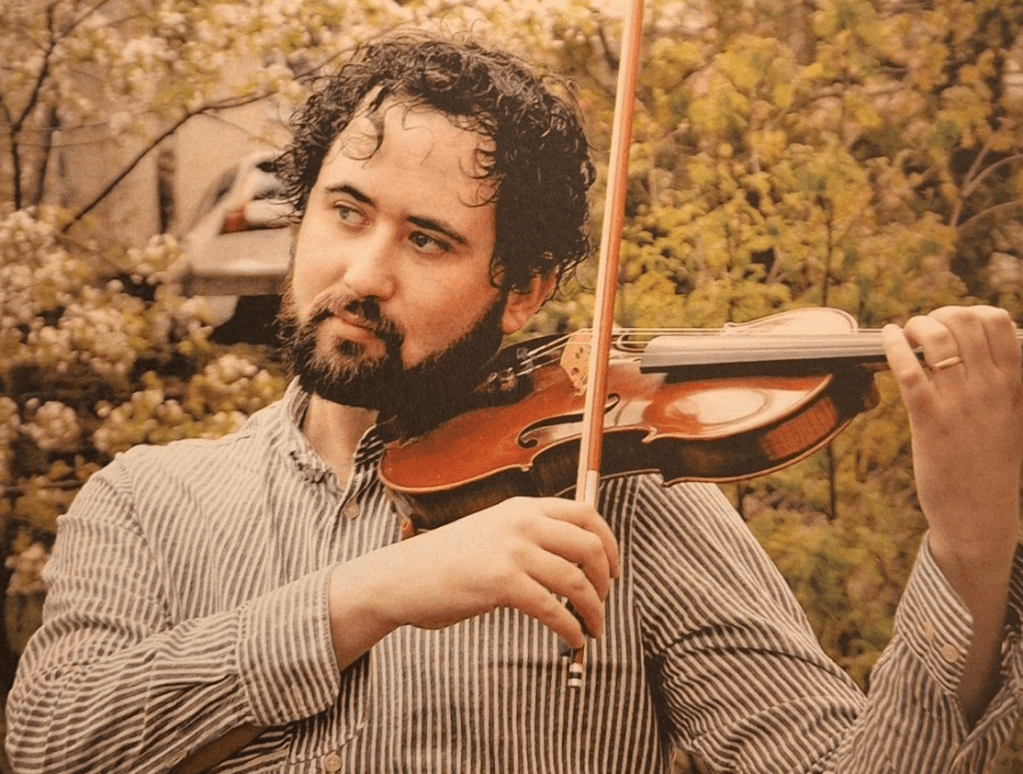
Now pay attention. Imagine you’ve drunk your favorite wine for years, you know its taste, its structure, and you no longer even smell the cork. Then one evening you’re handed a glass of water. No explanation. Just water. And you drink. Would you call the water bad? Now imagine your favorite musician stops singing, removes the lyrics, strips away everything we’re accustomed to in their songs — leaving only one instrument, a solitary voice, a violin. Does this become poorer? Or, on the contrary, does it at last become itself?
Well, let me get straight to the point. Woxlin could have continued making albums in the spirit of Americana indefinitely. He has mastered that sound. He feels at home there — in tone, style, and inflection. But he takes a step inward rather than a step to the side. He returns to the roots, to elements that lie beyond stylistic choice. The violin on his new album ‘Ur egen fatabur‘ is about returning to where everything begins. To a sound that stands apart from market forces, trends, and platforms. This music exists on its own, and here Woxlin serves less as author and more as conduit.
Twenty-one tracks. Forty-two minutes. The violin at the center. Please do not assume there’s nothing else to discover. On the contrary. This music unfolds softly and without pressure: first a narrow opening, then widening; then marshland, hill, and finally water. Polkas, waltzes, snoa, hambo — Jon-Olov Woxlin somehow manages to enliven traditions with a fresh perspective.
His list of inspirations bears no resemblance to an academic catalog. Jon-Erik Hall, Per Eric Svedin, Per Maistrom (the very one dubbed “chief instigator of quarrels” — a fitting label), the Est family — names that hold meaning only for those raised in music or for anyone who has spent an evening in a country house with skis on the wall and a dusty violin by the stove.
Honestly, describing individual tracks here seems odd. First, it makes no sense. This is precisely a case where the album functions as a single canvas. Not a tracklist but a journey—from the first click of the bow to the final fading echo. The violin leads you, and you follow. Here your imagination, pure imagination, must take over. Listening to the violin, try to picture where you are, what surrounds you, who’s beside you.
For example, on the second track, Limingoånpolskan, I was simply thrown out of reality. Not at once, but rather abruptly—I found myself inside a kind of time bubble. Everything began to spin. I became something like a duke at a ball, immersed in gold and velvet in a vast hall reminiscent of Versailles; as the ladies passed by, I offered a polite nod and bow. And somewhere near the stage, Jon-Olov Woxlin performs, and everyone in the hall listens. That’s how I see it. That’s how it works. This isn’t an album to dissect; it’s more a painting you hang in your mind and revisit under the right light.
Jon-Olov Woxlin’s violin playing deserves special mention. When you hear the bow flying across the strings, you realize that behind that effortlessness lie years of painstaking work. Rapid passages swell into rolling waves, double-note trills reject any simple melody, and shifts along the fingerboard demand perfect control—everything is honed to automatic precision. I felt an internal memory metronome click into place: thousands of hours of practice, hundreds of repetitions, millions of micro-movements.
Woxlin avoids descending into sheer seriousness. Near the end, a theme from Star Wars’ Imperial March surfaces. The unexpected contrast brought a smile: familiar fanfares weave into the flow. A cosmic rocket launching from tradition’s core.
TikTok drives a race for likes; content flashes by. Clips reign while anything demanding attention and immersion slips out of view. Against this backdrop, ‘Ur egen fatabur’ emerges as a genuine outpouring. An album here serves as both fragment of history and direct dialogue with the present.
It arrives as the remedy we’ve awaited. Algorithms favor short formats and memes. Here is space to inhale, to pause, to set the phone aside and let music unfold on its own terms. Woxlin restores the conviction that music can heal, narrate, serve something greater. Music has become a commodity measured in likes and streams. Here, it obeys its own laws, valued by depth of sound and breadth of vision. Woxlin carefully opens a door to a realm where a bow speaks louder than words, granting the listener a personal adventure.
Maybe you’ll have a playlist in the kitchen, where, between the shelf of plates and the kettle, the violin will pour itself out. Play it before sleep to enter a midnight forest untouched by any TikTok rush. Everything new echoes the old under fresh light; ‘Ur egen fatabur’ by Jon-Olov Woxlin transcends trends. Authenticity does not age. Allow this album time; it will reward you with memories you never expected.
*This review was made possible by SubmitHub








 Indie Boulevard Magazine