
Listening to Eliza Marshall’s debut EP New Birth, I catch myself thinking how rarely we pay attention to flautists at all. They usually stand quietly at the side of the stage, hidden behind vocalists and guitarists, fading into the glow of someone else’s spotlight.
But Marshall has a completely different story, and it becomes immediately clear. She has long earned respect, working with legends like Stevie Wonder, Paul McCartney, and Peter Gabriel. Though, to be honest, even those big names carry something distant, almost mythical, as if they always exist somewhere up there, on an unreachable musical Olympus. So when a musician with that kind of background suddenly steps forward and speaks in their own voice, it is always intriguing and commands attention.
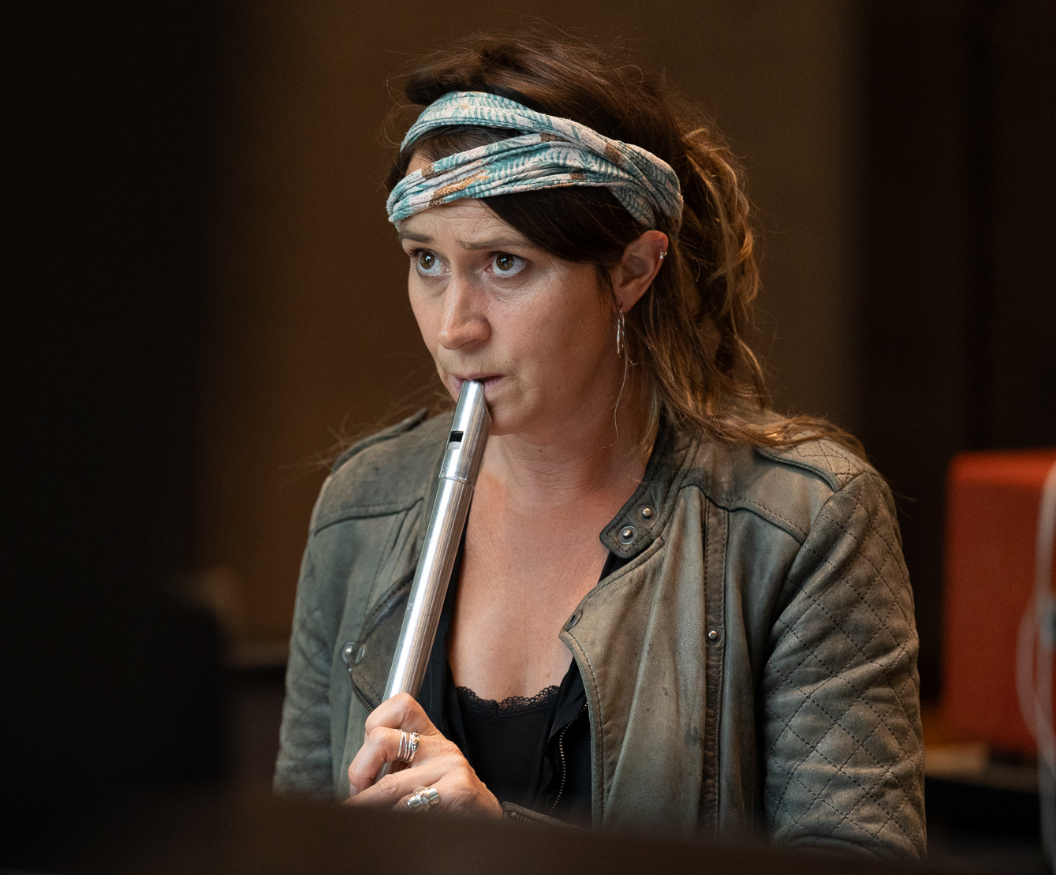
photo by York Tillyer
New Birth is a telling title, even if slightly clichéd. But the cliché quickly fades once you dive into the tracks themselves. There is something in this music that brings back the feeling of early morning, when the world seems transparent and just begins to fill with sounds, scents, and the anticipation of something unknown. Eliza Marshall picks up the flute, an instrument often associated with the classical, even old-fashioned, and sends it into an entirely new space — one where electronic textures shimmer and ambient waves flow smoothly into one another.
What stands out most is the contrast: the sound of an acoustic flute floating over hazy, blurred electronic landscapes. There is a sense of gentle disorientation, but not a disturbing one — rather, something pleasant, like in a dream, when you more or less know where you are, yet you are not completely sure. It is in this half-asleep state that you begin to realize how naturally the different worlds Eliza set out to combine fall into place.
The three compositions on the EP sound different enough that each could stand as its own story, yet they are connected by an elusive thread. Maybe it is the atmosphere of the Real World Studios in England, which has long become something of a Mecca for musical experimentation, or perhaps it is the influence of Dakar, where even the air seems infused with rhythm and life. Between these two points, Eliza Marshall stretches that invisible string on which her music balances — and she does it with such grace that the listener instinctively relaxes and trusts the journey.

photo by York Tillyer
The EP opens with a track that shares its name with the release — New Birth. A pleasing symmetry. This track indeed opens not only the album but also a new facet of Eliza Marshall’s creative thinking. From the very first seconds, it feels like you are standing on the edge of something unknown. Here, the flute almost conducts the landscapes. One moment you are in a sea mist, the next — in a desert at sunrise. All of this unfolds with what could only be described as cinematic structure: smooth transitions, shifts in tonality, plenty of air.
You can hear Marshall rediscovering sound itself in this track. That may sound abstract, but it is easy to explain — she plays with textures, and it seems sound is not a technical tool for her, but a material to be shaped. Each measure flows into the next, and this flow feels free, alive. What struck me most was its almost hypnotic nature: you do not notice when the track ends — it simply dissolves.
The second track, First Light, gently eases the tempo. Where the opening piece carried a sense of epic scope, this one offers intimacy, calm, and stillness. Instead of dense textures and rhythms — birds, open space, lightness. Here, for the first time on the EP, there is something that could be called a moment of absolute inner silence. I would say this is the point where music stops being music in the usual sense — it becomes a state of being. The ritualistic chanting, the grand drums — all of it fades, giving way to restrained tones and a sense that morning is coming. You are still half-asleep, but already feel the warmth, the light is already there, and it brings hope.

photo by York Tillyer
It is remarkable how delicately Marshall shifts contexts without breaking the overall fabric of the EP. This feeling continues into Our Times, the final track of the release. It builds on patterns reminiscent of Steve Reich — repeating phrases, micro-shifts that create a pulse similar to breathing. Here, meditation turns into motion. It feels like an internal dance begins. And all of it is anchored by her flute. Eliza breathes with the instrument. The way she controls intonation, the way she changes pressure — this is pure skill.
This is music with personality, and I do not mean the typical “emotional core” label that now gets applied to almost anything remotely deep. It is simpler and at the same time much more compelling. Eliza sounds sincere and at ease, without trying to jump out of her skin to prove something important or impress musical snobs. This is pure self-expression from someone who knows exactly who they are — and is completely confident that this is more than enough.
If music were a conversation, then New Birth would sound like the monologue of someone who had been silent for a long time, patiently choosing their words — and now finally speaks, without unnecessary pauses, doubts, or justifications. Eliza Marshall invites us into a space free from outside expectations. This is not another meticulously constructed conceptual puzzle or a game of hide-and-seek with the audience. It is music that comes across so confidently and effortlessly, it almost feels like Eliza herself is a little surprised by how precisely she managed to capture and convey a mood that had been lingering in the air.
Of course, all of this resonates most naturally with a certain audience — perhaps older, maybe even a little tired of the constant overload of formats, genres, and headline releases. But honestly, who’s to say — maybe it will be the younger generation, worn out by the aggressive pace, fleeting hits, and digital noise, that finds inspiration here. After all, returning to oneself is a universal theme, and New Birth speaks to it without a single unnecessary note.
*This review was made possible by SubmitHub








 Indie Boulevard Magazine