
London’s synth-pop enchantress I Am Boleyn has dropped ‘Voyager’ — and it hits like stepping out of a warm bath straight into the cold night air.
Let’s start with the obvious: I Am Boleyn is no newcomer. Her EPs Paris to Boleyn and Lost Summer already made a solid impact, earning her a loyal following stretching from Los Angeles to London, from the Peppermint Club to Art Basel in Miami. She is not the type to show up and vanish. But releasing a solid EP is one thing — putting together a full-length album that sounds cohesive and confident without turning into a repetitive echo of herself is a different challenge.

photo by Harry Harper
And Voyager is exactly that kind of album — it holds the bar she previously set and pushes it even higher. Fifteen tracks make for a bold move for a debut, and what stands out right away (or rather, what hits the ears first) is how effortlessly it flows. I played it on repeat maybe five times, and each time it soaked in so naturally it felt like it had been living inside me all along, just waiting for someone to press play.
Thematically, there’s an intriguing story unfolding here — a kind of journey of a Space Queen arriving on Earth, diving into a sea of emotions: longing, love, despair, and self-discovery. Sounds grand, I know, but in practice it all comes across as surprisingly human.
If the album sounds like a voyage of a cosmic queen exploring human emotions, the visual aesthetic drives the point home even more clearly. It’s the same blend of glossy futurism and unexpectedly grounded, almost human vulnerability. She is both untouchable and deeply relatable — her skin glows with cold metal, subtly dusted by stellar wind, shadows play across her frame, and those hyper-glossy thigh-high boots gleam with extraterrestrial polish. She literally radiates a kind of cosmic luxury, but her eyes reflect that very longing, that very fragility her music revolves around. The visual identity fits Voyager perfectly. The posture, the cold shine, the gaze — all of it speaks of control, distance, and absolute presence. Just like her tracks — restrained but emotional, polished but with a splinter under the skin.
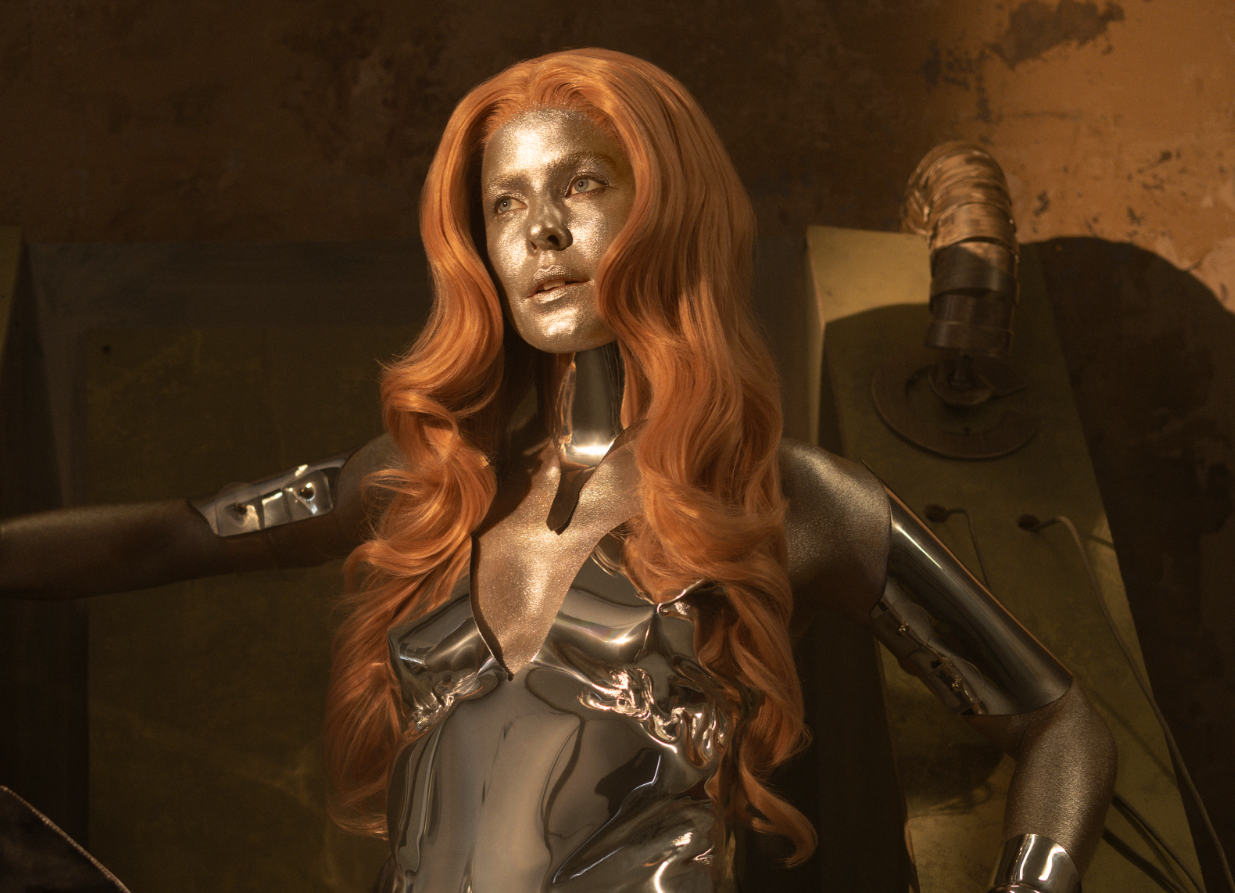
photo by Harry Harper
I Am Boleyn moves with precision between cosmic epic and personal lyricism. The album features quite a few covers, and I’ll admit — I usually approach those with caution. A cover of Britney Spears’ ‘Toxic’? Let’s be real, that is a bold move. But Boleyn clearly knows what she’s doing. She reshapes these well-known hits so thoroughly they sound both fresh and authentic. It’s that rare sweet spot where a cover does not kill the original, nor does it blindly imitate it.
Still, beyond those covers — which include The Corrs and other retro hits now reborn under a sleek layer of shimmering electropop — there is plenty of original material. And those tracks hold their own just as confidently as the recognizable ones.
The opening track Only Space sets the tone right away: there will be synths, there will be space, there will be radiant vocals that glide and hover. The intro breathes like an ’80s movie, where the main character always has a silver jacket and eyes fixed on the horizon. It sounds expansive yet danceable, like M83 remixing their own nostalgia.
Then comes Taxi, which just grabs you by the hand and pulls you through the neon. This is the track where I Am Boleyn’s full sound reveals itself: weightless vocals light enough to wrap around yourself, that signature contrast between warmth and chill, where club lights blend seamlessly with morning melancholy.
Breathless — yes, it’s a cover, but it’s also a reset. The entire synth-pop arrangement here makes the original feel like a draft. She reinvents it, and the familiar becomes something else entirely — more beautiful, more layered, more alive.
Here Before feels like a scene change. The album drifts into fog, the synths begin to blur, the vocals hush. Suddenly there’s an atmosphere — the kind you could pour into a glass and drink at the end of the day.
Say Something adds weight. The rhythm turns rougher, the bass drops lower. You can feel the album shifting into a new phase — almost ritualistic. This is music for moving through the dark. So when Interlude follows, it makes perfect sense: tension, steady pulse, bare structure. And then suddenly, you realize — this is Toxic. And once again, it just works. A cover done right.
Another Me echoes an asteroid shower. Everything scatters, everything floats. It is the moment when you stop dancing and just drift. Here, synth-pop abandons form. Only the voice remains. Only melody, slipping away — a meteor crossing a black sky. Meditative, nearly spiritual.
The final track — Until The Summer Ends — resembles a sunset seen from the far side of the atmosphere. This is synth-pop at its most refined and polished. The album does not close — it fades out, as if Boleyn is saying: “Mission complete.”
Voyager is a sonic maneuver that defies genre gravity. It has everything: atmosphere, precision, lyrical structure, restraint.
What is more, this transformation reveals itself not only in sound. You can trace it visually too. Look at her promo photos — at the beginning of Voyager, she appears as a pure alien presence: the embodiment of something extraterrestrial, distant, unknowable. But as the album unfolds, as the tracks grow warmer and more fluid — her image changes. The metal softens. Skin emerges. Emotions surface. By the end, we no longer see a synthetic entity, but a person. She gradually adapts, goes through a transformation, becomes part of our world — without losing that alien core. The first capsule has launched. Maybe this album is a kind of transmission station, a relay through which someone, somewhere far away, at the edge of time, wants to say: “I am here. I hear. I sing.” She came from the stars — and it looks like she is staying.
*This review was made possible by SubmitHub









 Indie Boulevard Magazine