
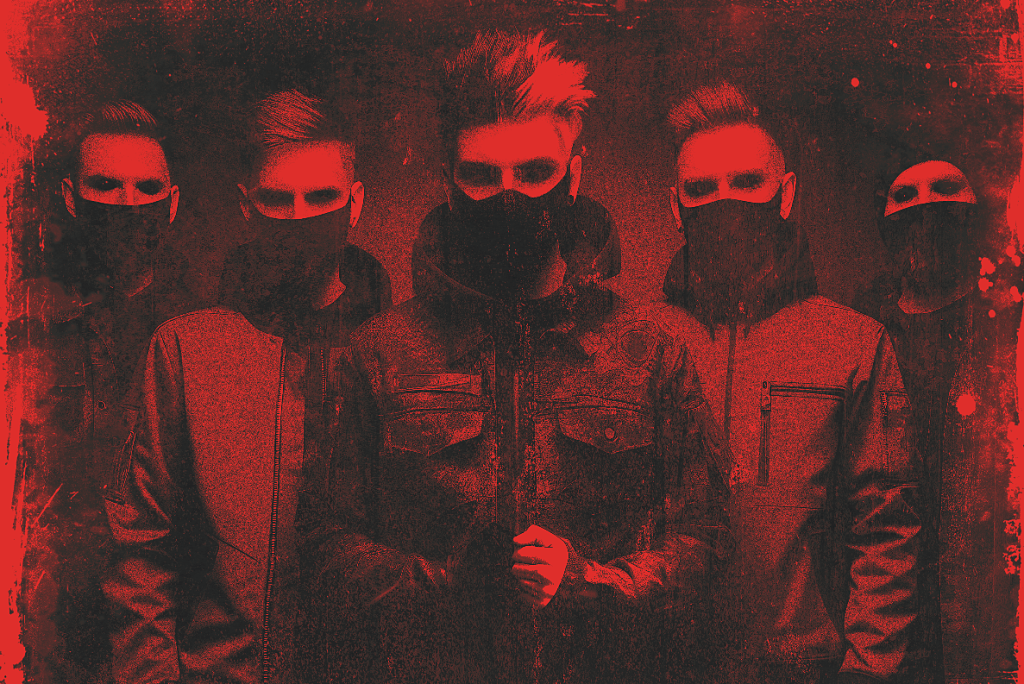
Bleak is back. Back to clear the wreckage, call things by their name, and prove they’re still alive — and burning even brighter than before. The new single ‘The Wave’ feels like a dismissal of everything polished, everything packaged, every factory-made reunion.
At the center of it all is Caleb Daniel Lit — the man who’s carried this band since the late ’90s. Through label disasters, failed guitarist swaps, lineup implosions, detours into Fireal and Inkakai, and back again. Over twenty years, he’s written more songs than most people have heard, and survived more sabotage than you’d think possible in the Finnish alt scene.
‘The Wave’ is an old song, recorded for the first time. Yes — this is the real version of Bleak. The one no one got to hear back in 2006. Just the raw core that started it all — when Caleb was sitting in his childhood room with a guitar and it was all just beginning.
Now, with all the excess cut away — from the music, from the surroundings — it makes sense to talk straight. No masks. What is Bleak today? What’s left from the past projects? What had to be cut out? And what comes next? Caleb lays it all out, filter-free.
Hey Caleb, really appreciate you taking the time — I know things must be hectic right now, and it’s an absolute honor to dive into this with you. You’ve described ‘The Wave’ (new single) as something pulled from 1994 and unleashed in 2025 — which is insane to even say out loud. That’s thirty years of distance, of hindsight, of context. When you dusted off that old demo and started reworking it, what were you really trying to hold onto — and what absolutely had to go?
Hey, no problem, happy to do this. Thirty years is an almost surreal span to articulate. Bleak signed to a label in 2005, which was already twenty years ago. If we go even further back to the inception of the band, it genuinely feels like another world. And in many respects, it was. Bleak’s later years were mired in unnecessary conflict and internal dissonance. Lots of drama and noise, fracture lines that didn’t need to happen. To make sense of how things came together and fell apart—or even how they worked at all—I felt I had to rewind the tape to the real beginning. I could have picked up where we left off in 2006, but didn’t want to reenact a life I’d already lived. What hadn’t been touched was the origin—the formative stage that set everything in motion, the spark that lit the whole thing. That stayed buried under all the chaos. For me, the path forward was to go back and tap into that foundation.
After three decades, some memories are more faded, others razor-sharp. Songs like ’The Wave’ act as temporal anchors where I’m transported back in time, being a kid with a guitar. It’s a profound, visceral experience. ‘The Wave’ was born of instinct and I was intent on preserving its raw, unadulterated essence. Although we performed the early version live between ’95 and ’00, we never recorded it. I demoed it in 2014 for Fireal but withheld release; during our seven-year hiatus, there was no imperative to publish. Later, I considered revisiting it with Inkakai but didn’t want to change it that much. So, I resurrected Bleak with the original guitarist, deliberately sidestepping the label-sanitized, tampered version Finland was served.
Which brings us to the debut album [Burns Inside]. I have mixed feelings about that record. The songs are there, the rhythm guitar sound is there, and I like that it’s heavy. But it’s buried under too much overproduction and other questionable choices. Take ‘Any Given Day’: Janne “Crab” Lehikoinen’s clean guitar work borders on cringe-worthy, while Tuomas “Madu” Miettinen’s imposed rhythm guitars are uninspired regurgitations of motifs I had already written. Some individuals’ main skill appears to be derivative mimicry.
Ultimately, the whole thing flatlined. This underscores the significance of Bleak being re-established at its foundational core. The feedback for ’The Wave’ has been clear: this actually sounds real. And I’m really happy it turned out that way — because this is the Bleak no one got to hear twenty years ago. ’The Wave’ doesn’t follow the heaviness on [Burns Inside]. Personally, I love when the guitars come crashing down like a tidal wave of sound. The kind of sonic weight, where it just rolls over you and swallows everything for a moment. You’ll be hearing more of that again. But we’ve also done that before. So this time, going for something more raw, more organic, felt like the right move. These days, everything’s so overproduced, so hyper-polished, it barely has any air left in it. I wanted the song to breathe, to live.
And Mikko Herranen—who didn’t just mix the track but threw down backing vocals too—knows this sound like it’s wired into his DNA. He’s a sonic architect of alternative music, and Finland’s national treasure. Mainstream producers would’ve neutered ’The Wave’ into industry-chewed fluff. That kind of sonic castration is exactly what I wanted to avoid. I needed to keep that raw, authentic sound intact—no filters, no gloss, just the real thing.
You could say our current direction is the antithesis of what a certain Finnish dark pop outfit—let’s call them The Ramses—is churning out lately. Overproduced gloss, plastic aesthetics wrapped in dark tones—a synthetic edge that tries too hard to bite but ends up feeling hollow. There’s no weight behind it and it reeks of commercial strategy more than artistic intent. Authenticity sacrificed at the altar of commercialism. I respect the singer Lauri Laffer’s gym grind but maybe channel some of that energy into making music that actually bleeds. Now it looks like he’s just milking what’s left before his hairline ghosts him completely. And those black “anti-pandas” in their latest video ties into something I’ll get to in a moment.
In contrast, I’ve got a lot of respect for Tuomas Holopainen. He’s stayed true to Nightwish’s core while still pushing his own creative evolution. That kind of artistic integrity is rare. He never caved to superficial trends or watered things down for the sake of appearances. It’s all substance and I admire that. All in all, the new Bleak album’s written and some of it echoes songs like ’What You Are’, but stripped of too much polish. The heaviness is still there—maybe even more so—but this time it’s unvarnished. While ’The Wave’ is pure grunge rock, there’s also heavier stuff coming.
So let’s talk about that return — and not the surface-level “hey we’re back” announcement. I mean the real decision to resurrect Bleak. After Inkakai and Fireal, and everything that came with those projects — the anonymity, the reinvention — what made you say: it has to be Bleak again, and it has to be now? What happened behind the scenes that pushed you to reclaim the name, especially after everything that went down with the old lineup?
First off, I hope certain international journalists and someone from Sony Publishing is reading this. Some details are about to get… interesting. Secondly, bringing Bleak back wasn’t some reunion stunt. I spent years exploring new sonic territory with Fireal and Inkakai—my current main focus—but Bleak is in my DNA. It’s the origin point for everything I’ve done in alternative rock. I’ve been letting it evolve naturally in time. Now, I’m revisiting the source.
Finnish A&Rs never really understood Bleak or U.S. alt rock, for that matter. [Burns Inside] could’ve been a great record if it had been produced in the States. Instead, it got swallowed by a soulless Finnish major-label machine, people who never understood the genre. Some moments survived, others are diluted shadows of what could’ve been. Maybe that’s why some assumed Bleak was just a label creation.
Ironically, certain “15 Minutes” anti-pandas — “Snake” (alter ego: Parasite), “Fatal,” “Wank Solo,” and their pals “Lobster” and “Senior” — teamed with a metal label (“Backboneless Ranch”) to spin another, fake Bleak that surfaced in the U.S. in 2019 (hint: “Mexico”). Not to mention a certain “new metal” band in Finland since 2013—let’s call it “Sightless Station”. Both are ghostwritten by the same crew, recycling stolen ideas from indie artists, including my own unreleased demos (one called ‘Flatline’). Courtesy of “Richard the Headless” from “Spineless Publishing” and Marja K from “War Chapel,” their long-time fixer, running the whole racket through their sync pool. And there’s a lot of stolen shit floating around in it.
How deep does the rabbit hole go? More revelations will follow…Yet another one of their Bleak attempts surfaced this year—this time with threatening lyrics and a not-so-subtle reference to the “dead weight” line in our bio, which called out former members. Hint: “Wolves”—a nod to Satanism and Satan worship, which these ghostwriters use not as belief, but as a tool for their juvenile agendas and shock tactics.
And it all funnels through the same Orchard, under the same Sunny weather… I brought back our raw, honest sound as a middle finger to these polished clones and label-backed, ghost-produced fakes who’ve hijacked the scene, turning it into a lifeless carousel of theft. But let’s be clear: I’m not anti-major label. Not against ghostwriters or producers. I’m even open to working with them myself if the chemistry’s right and if it meant pushing our band to the next level. And I’d happily sign with a label like Sony if the deal honored our vision. That’s not the issue.
The issue is plagiarism. Backroom sabotage by these individuals who treat stealing someone else’s voice and identity like a hustle. It’s cowardice with a budget. Bringing Bleak back isn’t about clinging to old memories. It’s about principle, about telling the truth. Reclaiming what’s real and earned. No apologies. That’s my ground, and I won’t budge. Bleak remains the root, the bloodline. The engine never stopped, even when the surface went quiet. The band may not be exactly what it was in 2006, but it’s what it should’ve been all along.
Okay, there’s a lot of confusion online about what exactly separates Bleak from Inkakai. From a fan’s perspective, they’re almost bleeding into each other at times. Can you break down — clearly — what defines each band for you, both musically and spiritually?
The confusion doesn’t surprise me. The blur was partly intentional, partly necessary. Bottom line: Bleak is the raw, unfiltered origin—the band I started as a kid, the foundation of who I am in alternative music. That original DNA is still alive in me. Fireal was Bleak in everything but name. I wrote most of The Dark Side during the Bleak era. With Fireal, I tightened the visual identity and leaned the sound more industrial—but at its core, it was still Bleak under a different banner. The logo barely changed and I added “(ex-Bleak)” to make the link obvious: same blood, different skin.
Inkakai is a bit different. Born during Fireal’s seven-year silence, the band went anonymous in 2013 with the masks, uniform and deeper industrial to the sound I call “Imperial.” It was a natural evolution but spiritually, it’s the successor to Bleak. To me, it’s all one continuum—just bigger, darker, more ambitious. The hoods, the masks and symbolism are the armor for the vision I’ve had since I was a kid. That vision started taking shape after 2011, when I worked as Lordi’s right-hand man during Finland’s Clash of the Choirs. I became fascinated by this world of masks and hidden identities, and eventually wanted to implement that in my own band.
Since I was a kid, I’ve been drawn to dark characters like Snake Eyes and Darth Vader, so the concept hit home. If someone knew me growing up, they’d see all the fingerprints in Inkakai. I even found an old childhood sketch of a hooded sci-fi figure with red accents—basically Inkakai’s blueprint. In Bleak’s second run (2002–2009), I never had the space to explore that side. Inkakai gave me the freedom to rebuild, to risk, to go deeper into something more cinematic, layered, and deliberately complex— sonically, lyrically, emotionally.
Yes, these two are connected and part of the bigger whole. But no—they’re not the same band. Bleak is the ember that sparked it all, Inkakai is the sharpened blade forged by harsh life, unforgiving time, and unwavering faith.Inkakai is the forward path, but both past and future coexist side by side — because to know where you’re going, you’ve got to remember where you came from.
That fire logo — the one that’s burned itself into every Bleak visual since 2003. You’ve hinted that it holds a deeper meaning you’ve never explained. What’s the story there?
The origin of the logo traces back to something as innocent as the retro game Wonderboy in Monsterland I played as a kid with Amiga 500. The fire-devils and fireballs stuck with me—maybe resurfacing in 2003 because I was living in a rough neighborhood, and the mind was summoning symbols of safety. Back then, I had to watch my back every night to avoid getting stabbed or mugged.
The logo’s fiery eyes symbolize inner fire. They might unconsciously echo the Balrog—fire in the dark—but I’ve always been strongly repelled by Satanic imagery and ideology, even though I’ve long been fascinated by occultism. The Fire and Eyes logo is about vision—enlightenment, judgment, and truth. The eyes echo the Seraphim—the “Burning Ones”—who burn away lies spread by the Father of Lies. The fire cleanses, the gaze exposes.
But they also represent the eyes of vengeful spirits of fire—sworn to avenge the injustices done to them. Cue the onibi—spirits born from the corpses of resentful people who have become fire. One evolved version of the Fire and Eyes logo from 2013—technically a fireball with eyes—takes after the form of the onibi.
The fire theme and the triangle (Fireal/Inkakai) pack layers of meaning—not just the onibi: alchemy’s fire sign, the Holy Trinity, God’s unquenchable flame, the fire of Creation and Truth. But there is definitely no “hellfire” there. Again, satanic themes are ridiculous in my eyes.
By contrast, the anti-pandas—“Snake,” “Lobster,” and the aforementioned rest—have built shallow, plagiaristic “anti-us” projects themed around Blindness and spiritual decay. ”Sightless“. ”Wolves”. ”Parasite”. ”Chaos creatures”. Full of threats and constant references to “Spine.” It’s as juvenile as it’s obvious.
There’s this UK-based anonymous masked band—let’s call them ”Bleak Stolen” (decode that)—that was quietly pieced together behind closed doors by the same ”Backboneless” label that later made a big show of “signing” them, as if it hadn’t already been a done deal.
Behind the scenes, the music’s ghost-produced by a faceless collective I’ll lump together as the “Leo-tards.” Besides some from the previous group, one of them is a certain ”V”, another a former ”Peri” guitarist, and then there’s ”Drug-a-smack Lund”, a Finnish producer now based in the U.S. He used to float close to my orbit, siphoning ideas and channeling them straight into their Satanic echo chamber.
What they’re doing musically and visually is what The Cibrius (the early version of Inkakai) and our current style would look and sound like if you ran it through a Satanist meat grinder—jacked up on occult theatrics. Their mystique draws on Jungian archetypes: the hidden Shadow, the guiding Priest, and the balanced Anima and Animus. But their lyrics are steeped in Luciferian chants about Ascension, ritual sacrifice, and recycled Lightbringer allegories posing as rebellion. It’s hollow theater—layered with symbolism meant to look profound but ultimately empty. They’re not creating anything original; they’re repackaging age-old occult tropes, mixing just enough mystique to bait curiosity.
What they’re really pushing is a stolen brand dressed in esoteric drag, built on a satanic message that thrives on ambiguity and viral spectacle. It’s not about art. It’s about Summoning—for clicks, for reach, for control. Fair warning—this next part delves deeper into religious territory. I’m no zealot, but I remain open to confronting the deeper truths that expose the decay festering within the music industry. I’ve witnessed the damage firsthand—both what it has inflicted upon them and what they have inflicted upon me.
First off, whether you see spiritual entities as literal beings or just metaphors—that’s besides the point. What really matters is how belief shapes human behavior. It boils down to whether you’re being an asshole or not. I’m not waging war against Satanism. I don’t concern myself with others’ beliefs—unless they begin to harm me or those I care about. I’ve worked alongside a guitarist openly linked to Satanism, and musically, we had no issues. Creatively, we connected. But I’ve also been targeted by people who use Satanism as a cover for their shitty behavior—and that makes it personal. There’s a clear line—a crucial distinction. Belief is one thing. Weaponizing it—turning it into a destructive ideology or an aesthetic weapon—is something else entirely.
LaVeyan Satanism is symbolic, atheistic rebellion, dressed up as empowerment. But that often becomes a gateway to Theistic Satanism, the real worship of a literal Satan. Whether they’re devout Satan worshippers or have simply buried their heads in so much cocaine they’ve had their little “divine” experience doesn’t really matter. What matters is that the higher-level believers mask their intent with seductive half-truths—manipulating newcomers and cloaking domination in the language of “freedom.” At its core, it’s a cold, hierarchical pursuit of self-deification through deception, control, and spiritual cannibalism. People become tools.
As a Christian—and more importantly, as someone who refuses to act like an asshole—I reject that ideology. But I’m not helming Christian bands. I’m not here to preach Jesus or grace—that’s some other Christian’s job. Personally, I don’t buy into “turn the other cheek.” I believe lethal force is justified within the codes set by the Bansenshukai, Shoninki, and Ninpiden. Discipline and honor guide me through the seven Seishin Teki Kyōyō principles and the Bushidō code. There’s a clear difference between blind violence and measured justice.
That said, the music industry is deeply saturated with Satanic influences. Among its players, there are sheep and wolves—but also dogs. Yet these dogs have grown lethargic, their vigilance dulled. They have surrendered to conformity, pacified by comfort. For them, Jesus has become a sedative, and grace a narcotic to cling to. They remain passive and silent, never cultivating the strength to resist, instead awaiting salvation and healing.
The wolves now dominate the narrative, normalizing sin and commodifying it for mass consumption. They occupy pulpits, dictate cultural discourse, manipulate media, undermine education, and prey upon the vulnerable. Meanwhile, the sheep acquiesce, murmuring prayers and feigning complacency.
The wolves no longer conceal themselves. They don virtue as a façade and market it shamelessly, while the sheep consume it unquestioningly. Faith, once a source of resilience, has rendered many Christians fragile—devoid of the fervor and resolve that once defined them. The dogs—once protectors—have nearly vanished.
In their place rise influencers and soft preachers. The Church has exchanged its sentinels for TED Talk platitudes adorned with Christian symbols. The gates stand wide open, and the wolves were welcomed in—ushered by cowardice, politeness, and weakness. Perhaps it is time to awaken. Being a sheep was never enough; being a dog is no longer enough.
Enter the dragon.
Too dramatic? Too poetic? Amusing? Confusing? Irritating?
Good.
Alright, let’s jump to ‘Fate’ — that track with Ana Johnsson for the movie Jade Warrior. Best Nordic Song of 2007, a Finnish-Chinese fantasy film, massive cinematic energy — and you were right in the middle of it. A cross-cultural collaboration, early hints of the aesthetic that would later take shape in Inkakai. And honestly, even now the track still sounds fresh — the production holds up like something that could easily be released today. How did all of this even come together? Where did that journey start, and how did ‘Fate’ end up becoming part of such an unexpected story?
“Fate” marked a turning point, born from the opportunity to collaborate with Ana Johnsson for Jade Warrior—a rare Finnish-Chinese fantasy film blending Eastern mythology with Nordic storytelling. Ana brought a presence that fit perfectly. Her voice was powerful, emotional, and deeply human. This project wasn’t just about merging styles but honoring the roots on both sides, crafting a soundscape that respected and celebrated both traditions. The song had to carry the film’s intensity and mystical energy while still connecting emotionally with listeners beyond its context.
The film was niche as Finnish-Chinese fantasy isn’t common—but that only made it more meaningful. “Fate” became a creative milestone that shaped my vision moving forward. It opened the door to cross-cultural exploration in sound, visuals, and philosophy—a key moment that left its mark on everything that followed. Looking back, “Fate” served as a bridge—between cultures, genres, and phases of my creative journey. The fact it still resonates proves it was never just a fleeting moment.
It was a wellspring of inspiration for Inkakai.
You have been described as the engine — writing, producing, shaping the sound — but with this new lineup, it feels like there’s fresh electricity in the room. How different is the creative process now that Bleak is a new band, not just a reboot?
The creative process flows much smoother now. I remember the fights at rehearsals from 2002 to 2009 and have no nostalgia there. Sure, there were good times as well. But that mix of good and bad was exhausting, like oil and water. It was unneccessary. Today, the drama’s gone from my projects. No fights over artistic direction or anything, really. This space breeds creative health and spiritual freedom. Some say true innovation comes from conflict, but watching some ex-members and their so-called “ideas” proves otherwise. Their work was always mediocre patchwork—then and now.
Those making music just for commercial gain leave a clear mark—formulaic and artificial. It’s not about talent or skill, but soulless music flooding the charts, pushed by money and connections, not artistry. That’s the harsh truth. I never followed that path because I never saw the appeal—but I always saw the corruption and it’s clear as day now. I’m mainly making music on my own terms but if good collaborators come along, I’ll stay open. But cautious and selective.
The creative process now is leaner. This isn’t about some sudden magic or effortless genius. Ideas come when they’re ready, raw and honest. I’ve learned to trust that initial spark, to ride the momentum without trying to over-control or overthink. This smoother flow has nothing to do with complacency or taking shortcuts. It’s about the organic nature of inspiration. It’s about patience, discipline, and knowing when to push and when to step back. Ultimately, this process brings freedom—from overproduction, from forcing ideas, and from trying to please everyone. It feels much more natural now.
When you talk about leaving behind “toxicity” and “dead weight,” it becomes clear this was not a return for old time’s sake. Something had to break for something new to grow. What exactly did you have to cut — emotionally, interpersonally, creatively — to clear the path for the version of Bleak we’re hearing now?
Over the years, I’ve played with a lot of musicians. Some were hired guns for touring, others passing through — and some horrible mistakes. But when I bring someone into a band, I give them space to prove themselves. I don’t make snap decisions. I give time, trust, and the benefit of the doubt because no one’s flawless.
I’ve only once let someone go purely because they didn’t have the chops — back in 2004. One named Charlie. We’d played together for two years. It felt like good chemistry at the time, but there was a musical ceiling they couldn’t break through, even with effort. So I made the hard call and we let him go. I chose honesty over comfort. It stung at the time. But knowing what that person has said later on, I don’t lose sleep over it.
People love to label the singer-songwriter as “the ego,” the “dictator.” But being a leader means making the hard calls. And sometimes it’s about the opposite thing: not about talent but loyalty. I’ve had musically solid guys stick around, but befriend my enemies because of work and money. The most heartbreaking part I’ve learned is that time doesn’t define loyalty. Character does. Someone could be with you for 15-20 years and then just switch over to the side that pays best.
Put yourself in my shoes. Would you keep people like that around? That’s not exactly bandmate material. Then there were the three toxic members who had to go—and honestly, they probably never should’ve been part of Bleak in the first place. I still carry a lot of good memories from 2003, but over time, the dynamic shifted and slowly turned toxic. It’s still hard for me to understand the mindset of some people—how they struggle to coexist. Why does it always have to be black and white: win or lose, good or evil, friend or foe—when we can just stay in our own lanes and move forward? Leave me alone, don’t steal or sabotage what’s mine—and we have no problem. Do the opposite and you’ve created a problem. Everything that follows is on you. The redeeming actions, the compensation—that’s your responsibility. Own it and do the right thing.
Cutting out that toxicity was essential. You can’t build anything that lasts when there’s cancer in the bloodstream. Looking back now—especially after everything that’s transpired since 2009—I’m forced to admit my only real regret is not cutting them loose sooner. How sad is that? It’s a shame it’s come to this—me having to drag it out into the open. But they twisted my arm. I didn’t choose this situation, and I won’t stay silent either. After years of quiet attempts, offering peace to those who didn’t deserve it, I’ve finally hit my limit.
When an offer of peace is met with playground-level bravado like “If you want peace, prepare for war”—especially during an actual war in Ukraine—you’re not dealing with rational minds. You’re dealing with narcissists buried so deep in nose-candy it’s farcical. In their delusional, grandiose, and aggressive cocaine-fueled ego-rage, my restraint was warped into weakness to inflate their bloated sense of power. Classic stimulant psychosis fused with narcissistic fantasy—fueled by coke, alcohol, and the echo chamber of groupthink. Reasoning with them is pointless.
But these wired, paranoid “supermen” are already unraveling. They’re doing themselves in. I don’t lose sleep over cowards who hide behind threatening lyrics and symbolism. If they want a war of attrition, they’re going to lose. I’m still here. And if anyone thinks I’ll break or back down, they’ve profoundly misread the situation.
That said, I’ve always stood and strived for peace and so would anyone with a shred of sense. I didn’t make anyone my enemy. These people chose that role themselves, they deliberately picked and created this ”war”. And have been spinning their false narrative ever since. Because underneath the curated social media smiles, the filtered photos, and the fake professionalism—there’s chaos. Drama always simmering just below the surface. Especially in a culture like ours that fears emotional honesty. That silence — that “don’t rock the boat” mentality — it doesn’t create peace. It breeds narcissism. It hands manipulators a blank check while the rest of us eat the consequences.
Narcissists always cast themselves as heroes or victims in a drama they created. They write the script, put themselves in the lead, and expect applause. But the second reality kicks in — when someone like me bursts their bubble — they panic and overreact. Because beneath all the lies is a scared, insecure kid who’s been faking it since day one. That’s the root of it: self-hate. They belive no one could love the real them, so they bury it and invent personality traits, stitched together from borrowed style, stolen ideas, fake charm. And deep down they know — if the facade slips, there’s no substance. No originality, no real identity.
That’s why they envy and despise natural talent, charisma and leadership. These are things they’ll never possess. So they manipulate, lie, buy influence; surround themselves with people who worship status, flaunt wealth because it’s all they’ve got. Candy wrapping over a pile of shit — and they know it. Their friends are opportunists, the kind who vanish the second their empire of dirt collapses. And the women are little more than prostitutes, status accessories — rented beauty, not real connection. It’s all hollow and they know it. That’s the punishment. Deep down, they know they’re frauds.
In my situation, their game is ghost production. But the truth is none of the riffs, melodies, or style they peddle are original. They steal from indie artists they pretend to look down on. People like me. They take what they can’t create, slap a shiny name on it, and pass it off as theirs. No shame. Just theft, plain and simple.
What most don’t know about Bleak from the Burns Inside era is that the official 2006 bio was label-made fiction. Madu never co-founded Bleak with me—I fought to get him in, originally opposed by the original guitarist. The label spun it as “two cousins formed a band” to clean the story and sell it.
He knew I was driving the car—yet over time, he went from being a passenger to giving directions, acting like he owned it, like he was entitled to take the wheel. I’ve seen the same thing happen with a few others too—you offer influence, and instead of gratitude, they try to use it to take control. It’s something almost primal, and honestly, hard for me to understand.
He wasn’t a founder—but he was my brother, and I loved him. A small part of me, the part still living in those early days we shared, still does. But I don’t know if I can ever forgive him.
I hate to say this, but it needs to be said now: bringing in Madu, Crab, and Mikko “Junior” Pietinen turned out to be the worst decision I ever made. Bleak would’ve existed without them, the songs would’ve still been written and released. And we would’ve been spared over a decade of unnecessary drama.
That said, I always liked the drummer of [Burns Inside], Timmy. Ironically, he was the one who didn’t even want a musical career. Maybe whatever led him to that decision is what made him a better person. I do have some good memories with Crab and Madu from before 2005—but I don’t recognize them as the same people anymore. Everything started falling apart when Bleak caught fire. When success and money started becoming real options — that’s when the rot set in. The band stopped being about music. It became about money.
Sometimes I wish I could rewind to the basement jams, to the realness before it all got tainted. Back when it was about music, friendship, humanity. That’s what we lost — and it’s the part I still mourn. But lately I’ve seen no signs of remorse. No interest in peace. Just more ego and silence. And honestly? I don’t think I care anymore. I tried, they didn’t listen. We’re done.
If there’s one constant, it’s that people have always underestimated me—thought I’d break, burn out, or disappear. Yet here I am. I’ve endured decades of shit—and something far worse than anything they’ve faced, even combined. And still, here I stand: unbroken and more determined than ever. I’m just one man, but I’m doing it all, moving forward, breaking through every obstacle thrown my way. Maybe it’s time they took the hint. They were wrong about me then, and they’re wrong about me now. What goes around comes around—and I’ll be right here when it does.
‘The Wave’ just dropped — raw, unfiltered, and clearly carrying more than a decade of weight behind it. But what comes next? Are we talking more singles, a slow burn rollout, or are you quietly shaping this into a full album behind the curtain?
At the very least, we’re definitely planning to release more singles. ‘The Wave’ served as a reintroduction—both a signal to the audience and a tonal anchor—but what follows is closely interwoven with the evolution of Inkakai. Creatively and logistically, the two projects are entangled in my mind, which means the trajectory of Bleak’s releases is directly influenced by how things unfold with Inkakai.
I’m sitting on a substantial volume of material that could easily be shaped into an EP or a full-length album. But if experience has taught me anything, it’s the value of restraint. Premature announcements or overpromising before all variables are locked in only leads to unnecessary expectations and potential letdowns. That’s why I’m intentionally withholding specifics until the groundwork is unshakably in place.
Right now, the priority is integrity—curating something real, not reactive. Every single must carry its own weight, its own thematic identity, contributing to a larger arc without being forced into a cycle. I’m not interested in feeding the algorithm or chasing relevance, I’m more interested in creating something cohesive, compelling, and honest. So yes—more singles are on the horizon. But beyond that, I’m not offering timelines or definitive formats yet. When it’s time, you’ll know.
There’s this recurring warrior imagery that’s followed you through every phase — even now, with Bleak reborn, that ninja-samurai energy still lingers in the visuals, in the way you present yourselves, in the atmosphere around the project. Where does that come from? What draws you to those archetypes, and how do they tie into the mindset behind Bleak’s music today?
The black-and-red, fire-and-darkness aesthetic is a throughline between Bleak and Inkakai—both visually and philosophically. The mouth masks, often seen as an Asian nod, are more than just style. They embody the logo: the absence of a mouth.
We waste no time on idle speech or meaningless chatter like you see people do on social media. This silence isn’t passive—it’s controlled, a refusal to be diminished or distracted by empty talk. That vigilance contrasts with our raw honesty. We are thoughtful, weighty, and unfiltered—breaking the silence with truth. We stand for keen perception and a burning inner fire expressed through action and presence. It’s about clarity of vision and purposeful intensity—choosing silence as a deliberate, strategic act of strength.
It also represents semi-anonymity—the blurred identity of a collective. One rule stands firm: no fully exposed faces. The masks stay. And yet, no matter how much I crave total anonymity, as long as my voice is heard, the mask can never be absolute. Still—if people respect Sleep Token’s anonymity, why not Inkakai’s? After all, we’ve been masked, hooded, and anonymous since 2013. Strangely enough, I introduced the mouth masks into Inkakai’s aesthetic in late 2019—months before the pandemic hit. Make of that what you will.
The Asian influence runs deep in my childhood. Our house was filled with martial arts books. I grew up watching American Ninja 2, The Last Dragon, Best of the Best, and The Karate Kid. I spent hours on the Amiga 500 playing martial arts games and devoured G.I. Joe / Action Force comics—especially the Storm Shadow vs. Snake Eyes dynamic. I began training in Shorinji-Ryu Karate at 14, started Hóu Quán at 19, and continue practicing Wing Chun today.
Martial arts have been quietly woven into the fabric of this band. Both our original guitarist and the second lead—the one responsible for the second expressive solo on The Wave—come from a Judo background, bringing with them a deep understanding of discipline, timing, and controlled force. Meanwhile, the main guitarist’s foundation in Brazilian Jiu-Jitsu adds another layer—fluidity, adaptability, and a tactical mindset. Presence, precision, and the philosophy behind every movement, musical or otherwise.
Western society claims to stand for freedom, but increasingly, that promise feels emptied of substance. What was once a culture of ambition and innovation has been sidelined by a market-driven mindset that rewards manipulation over merit—morphed into a system obsessed with image, distraction, and profit. The foundational ideals—liberty, merit, community—were always unevenly applied, often serving the powerful more than the principled.
Over time, those ideals have been reshaped by market logic: honour replaced by self-branding, integrity by influence, and freedom by consumer choice. What remains is a hollow framework—freedom in form, but not in function—where the language of values persists, even as the system rewards their erosion. Freedom itself has been commodified, reduced to a branding tool rather than a lived principle.
What speaks to me about Asian martial arts is that they aren’t about show—they’re a path. A complete philosophy. Everything is Kung Fu. Traditional Asian culture isn’t just aesthetics or ceremony but rooted in values—honour grounded in action, discipline as a lifelong pursuit, and inner refinement as both a personal and societal ideal. These principles are treated as frameworks for living. They carry weight because they’re meant to be lived, not marketed.
This contrast becomes sharper when placed beside the modern Western model.
Now that Bleak has clawed its way back with a new lineup, a new sound, and a clean slate, what does success actually look like to you this time around?
The first word that comes to mind is relief—followed closely by a steady sense of determination, and perhaps most unexpectedly, peace. It’s not a simple feeling, but a layered shift grounded in one thing: moving forward by revisiting where it all began. It’s like having once held something sacred—something deeply personal and tied to people who, for a time, meant everything. Think of a relationship where shared music, inside jokes, and places become sacred markers—until the collapse. A dramatic, irreversible break transforms all that light into shadow. Suddenly, the songs that once soothed now sting. The warmth is gone, replaced by a cold void.
In the aftermath, those memories feel vandalized. What used to heal now hurts. But with time—slower than you’d like—the edge softens. The reel stops playing on loop. And eventually, a hard truth settles in: no amount of longing can rewrite the past. It’s fixed, sealed like an old photograph—untouchable but still real. What does change is how you relate to it.
The real task is reclaiming it. Not to erase or simplify, but to reinterpret it. The laughter, the beauty, the music—none of that is invalidated by what followed. It still matters. The key is building new meaning on top of it, forming fresh associations that outgrow the scar.
For me, this became an act of authorship—writing a new story in place of the old one. Not denial, but transformation. Not erasure, but evolution. What once hurt now fuels me. That shift is quiet, but it’s powerful.
I actually sat down and wrote a brand new track. It’s raw, aggressive—hardcore to the bone. A total sonic departure.
And the title’s locked:
‘Polyamorous XXX–Prime Minister Does Davos’
*Promoted content. All information provided is prepared in accordance with editorial standards and is intended to offer useful insights for readers.





 Indie Boulevard Magazine