
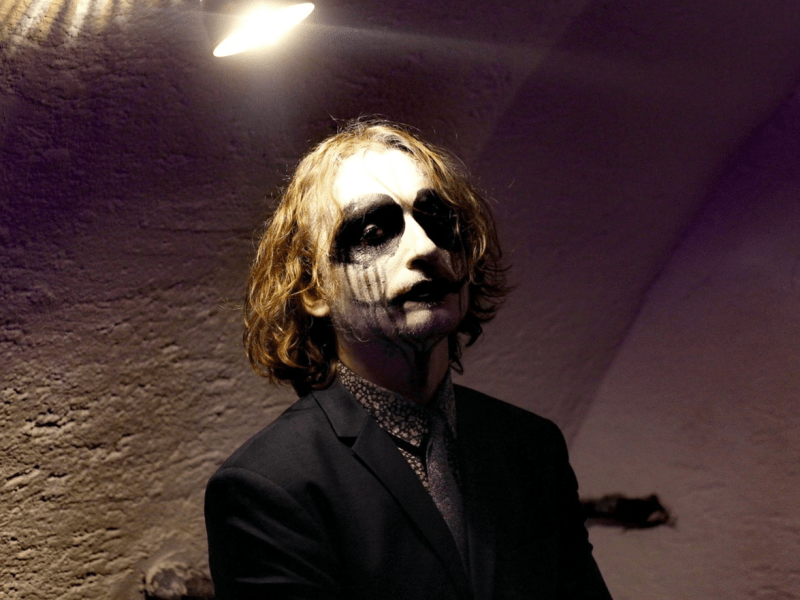
Simon Talbot has never looked like an artist interested in entertaining. Even in HALO, where there was a certain scale, a certain theatricality, he always gravitated towards the quieter corners. But here — there’s a different depth. A Collection of Oddities is made of material that wouldn’t suit any band. It’s far too personal, too delicate, too indie. This is the kind of thing you write down because if you do not, it will eat you alive from the inside.
I’m not sure who’s still expecting Simon Talbot to deliver anything “normal” — in the sense of a coherent pop structure, pleasant melodies, something playlist-friendly you could throw on in the background. Personally, I clocked long ago that he’s not here for that. His thirtieth album, A Collection of Oddities, completely pulls the ground from beneath your feet. It’s a grim record.
This album is impossible to listen to in a rush or through earbuds on a bus. It’s simply not that kind of music, you see? It chooses you. It decides when you’re ready. I get the sense that Simon as an artist moved on from the idea of “an album as a collection of songs” ages ago. For him, it’s more like an art installation — a series of states, where each track isn’t better than the last, but digs further into your mood. HALO had dark moments too, but there were still frames — guitar, bass, rhythm, structure. Here, none of that holds. The songs fall apart, trail off, vanish right when you think you’re finally starting to get into them.
He wrote these tracks over three different seasons, and there’s this strange sense of time flowing unevenly. Spring, summer, winter — all smudged into one long day, where dates no longer matter. There’s only his voice, not especially confident, but absolutely certain that silence is no longer an option. It feels like the songs were written with no concern for genre or form. Just as they are. Sometimes rough. Sometimes uncannily precise. But never false.
Talbot has always understood the line between vulnerability and performative suffering. And here, once again, he’s walking it. I don’t know if anyone else has picked up on this, but the album’s geography is odd. Technically it’s London-based, but the mood sits somewhere between a cold Berlin and a coastal Finnish town where the sun never shines. The tracks aren’t about London, and not really about events either — they’re about internal spaces you wander through alone. And it’s not always comfortable. But truthfully, that’s exactly what I like about it.
Art-House Obscurity
I genuinely enjoy how this album sounds. It’s dark, slightly murky, and sometimes that kind of depressive music hits the spot. The opening track — Madness or Sadness — sets the tone brilliantly. The percussion hits sharp, almost as if it’s a knock to the head. To me, it captures that feeling of being trapped inside your mind, everything colliding and echoing. The keys press down with a steady tone, and the whole thing unfolds like a thought that has been looping for three days straight.
Stressed is my favourite out of the anxious tracks. The drums push the pace forward — you can feel everything speeding up, even if you are resisting. The guitars go off into a different key entirely, and I think that’s such a bold move.
For the first time on the album, in Remember – s, there’s a bit of light. The bass is soft, the guitar familiar, and suddenly it starts to feel like that kind of slightly sad, slightly warm indie you listen to on a train, staring out the window. This one could easily belong on a more accessible, even mainstream release. The rhythm sticks, the vocals are precise, everything lands “by the book.” I can hear it fitting neatly in playlists alongside The National or even AM-era Arctic Monkeys. The rhythm is gorgeous, the structure totally clear, and it’s obvious that Talbot can write music that reaches people. He just usually chooses not to. Here, he did. And it came out perfectly. Though it does feel like he half-smirked afterwards, as if to say, “alright, that’s enough of that.”
Anxiety of the Mind brings us back to more familiar ground, but from a slightly different angle. The guitars are gentler now, almost kind — but the vocals pull everything back into the pit. I think he’s deliberately offering hope in the arrangement, only to drag it back with the voice. It’s a very deliberate delivery, and it lands exactly right.
Impulsive is pure atmosphere. I like how it all unravels. There’s no verse — but it sounds big. You can tell he wanted this to be almost cinematic. I really enjoyed it because this is where he pushes past the edges.
And the final track — Love Phobia — is another league entirely. Here he’s playing a different game. The tempo shifts, the mood changes, and suddenly you get the sense you’re listening to a different Talbot altogether. And it’s brilliant. He’s unafraid to change the rules mid-album. If something needs to be torn down and rebuilt — he’ll do it. He shows that the whole idea of the record is not to “find a sound and stick to it,” but to follow wherever the thought leads. And if that means changing the tools, the tone, the rhythm — so be it.
I don’t know what can still surprise you in 2025, when there are a hundred albums dropping every week, half of them engineered to please from the first track. Everything’s so neat, so polished, so calculated. And against that, A Collection of Oddities by Simon Talbot sounds like something that was never meant to be released at all. Or maybe it was — but only for himself. And it’s exactly these kinds of records I always end up remembering more than anything trendy or timely. Talbot, I think, has long lived in his own world, and if you’ve listened to HALO, you’ll know exactly what I mean.
Even if A Collection of Oddities feels a bit heavy, foggy, or introspective to some, the fact that an artist like Simon Talbot exists — someone who approaches music as a true painter of sound — that alone feels important. Because there are people out there creating not for numbers on Spotify. They create because not creating would be worse. Simon is one of them. And yes, his music might not click with everyone, it might feel slow, opaque, too closed-off. But as a figure, as an artist, as a person who builds nothing theatrical around himself — he inspires.
Me, for example — I don’t enjoy Lars von Trier. He’s not for me. But if I’m at the pub with friends, pint in hand, talking music, film, art — I’ll still bring him up. Because he’s out there, doing the work, releasing strange, honest things. And that’s powerful. Same with Simon Talbot. Even if his sound doesn’t pull you in right away, even if the album left you unsure — you’ll still remember him.
And I think, with time, these are the names that keep resurfacing. They become reference points. Just mentioning them tells others where you stand. Talbot is one of those names. A quiet signal: I’m tuned in.
*Promoted content. All information provided is prepared in accordance with editorial standards and is intended to offer useful insights for readers.







 Indie Boulevard Magazine