
Pop music these days can be weird. It can be shiny, glossy, and as empty as a birthday balloon three weeks later, or it can absolutely rip your heart out and glitterbomb you with emotional damage. Somewhere between sobbing on the dancefloor and texting your ex at 2 AM, there’s Luke Rhodes—a neon-soaked, heart-on-sleeve pop provocateur who crafts shiny bangers out of personal disasters, messy breakups, and existential chaos.
Luke Rhodes—an Italy-born dreamer chasing after stadium lights and Hollywood signs—has perfected a very specific brand of emotional escapism: 80s synth gloss, early 2000s sass, and modern TikTok-era heartbreak. He writes, produces, and performs everything himself, spinning tales of romantic ruin and starry-eyed optimism with a confidence that borders on reckless. Each single he drops feels like a mini cinematic event, full of lavish visuals, moody drama, and a desperate kind of glamour. It’s equal parts catharsis and charisma, delusion and clarity.
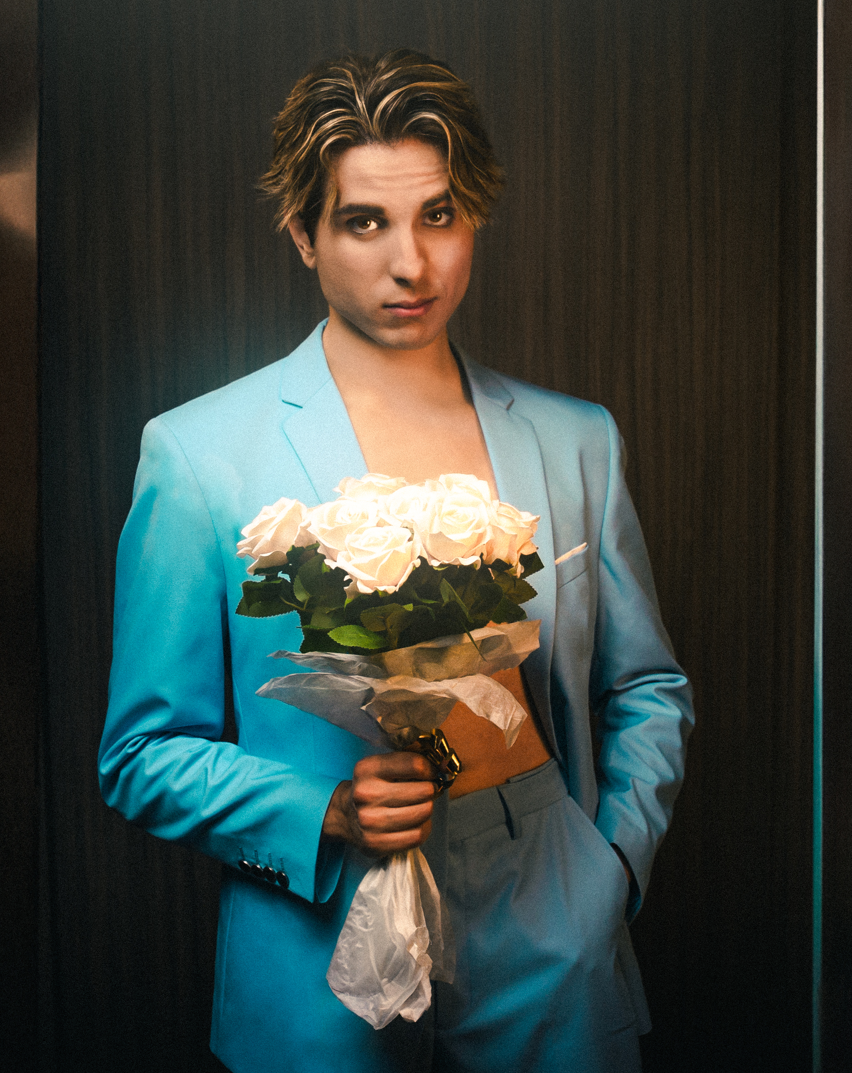
photo by Andrea Amadori
Now, Rhodes is back with “Tell Me I Was Wrong”—a track drenched in vintage neon synths, slick, pulsating beats, and a chorus so big it practically begs for a confetti cannon. This song might just be the soundtrack to your next spectacular mistake, or the anthem you scream at karaoke while crying into a plastic cup. It’s romantic melodrama wrapped in glittery pop hooks, and Rhodes isn’t holding back this time.
But beneath all the sparkle, Luke Rhodes is building something deeper, darker, and frankly, a lot more intriguing. We sat down with the Luke himself to talk about heartbreak, ambition, and just how far he’s willing to go to turn pain into pop. Trust me, you’re going to want to stick around for this one.
Hey Luke, thanks for jumping into this — really excited to dive in with you. So first of all — congratulations on “Tell Me I Was Wrong.” The track goes big in all the right ways. Huge chorus, velvet synths, that heartbreak-on-the-dancefloor energy. It’s very “crying in sequins under a disco ball.” I know you produced it yourself, so walk me through that. When you were sculpting this sound, what were the must-haves that made it feel emotionally sharp and pop-perfect?
Hi Indie Boulevard, I’m so happy you liked the song, it’s the 4th of my pop dance project and I feel I’m finally starting to create a little world around it. I’m glad to have the opportunity to include you and all the people who are curious to peek. Producing “Tell Me I Was Wrong” initially looked like the easiest of the wins: I was juggling between 3 tracks, and when I drafted this one, it immediately sounded 90% ready. I experimented with some vintage classics like Roland drum machines, Yamaha pads and a MiniMoog, I immediately fell in love with how old style and effective in its simplicity it sounded. I was so excited that this one fell back in place by itself! Of course, I must’ve cheered too loudly, and Murphy’s law kicked in, because bringing that almost-ready, to a full “ready” was one of the hardest things I’ve ever done hahaha. I kept struggling for months, wiped and re-did the whole production, sound by sound, three times, and each time I felt like it missed something. I was guided by my trusted sound engineer, Sam Wells, and by some of my producer friends, who pointed me towards the right direction and this version is finally my 100%, my peace, but oh boy what a journey!
The official visualizer really leans into that tension — glitter and grief, cheekbones and chaos. It’s theatrical but still vulnerable. And you in that blue outfit, just pleading into the camera like you’re halfway through a breakdown and a runway show. What was the concept for the video? How much of it was pure fantasy, and how much of it came straight from your own mess?
Roughly a year ago, scrolling through my IG, this small clothing brand AD popped out, showing a girl inside an elevator with that iconic “sliding through the floors” effect. I immediately saved it in my inspiration folder like I usually do, and let it sit for months and months. When I was producing this song, the thought of those elevator doors opening just came to me like a flashback. I hit play on the “for you I’ll always open the door” part, and I knew it was the perfect time to use that inspiration.
The rest came to me naturally: the old film look, the dress, the warm light and the bouquet were a natural evolution of that “hopelessly in love” vibe that I was feeling. And I really couldn’t think of a more literal representation of how I feel in the song, than hanging in a beautiful, sparkly elevator, without being able to step out. I can say that luckily this time every detail kinda clicked by itself! I’ve been happily following my artistic side to bring all those ideas to life, and I wanna thank Andrea Amadori, Gaia Gianotti and Diego Minestrini, for literally being the reason why I’ve been able to create this magic elevator world.
So, the blue jacket, the bouquet, the candlelit tones — it all clicks into this hyper-glossy, slightly delusional world. I love it. So how important is visual storytelling for you when it comes to music? Like, are you writing songs with the music video already forming in your head?
Absolutely yes! Well… kinda) When I’m creating a song, I usually go through 3 main phases: the inspiration, the songwriting and the production. During the first two I let myself wander inside the harmony and surprise myself with every possible idea for both the melody and the lyrics. It’s in the third phase, when I start to define the core of the sound and what’s gonna be the vibe, that visuals start to shape in my head.
I’m firmly convinced that we all have different – and all valid – ways to approach music and get curious about an artist’s work when we first make contact with it. Some are impressed by sound first, others by the images, it’s so… human. If I considered myself strictly a musician, I’d probably save myself hours, no, days – and nights – of work, and only focus on my sound. My goal, though, is to use both music and visuals to perform, to communicate. And visuals have immense power when it comes to carrying a powerful message to people.
They come to me in a very detailed form, from the beginning. They also evolve really quickly, and they keep doing it through the whole process for whatever reason, expanding, shrinking and expanding again (I might change everything to a better idea, align it with the aesthetics I used in the past, adjust it to budget, time, to overcome a hundred variables) and in the moment I actually shoot the thing, I start to see it for the first time. It’s exhausting but I really love it and it’s so artistically rewarding, and I plan to get really soon in a place where the budget is not such a low ceiling anymore for my artistry.
I saw Behind the Curtain — It strips everything back to the bones, and honestly, it lands hard. There’s something really exposed about it, almost like you’re letting people into the quiet that exists behind the drama. It’s the opposite of the high-gloss pop world you’ve built around “Tell Me I Was Wrong.” What did it mean for you to show that side of yourself? And how do you hold both — the sparkly pop icon and the artist who only needs one spotlight and an acoustic guitar?
Behind the Curtain is a bet I made with myself. In my career I started crafting many different versions of me, trying to figure out where I wanted to land and put my hard work into. And often, after finding a new and better way to channel my creativity, I used to abandon the previous one, which is not a big deal most of the time, but the Luke Rhodes you see in the documentary, the “artist who only needs one spotlight and an acoustic guitar” like you said, deserved better. He is the little Luca, who used to sing the 3 songs he knew to his parents in the backyard, playing a guitar that was almost bigger than him. I decided I was gonna move on from shows like that, at this point they almost feel like a creative trap and the only way to be on stage in my country, I was ready to leave it behind and dive into the shiny world of pop performances, but not without a proper goodbye (surprise surprise, another dramatic move from the pop boy, who saw that coming?).
I’m proud of having been able to make something so structured and articulated, out of the beautiful shots that Andrea captured when I played in that spectacular theater. To have blent it with raw moments behind the scene (thank god I vlog during every apparently insignificant moment of my life hahaha) and to have composed orchestral versions of my songs to use as soundtrack with the talented pianist Fatjon Zefi. Even if it took me more than a year to edit it and put together all the pieces that me and my colleagues carefully crafted together, I’ll always look at this collective milestone with joy and pride.
Pop artists today are expected to do it all — write, produce, direct, post daily. And you really are doing it all. So I have to ask: what’s the part of this process that still feels magical to you, even after all the planning and stress? What’s the one thing you always look forward to?
This is totally true, back in the 80s very few people could dream of big stadiums and bright spotlights, not that today this is an opportunity reserved to everyone, I’m fully conscious that the odds say I must be a little insane to pursue this career! But the difference is that today, people like me (who weren’t raised by an influential and wealthy family, who have to create their path by slicing leaves in the jungle, Indiana Jones style, ‘cause nobody did that for them), have a chance, and as beautiful as it is, there’s a price to pay.
I got used to recurring burnouts now, became an expert at managing hard times and keep my productivity at a decent level while prioritizing my mental health, but I can’t say it’s easy, especially when you have to accept that sometimes you can’t give what you know your 100% can be, sometimes you have to rest and fight the voices in your head calling you “lazy”. What keeps me alive through the jungle is the side of the job that was always meant for me, the things that really call me like sirens. My love for the creating process, both in the studio, singing my heart out at the mic and stacking harmonies, and in front of a camera, with the sparkly dress and makeup I chose, seeing for the first time in reality, what I could only imagine ‘till then.
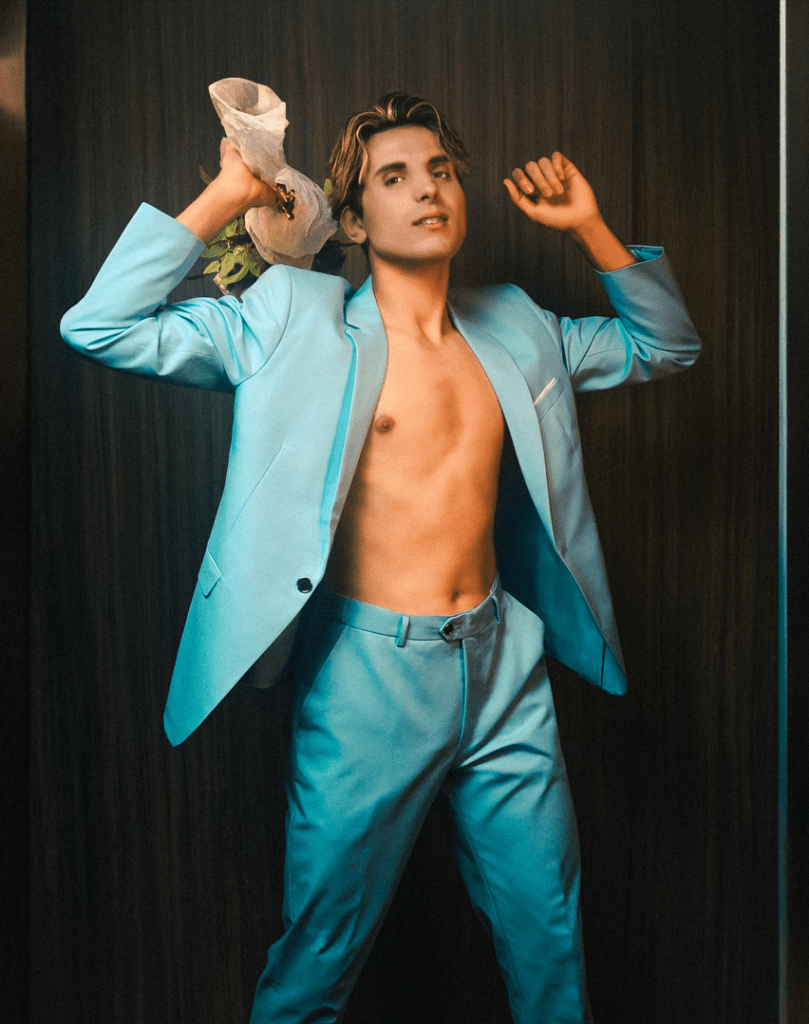
photo by Andrea Amadori
You’ve mentioned Michael Jackson, Chappell Roan, and Dua Lipa as influences, and I definitely hear that mix — slick production, bold performances, and pop as high drama. But what’s one influence that people wouldn’t expect? Something that shaped you creatively, even if it doesn’t show up on the surface.
First of all, I love that you can find traits of my influences in my work. I know those are huge names to cite, and I still consider myself a huge work in progress, but I won’t stop until I’ve earned a seat at that table. My purpose is to earn the same one in a million opportunities when it comes to performing, collaborating and making music history. My blueprint is definitely Beyoncé, her hard work ethic, her discipline, her style and the way it can change without ever sounding forced or out of place, but I think my love for her is something it shows, a lot! She’s the one who introduced me to a whole bunch of genres that I now consider the key to my musical vision, funk, soul, R&B. Growing up I used to almost exclusively listen to punk rock, and I feel I’m gonna carry this influence in me forever, Avril Lavigne and Green Day probably owe me 10% of their total sells hahaha. Also my mom used to put old CDs when it was cleaning day at home (and 6 years old Luke had to help do the chores) so I grew up listening to timeless Italian songwriters like Fabrizio De Andrè and international ones like Cat Stevens (he was my soundtrack when I was in the womb and still love it!).
Italy isn’t the first place people think of when they hear hyper-pop ambition, but here you are — full vision, full volume. Do you feel like your upbringing in Italy shaped your approach to pop music? Were you always dreaming in English hooks and stadium lights?
Being born and raised in Italy, with a very international project, has definitely shaped my vision growing up. I’m still currently growing out of the idea that everything Italian is bad and everything international is good.
To me? The Italian music industry is not the best fit, people here resonate with a totally different vibe, they like to understand the lyrics (and let’s admit it, we’re not the best English speakers!) and that’s not something I can totally blame on my country. I’m learning to see it as a neutral fact and focusing my energy on trying to reach my potential best audience from here, using the opportunities that social media gives us (soon, hopefully, I’ll be able to create content directly from the US), and that’s what matters! I’ve learned to love the good side of being born in Italy, to appreciate the bright sides I shouldn’t take for granted, the calm, the nature, the people, the European way of living life. The more I grow up, the more the American Dream becomes less bidimensional. I can see it in a more mature way, in all its beauty and its flaws.
I got closer to the other side of my own dream, made out of everything I have to give up (temporarily or for good) and that I now know I’m really gonna miss. But of course this is not enough to stop me, I know that my chances are still there, I’m determined to take’em, and somehow, knowing that my future’s so far from a perfect dream comforts me, it makes it more real!
The phrase “romanticizing your worst decisions” should honestly be a genre tag at this point, and you’re doing it with style. Do you think heartbreak is the best fuel for your creativity, or is it just the most dramatic one?
Hahaha love y’all so much! The best fuel? I don’t know but it’s a pretty good and powerful one, right? Music has always been my favorite language to express what I have inside, since I was a kid, but I probably started making my own in high school, when I clearly needed therapy and nobody knew, me included! I went through my morning at school, then guitar lessons, musical theatre rehearsals, bus, homeworks, dinner, and the day could finally end in my room, as I closed the door and cried out all the pressure and stress I managed to hide from the first alarm in the morning. It’s a life that so many people still live, and I feel so, so lucky that I find a way to channel all that: heartbreaks, dreams, delusions, all of it.
I’m pretty sure it saved my life. On a less tragic side, my first songs were ridiculously dramatic. It’s almost funny to read those lyrics again. At some point in my life (probably when I moved to Rome), I realized I could work on myself, also thanks to my new independence. Having different needs in terms of mental health brought me to shift my musical interest towards the pop music industry, and what came naturally after that, was a desire to communicate things in a different way. Maybe to convert those new feelings into something more fun, danceable, energetic, and once again, a generic approach to heartbreak was the first fuel I used to experiment.
After years of perfecting the craft, “Down Bad” started a series of singles that embodies all this in my best way, in what we can define my pop dance era. Growing up of course I felt the need to talk about more than just heartbreaks, I’m focusing on the contrast my harsh lyrics have with the dreamy sparkling vibe of the music, and the more I write, the more honest, sharp and direct I aim to be with both the tone and the topics.
You’ve been releasing music for a while now — singles, even a whole documentary. The ambition’s there, the vision’s crystal clear. But still no album, just singles. Why? Is it a strategy thing, a perfectionism thing, or does the idea of a longform release just not feel right yet?
Can I say a little bit of both? To me, the concept of “album” is sacred. An album is not just a compilation of songs, I might as well create a playlist and call it a day. An album needs to be done with dignity. It has to tell a story, and to do it in a certain way, the songs (the chapters of that story), as different as they might be, need to move in the same direction.
You see, to honor this idea I should be able to give myself plenty of time to think, to create, and to perfect what I write. Not to mention that even though I love to be the only person in charge of the artistic decisions, I’m not a big fan of doing it all by myself. I’d love to collaborate with a team, to learn from other professionals and put together something bigger than anything we could’ve been able to do by ourselves. Creativity needs human interaction, inputs and a lot of brainstorming to avoid being stuck in our own brain. One day I’ll have all of that, I’m working to get there pretty soon, and I promise you’ll have a legendary album) Oh, EPs are a whole nother story, and on this side things are definitely evolving *wink wink*
You’ve built this world piece by piece — the songs, the looks, the live moments, even the documentary. It feels like you’re laying the foundation for something bigger. So what’s next in your vision board? Or are you cooking up something totally unexpected for the next chapter?
The feeling is totally right, my priority right now is to build a catalog, to learn, to perfect my crafts and lay strong foundations for a solid career. That’s how you become a legend. I don’t wanna be a one hit wonder, like the legendary Raffaella Carrà used to say, “study until you have time to do that, and be as ready as possible when success finds you”, and I think we got the secret of a long lasting career. I’m proud of every brick I’m laying, and definitely not a fan of erasing anything done in the past when success is reached, only to fake a sudden, explosive raise. I get it. It sells more and looks cool, but the small numbers are like steps of a ladder that only gets me higher! And I sure don’t wanna be up there alone, that’s why I’m working hard on consistency, to genuinely connect with everyone that connects with me, with what I have to say.
Strategy, socials, production, technique, are nothing without a solid fanbase, and maybe my bigger effort is to learn how to communicate show how much I appreciate all the beautiful souls that are supporting this little, incautious, maybe totally f-ed up idea I’ve had for 22 years of my life, and I still never had a single regret! Thank you so much to everyone who took a little bit of their time to read my story, to who will follow me in my journey starting today, and to Indie Boulevard for such a deep, thoughtful interview. I loved every second and I’ll never stress enough how incredibly important is what you do for independent artists like me, I hope you know that. Love y’all, see you really soon!
*Promoted content. All information provided is prepared in accordance with editorial standards and is intended to offer useful insights for readers.


 Indie Boulevard Magazine