
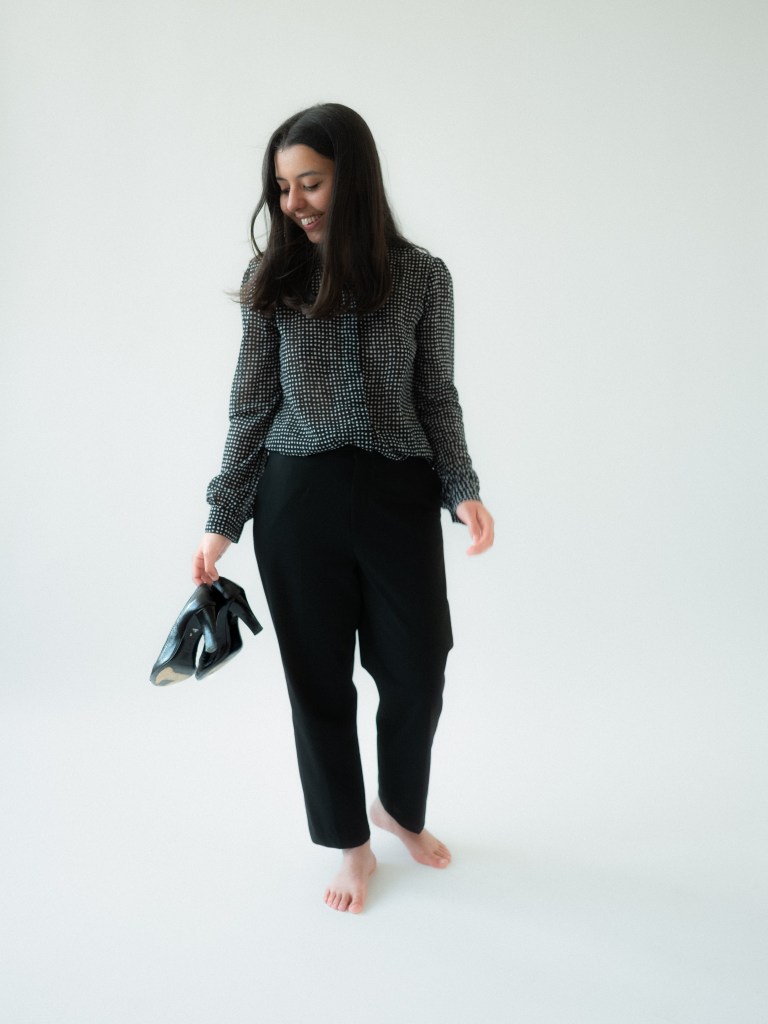
Can you imagine a girl from Casablanca sitting down at a piano at age five, and fifteen years later already soloing with the Royal Symphony Orchestra? Sounds like a Netflix screenplay, but this is the real story of Aïda Lahlou — a pianist who just released her debut album “Mirrors and Echoes” and is rethinking how we listen to classical music.
Ravel’s “Miroirs” — one of the most challenging piano cycles — and she inserts works from five continents between its movements. Yes, Lahlou does what few dare to attempt, what few can even think of doing. Catching Aïda for a conversation proved difficult — between concerts, album recording, and environmental volunteering, she literally has no free time. But we still managed to talk about why classical music needs a multicultural perspective, how her Moroccan roots influence her interpretation of French composers, and why she believes music should work as therapy for the planet. Spoiler: it turned out much more interesting than another conversation about “classical music’s revival.”

Aïda, I’ve been studying “Mirrors and Echoes” extensively, and the concept is truly remarkable. You’re taking Ravel’s “Miroirs” – already one of the most introspective and innovative piano cycles in the repertoire – and creating a dialogue with obscure piano miniatures from five different continents. You’re essentially building bridges across cultures and centuries through music, creating what you call a “musical treasure hunt” that reveals unexpected connections between seemingly disparate works. What inspired you to reimagine one of classical music’s most beloved piano cycles in this intercultural context?
The idea of travel I’d say is already inscribed within Miroirs, as listeners are transported to various vividly represented settings from movement to movement. The scenes in Miroirs are remarkably evocative…They’re a wonderful demonstration of how music can convey not just sounds but also atmosphere, smells, temperatures, and more. It’s like you are there, which is why the journey angle is particularly apt, I think. Noctuelles, the first movement, depicts moths hovering around the night sky. In terms of place, we are probably deep in a forest somewhere rather than, say, on a street, as the middle section, mysterious and broody, points towards it being an unfamiliar setting. Oiseaux tristes is also set in a forest — probably at sunset because of the darkness of tone and because it’s the time of day when birds tend to flock in looming, large numbers. Ravel also tells us that the day is really hot, in the kind of way that they only get to be in the height of summer. The music captures this perfectly: you can feel the oppressive, humid heat and the fragrant smells of the forest with the languid ostinatos and the dark, rich harmonies. Une barque sur l’océan is taking place out on the open sea on what at least at the start of the piece looks like a sunny, gently breezy day, which, of course, will turn sour as the weather changes. Alborada del Gracioso brings us back to civilisation with its human protagonist, and locationwise we are most resolutely in Spain, perhaps in an Andalucían village. I find it fascinating that, aside from the feelings of the protagonist, you can also get a sense of the values of the society he comes from, what it cares about, its beliefs and ideas…. For instance, you can tell they are probably quite superstitious… A few moments in the piece feel like the protagonist is ‘possessed’ by a spirit, or engaged in a sort of shamanistic ritual with supernatural forces. Magic is of course very important in the culture and everyday spirituality in and around the Mediterranean. We also get glimpses of the melancholic and romantic inclinations of people from this part of the world, often hidden behind a very energetic, flamboyant facade, which is also very well represented in the piece… It’s fascinating how deeply Ravel was able to understand and portray different cultures. Finally, La vallée des cloches is set in a vast, open space, where all you can hear is the distant tolling of bells. To me it feels quite oriental (Tibet, Indonesia, Thailand…), and I hear the bells as temple bells, but others like Vlado Perlemuter have imagined pastoral scenes in Europe, like verdant Switzerland hills, where the occasional church bell blends with cowbells from cattle.
What I’ve done with my album is fill in the gaps of this imagined journey. I’ve taken this idea of travel and created a larger story around it, one which would span different locations, times of day, and historical eras. I’ve also expanded on the works pre-existing themes of nature, mysticism, spirituality, and self-discovery, and picked companion pieces that would match both the thematic and musical characteristics of Miroirs.
You’ve placed a Brahms motet arrangement alongside a 14th-century Andalusian song, somehow creating coherent dialogue with Ravel’s aesthetic world. Can you walk me through your process of identifying these “unexpected kinships” between such diverse musical works?
Themes such as the contemplation of nature, spirituality, or self-discovery are topics that have dominated human consciousness since the dawn of mankind. Although works dealing with these ideas will have found different modes of expression depending on the cultural context or the time period they emanated from, they all connect to something universal, something we are all instinctively familiar with. In other words, the surface might change: ways of writing melodies, rhythms, musical textures, and so on might vary; but deep down, the essence is the same.
I’ve always been fascinated with ideas and concepts that seem to transcend all cultural and temporal boundaries. Over the last 100 years or so, fields like Jungian psychology, comparative literature, anthropology, and cultural studies have uncovered that there are archetypes, narratives and stories that speak to us universally regardless of our culture of origin, or even historical era. I feel like the political implications of this are immense, as they remind us that behind all the apparent divisions we all share a common humanity, and to a large extent, a shared way of viewing the world.
In putting together the musical programme, I strived to figure out what the pieces’ essence was, what the fundamental impulse behind their creation was. Once I was satisfied with the answers, it was relatively simple to pair them with works that shared the same fundamental feeling, even if, on the surface, they looked like they couldn’t be more remote from one another.
I’m particularly drawn to your inclusion of Lecuona’s “Malagueña” and “Andalucía.” You are yourself from Morocco, just across the sea from these cities. Do you have a particular affinity with Andalucian music and culture in general?
Yes, as someone who grew up in Morocco and was immersed in the sounds, smells, flavours, and stories of the region, I naturally feel a very close connection to music from Spain, which has so much in common culturally with that of Morocco. I also feel a personal interest in the Andalucian Golden Age, a period of brilliant artistic and scientific richness and religious tolerance: a time where Christians, Jews, and Muslims were cohabiting in harmony, and in many cases supported each other. As someone of Muslim heritage, I am also endlessly fascinated with the deeply erotic and sensual nature of the poetry and music coming from this period, which really challenges current wide-spread ideas about Islam and what it can mean.
I want to talk about how you approach Ravel’s music specifically. You mentioned that Ravel believed music should reflect the listener’s inner world. But when you play “Une barque sur l’océan” or “Alborada”, or any other work, you’re still bringing your own experiences as an interpreter. When you sit down to learn and perform these Ravel pieces, are you thinking about how your background might change the way you play them? And is that something that you welcome or on the contrary, try to efface in favour of a more objective rendering?
I should start straight away by dismissing the claim that removing your subjectivity as an interpreter is even possible; scholarly debates on this question have concluded this quite definitely. But for a long time, ‘removing yourself’ as an interpreter was considered not just possible but desirable. This is because of a certain ideology about how music was believed to be ‘absolute’, ‘pure’, and that its beauty was derived by absolute mathematical principles rather than from any kind of human subjectivity, and that any injection of the latter would only weaken its otherwise perfect form. This ideology, I would argue, started with Palestrina, grew stronger around Bach’s time, was given a heroic figurehead around the person of Beethoven which was then instrumentalised by 19th century apologists and music writers which theorised it and pushed it all the way to the start of the 21st century. We are only just starting to emerge away from this.
Now, I don’t think Ravel bought into the idea that interpreters could somehow conceal their own experiences when playing Miroirs. But in my opinion, based on what I read in his Esquisse autobiographique, he did want the music to imitate emotionally neutral natural scenes rather than emotional scenes. He wanted Miroirs to imitate elemental reality rather than emotional reality.
This may seem like a very philosophical, abstract distinction, but it’s actually a very practical one. It affects the way you would approach playing the notes. There’s a way to make notes sound like sounds, like they are just physical realities, and a way to make them sound like they’re a metaphor for a human emotion. Most music has been written with the latter aim in mind, because it was seen as a higher goal to be able to express the inexpressible in music rather than merely represent physical reality with sound (such works exist, but they were given the status of jokes or fun experiments, like Daquin’s Le Coucou, or Mozart’s La Tartine beurrée), but in the 20th-century, composers like Debussy, Bartók, Ravel, and others started to be seriously interested in the artistic possibilities afforded by ta new conception of sound as just… sound, a way to represent physical reality rather than as a vehicle for emotion. This came hand in hand with other movements in other arts like abstraction and cubism, which started to relish in the physical properties of objects. This was very radical, and this is one of the ways in which Miroirs belongs in the avant-garde of the early 20th century.
For example, in the various climaxes of Une barque sur l’océan, if you want to evoke human emotions, you might choose to play the notes with a strained sound, and a certain timing that imitates the emotional turmoil of someone going through feelings like anger, pain, or stress. However, if you want to make them feel like waves and just water splashing around, you’d play the notes with a deep sound, imitating the water’s properties of weight, speed, etc. I remember vividly a lesson with my professor, the brilliant Ronan O’Hora, who told me that my waves sounded angry. ‘It’s just water, he said, it’s incapable of feeling emotions, so don’t inject your playing with any emotion-like mannerisms’. This distinction was such a revelatory insight for me, and really changed the way I play this kind of music. Now I always ask myself whether the notes are supposed to represent feeling or represent a physical reality.
Each of these approaches will create very different effects on the listener. You could argue that representing feeling will cause the listener to feel the same emotion you are trying to express, because they’ve recognised its signs and experience a sort of empathy with it (in the same way you feel teary when you watch somebody cry), whereas the other way might be closer to the kind of reaction you would have when contemplating nature – in this case you are just observing physical reality, and this may or may not cause you to feel certain things. I think the latter is the effect that Ravel was after.
You’ve mentioned that Mirrors and Echoes seeks to spark “renewed awe for life” amidst war, pollution, and climate change. Classical piano music has always carried emotional weight, yet most listeners turn to it for reflection, solace, or escape rather than confronting global crises. Considering this, how do you see your album guiding listeners toward real-world awareness or action without feeling overly idealistic?
I think that in order to have the energy needed to go fight for something, especially if that fight is long, difficult, and challenging, you must first love it with every fiber of your being. Not just from an intellectual point of view, but in an embodied, visceral way. I think the main problem we have with protecting nature at the moment is that people would say that they love nature, and they might think they love nature, but really they don’t, because they have lost their connection to the natural world and they haven’t got an urge to protect it as they would protect themselves. In fact, they go ahead and actively destroy it, and find no real issue with that, even thought the truth is that they are part of nature, and by harming it they are harming themselves. It’s only by reconnecting to that fundamental, embodied feeling of awe and love that we can feel the need to do something to save it.
You put solace and reflection in opposition to the business of taking action against global crises, but to me they’re both equally necessary. In order to be an effective agent, you must act from a good place internally. A place of peace, clarity, wisdom and purpose. In order to reach this higher state, it is necessary to take time to nurture oneself spiritually, tend to one’s own garden. I see a lot of people who are big doers, who are very driven and ‘achieve’ a lot, but who are led by unhealthy emotions, by an inflated sense of ego, or the wrong understanding of a situation. Any action done without an adequate spiritual underpinning will never lead to lasting or favourable outcome. In the face of today’s challenges, there is a necessity to act, but there’s also a necessity for daily contemplation, critique, observation, and meditation, to make sure that our actions are not marred by poor judgment.
Your album sequencing is particularly sophisticated – opening with Beethoven’s Polonaise in C Major and immediately transitioning to Spendiaryan’s “Kaïtarma” establishes that this won’t follow traditional classical album conventions. You’re creating sonic juxtapositions that constantly challenge listener expectations, requiring active engagement rather than passive consumption. This approach treats the album as a complete artistic statement rather than a collection of individual pieces. How crucial is the complete listening experience to your artistic vision?
Whilst listening to the album as a whole would yield something quite interesting for the listener, as they’d be able to enjoy an immersive experience that takes care of them for a whole hour, I think there’s also much joy to be had by listening to the tracks individually, or in little bits.
I have an anecdote from the chairman of Les Amis de Maurice Ravel, Dr Manuel Cornejo, to which I had sent a recording of the programme in a message asking if the cultural association might be able to devote some funding towards my recording project. He sent me an email saying that he was extremely busy, so he was not going to listen to my recording, but that, piqued by curiosity he ended up listening to a bit of it, and then more, and then eventually the entire recital because he was really interested in the way that pieces were put together… It was the best compliment ever, and gave me so much motivation to see this project through… So, like him, it may be that listeners would start to listen to a little bit of the album out of curiosity and end up staying for the whole ride!…
“Mirrors and Echoes” presents a compelling argument for classical music as an inherently global art form. You’re revealing how European composers were already in dialogue with international influences – Ravel’s fascination with Spanish music, Tansman’s incorporation of Polish folk elements. This challenges traditional narratives about classical music’s supposed insularity and demonstrates its historical interconnectedness with world musical traditions. Are you prepared for potential resistance from traditionalists who prefer more conventional programming approaches?
This programme does challenge convention in that amongst the 15 tracks in the album only 5 of them are considered to be from the canon: the 5 movements from Miroirs. They also do not appear in the ‘correct’ order, which creates further friction with what would be expected, nor are they even grouped together. As you mention, when it comes to geographical origin of the composers, the album is also quite unusual in that we have composers from all central Asia, Scotland, South America, Germany, Poland/America, France, Morocco, etc, all writing in a way that to some extent reflects their national heritage.
However, I have balanced these deviations from the norm by being quite strict – one could say conservative – when it came to aesthetic coherence of these works. This was a very important consideration, because I knew that if one has a very bitsy programme it will not feel satisfying as a whole unless there are very strong links running all the way through. That wholeness was important as I wanted it to work as an immersive experience. The pieces on this album might be very different, but they all share a certain commonality, I feel, in what they are trying to achieve: they’re all quite sensual pieces for example. If I had included more ‘abstract’ works, in which construction and motivic development were the main points of interest, they would have stuck out like sore thumbs. In the programme as it stands there is, as you say, a constant dialogue between the pieces. They talk to each other and speak the same language, despite being from different origins. They are all, after all, written in the Western Art Music tradition.
Perhaps because of that and because the pieces all explore the same couple of themes, I have to say that even the more traditionally-minded listeners have not found much issue with this programme. Not that I have any problem with being considered a rebel (believe me!), but for me, in this album, achieving a satisfying musical result with the programming was a priority. I feel I have managed to do that, which may explain why there was little in the way of criticism. Traditionally-inclined people have noted its uniqueness and unusual nature, but no one so far has felt like it was jarring… Which is good because I wouldn’t want that.
However, there’s always the unspoken idea that if you’re doing things differently, it may be because you’re trying to get attention on yourself rather than doing it for an artistic reason. The assumption is that you’re not good enough to shine by doing stuff the usual way, so you have to resort to doing things in an unusual way. My response to that is that plenty of people who are doing things the ‘usual way’ are not doing it out of choice but because they are not unnecessarily able to think about compelling, new ways of doing things. If you are able to provide an interesting, novel way of presenting music, and do it well, you should absolutely go for it! It’s a strength, not a weakness. Not everyone can do that.
You’re releasing this album into a cultural moment where classical music continuously struggles for relevance, where streaming has fundamentally altered music consumption patterns, and where shortened attention spans challenge traditional listening habits. Yet you’ve created a 15-track journey that demands patience, contemplation, and sustained engagement. Do you believe audiences are actually hungry for music that demands their complete attention and rewards careful study?
I am happy if people enjoy the album in any way, be it by listening to the whole thing, or just a few tracks, or just a few seconds of one track, for example as an accompaniment to a carefully made reel on Instagram or TikTok. The album allows for an immersive, long duration listening experience for anyone who wants or needs that, but I would be very happy if people enjoy it in any way they see fit. Also, they’re not mutually exclusive. You can listen to a couple of tracks one day on the way to work, and another, decide to lie on your bed, close your eyes, and enjoy the whole album… Nothing wrong with that, and I certainly don’t expect my listeners to listen to the album all the way through every time!
With classical music rooted in centuries of tradition, do you see platforms like TikTok and viral digital trends as a way to expand listeners’ horizons, or more as a shortcut that risks diluting the art form?
There are some aspects of classical music that I think are really benefitting from platforms like TikTok that enable more people to enjoy them. For example, one of the big joys of classical music is to learn the stories behind it; the funny or tragic anecdotes, the scandals, the relatable struggles, the interesting or inspiring facts about this composer or that performer. All of these stories can be beautifully told and shared with large numbers of people using social media. Another big strength of classical music is its ability to fascinate people with the process involved in crafting something beautiful using a combination of theory, instinct and flair. This type of content also finds a very happy home in platforms like TikTok. Creating such high level beauty is extremely difficult, and people are always interested in watching phenomenal human feats or deeds. Classical music is full performers or composers creating unimaginable works of beauty or pushing the limits of what we thought was possible, and algorithms on social media favour things that are extraordinary and extremely impressive. This helps a lot of classical music content to cut through, become viral, and reach billions of people.
However, I don’t think the arrival of these platforms has been wholly positive, and there may even be some very serious negative consequences to certain artforms of which music is one. I find that our culture of screens (phones, tablets, computers, TVs) has led to a primacy of the visual medium over a more multisensory experience of life that has put non-visual artforms – like music, literature, cookery, etc – in a very unfair competition against visual ones like fine arts, dance, fashion or photography, forcing them to emphasise, or in some cases invent, visual aspects to survive. I think that has yielded some positive things; for example, musicians and cooks and perfume-makers and so on have had to expand on the visual aspects of their art — or in some cases, invent some — which has often yielded some artistically interesting results, like beautiful cover art for albums, or very visually-impressive culinary dishes, or intricately crafted perfume bottles. However, because the emphasis isn’t on the taste, the smell, the sound, or the unfolding of an experience in time, it is very difficult for even masterful artists in these artforms to compete with those in visual artforms. This is a very real frustration of mine, and I think that one of the long term consequences will be an impoverishment not just of these artforms but by extension in the way we are trained to experience the world. This in turn will alienate us even further from the real, natural world, a world whose richness lies in the fact we can experience it with all our senses.
As someone who balances roles as a Concert Pianist and Creative Director, your days must weave together performance, practice, and creative decision-making. How does a typical day look for you? Are there particular rituals or habits that help you switch between performing and managing the broader creative vision?
No two days are the same, that’s for sure. It all really depends on what things need to get done at that moment. For the last two years for example, whilst I was working on the album project, I got a lot less practice done than when I was a student, for example, because I had all these other things to work out and deliver. But I became a pianist because practising an instrument is so good for me: it grounds me, unstresses me, connects me to my body, exercises my brain and feeds my soul. So even when I’m really busy with administrative tasks, I never allow myself to stay too long away from the piano, because it’s bad for me. The moment I practice too little, my sleep suffers, I am more anxious, less grounded…
My ideal job would somehow be a mix between being an artist, activist, and entrepreneur. Because it doesn’t really exist, I have to invent it and defines what it means and how the three sides work together, not against each other.
In general, it helps me to devote the morning to creative tasks, because that’s when my mind is clearer, and I find that with admin it’s very easy to get sucked into a tasks and not emerge from it until 3 or 4 hours have passed. I like my practice to be uninterrupted ideally – three hours is my ideal practice session duration. After this is done, breaking things up between embodied tasks (practice, or going for a walk, cooking…) and admin tasks (emails…) allows me to stay focussed and efficient.
For longer creative projects, as soon as possible after having had the initial impulse for it, I keep a notes file on my phone and write down any ideas that occur to me at any moment in the day – this keeps my mind working ‘in the background’ whilst I do other things, and when it comes to concretely planning and delivering the idea, I find that I’m not starting from scratch, but already have a basis on which to work. This is how I developed my comedy show, for example.
For more entrepreneurial projects, I start by listing all the steps I need in order to carry them out. I devote part of my time to upskilling in areas that I am not yet able to do or able to delegate. Constant learning is imperative if you want to see through a complex project. The rest of my time would be devoted to executing the plan, assessing progress, and pivoting when necessary.
My need to practice enough and achieve enough on admin goals mean that I have a very strong incentive to stay efficient in my use of time… I have a natural tendency to overwork, but a recent learning is that strategic rest is a very effective use of your time…!
*Promoted content. All information provided is prepared in accordance with editorial standards and is intended to offer useful insights for readers.





 Indie Boulevard Magazine