
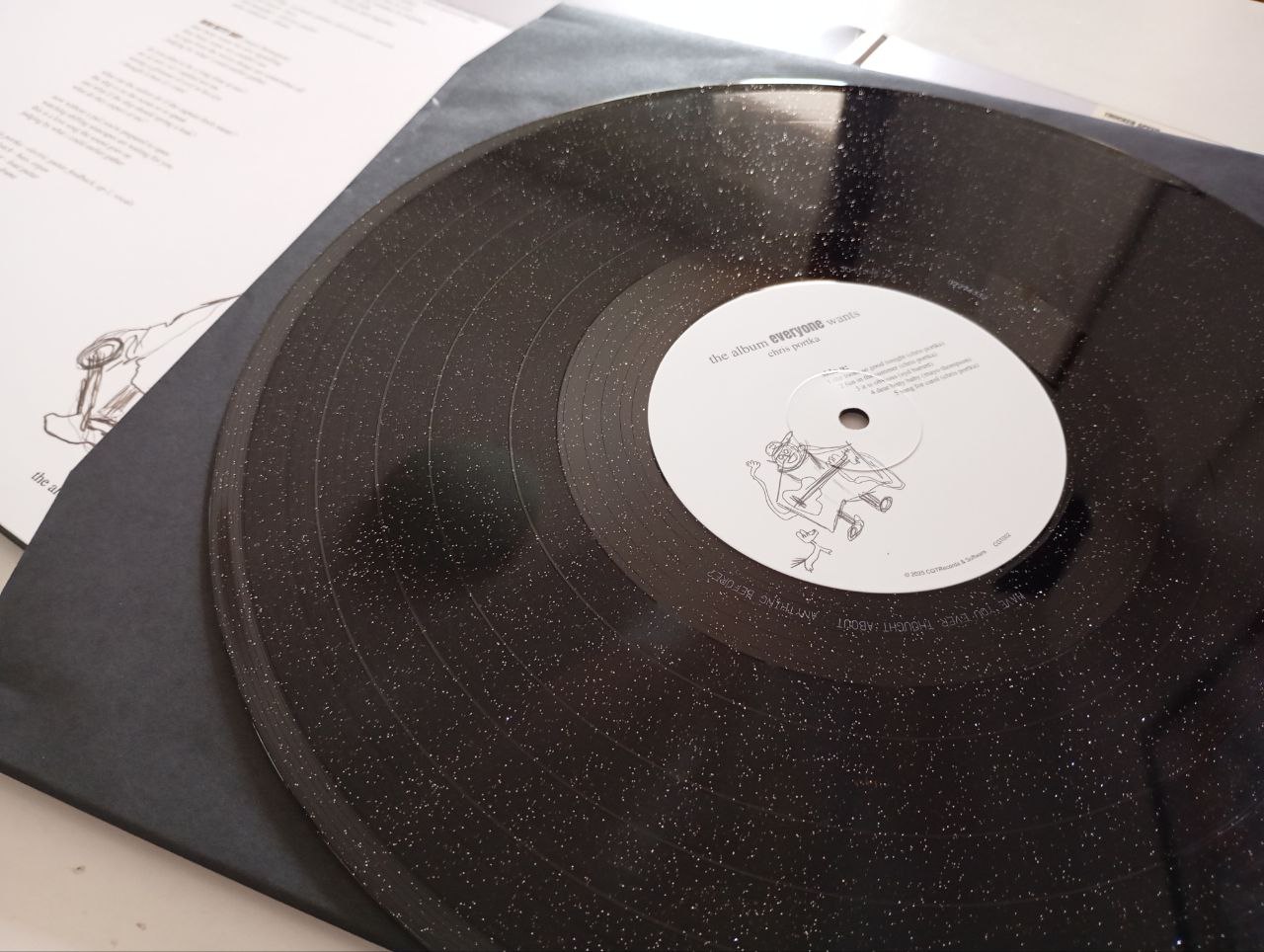
This vinyl showed up in my mailbox straight from Chris Portka himself, and that’s the first thing you need to understand about The Album Everyone Wants—it exists as a physical object before it exists as a set of files on a streaming platform. I already have his previous LP, Trash Music, on wax, and now this new release joins the collection.
Suddenly, the whole vinyl revival narrative clicks into place. Year by year, sales keep climbing—Dua Lipa to Kendrick Lamar, endless Bowie reissues flooding even shopping malls—the industry is pivoting back to a format everyone swore had died in the ’90s. Meanwhile, Spotify with its play counts, monthly listeners, and recommendation algorithms turns music into background noise, workout fuel, data points on growth charts. Vinyl restores gravity. Presence. A body in physical space.
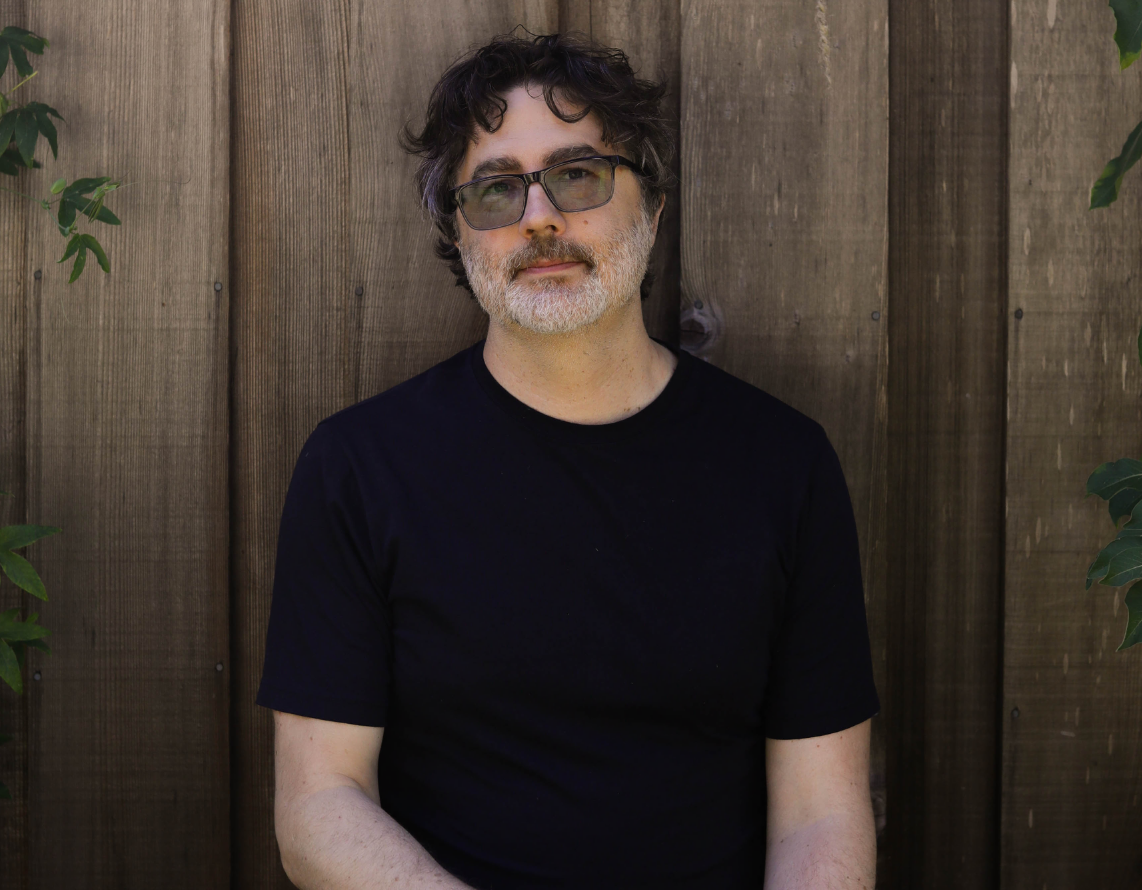
Putting a record on the turntable is a ritual the streaming generation is rediscovering like some archaeological artifact. Pull the sleeve off the shelf, slip the disc out, study the artwork, read the credits, lower the needle, wait through the first seconds of silence before the sound arrives—it’s the opposite of how we consume music now. It’s meditation, intentionality, the decision to stop and be present with this album, these eleven tracks, from start to finish. Portka makes music that demands exactly that kind of listening—attentive, immersive, tactile. His sound only fully reveals itself when you’re physically interacting with the medium, when there’s an object bridging the space between musician and listener.
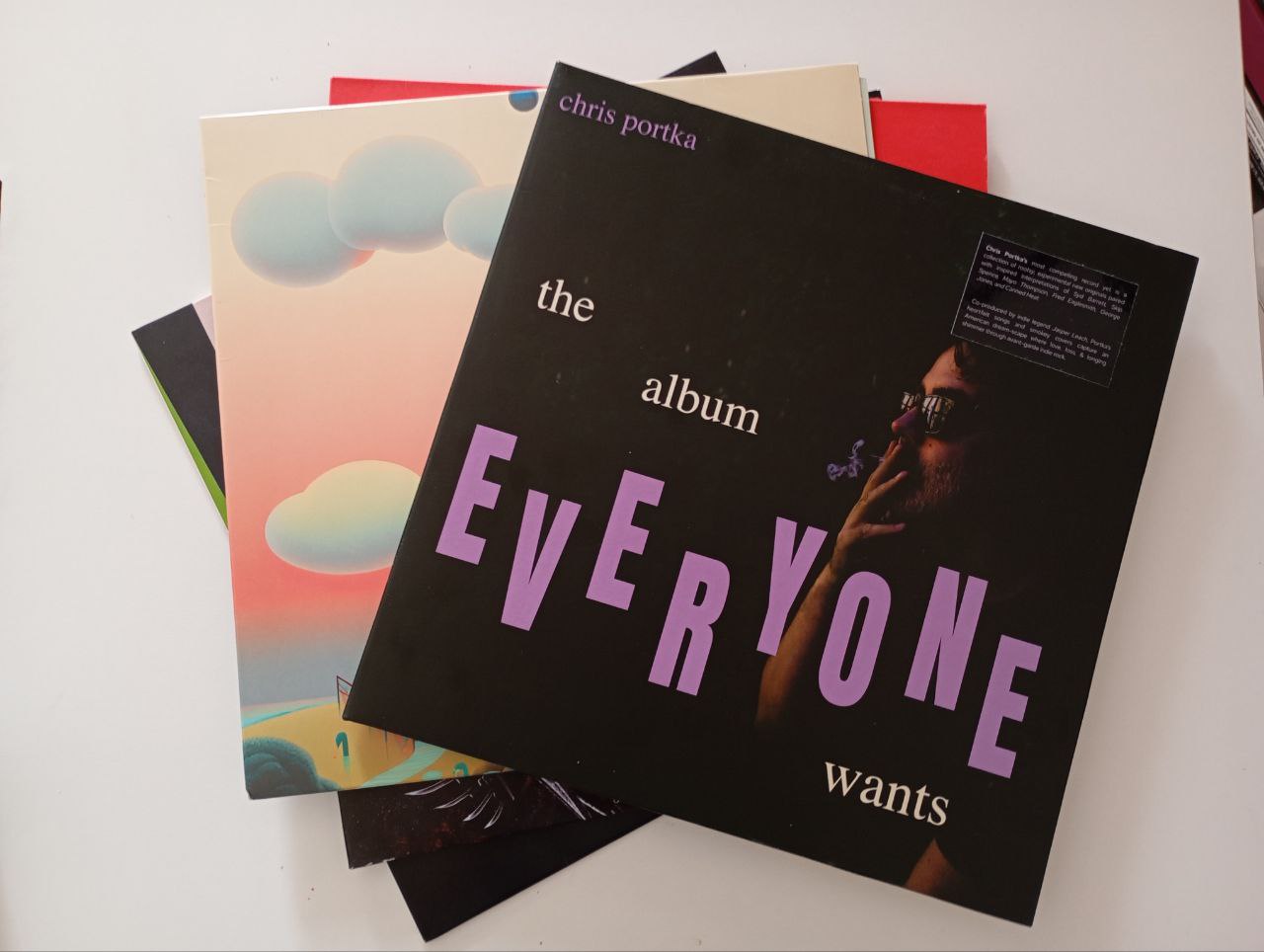
The Album Everyone Wants was recorded at Sear Sound (New York) and Brothers Recording (Oakland), produced by Jasper Leach, who’s worked with Burner Herzog and Brasil. Eleven tracks: seven covers, four originals. Syd Barrett, Skip Spence, George Jones, Chris Stapleton, 5 Seconds of Summer. American music spanning ’70s psychedelia to 2000s pop-rock, refracted through pedal steel guitar, lo-fi grit, and a kind of country-gaze aesthetic Portka seems to be inventing in the moment.
The leap from Trash Music to this record is like going from sketch to canvas, demo to statement. The debut was a bedroom project—four-track tape, minimalism, even some noise experiments creeping in. The Album Everyone Wants feels like a metamorphosis compressed between just two releases, dense with intensity. Portka shifts from a solo endeavor to a full-band sound, from acoustic guitar to orchestration that places strings next to brass, pedal steel against synths, field recordings alongside meticulous studio treatments. The result is dense, textured, layered—an album that plays like cinema, like a journey, like a hallucination.
Half of it is covers, and that’s the conceptual spine of the record. Portka circles a question most artists avoid stating directly: What even is a cover? Where’s the line between interpretation and the creation of a new work? If you’ve reshaped a song to the point it’s barely recognizable, is it still someone else’s, or has it become your own? Usually, we think of covers as straightforward remakes—same melody, same lyrics, maybe a rearrangement, like an acoustic take on an electric track. Portka treats the material differently. He keeps the skeleton, a few essential elements, and builds a whole new structure around them. It’s re-imagination through sound, texture, context.
What sets Portka apart from contemporary musicians is his drive to experiment as a baseline. He has a track literally called “Ambient Jazz Metal,” and the name is no gimmick: all three genres collide, fused into a single composition that seems to exist in multiple dimensions at once. The Album Everyone Wants—like every Portka record before it—is a platform for experimentation, transformation, for realizing ideas that until now existed only in potential.
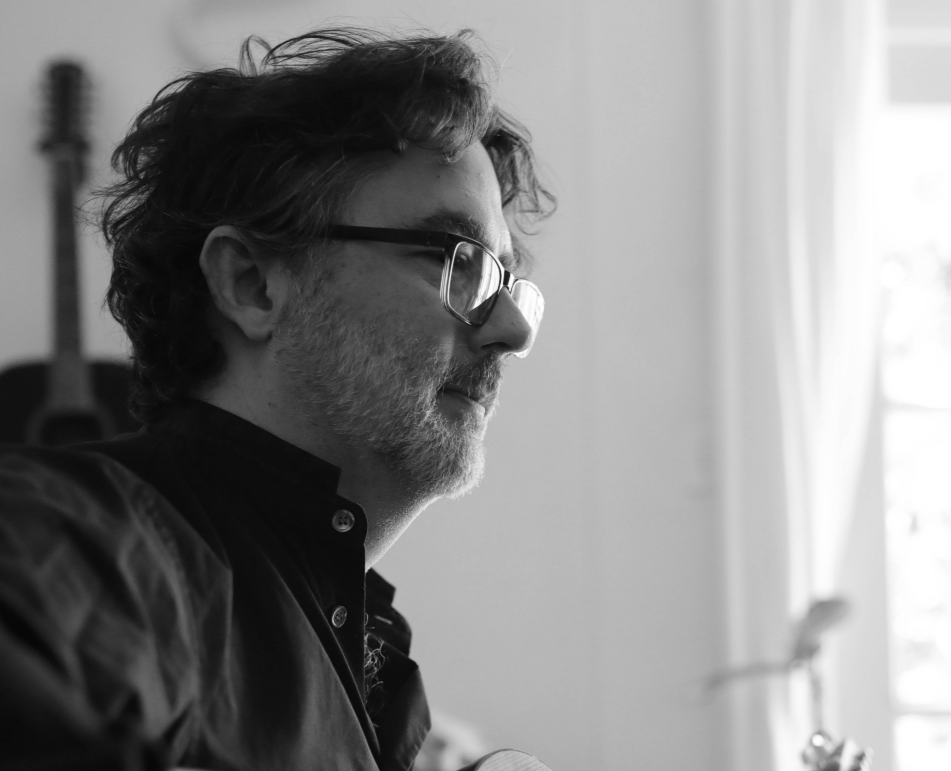
“She Looks So Good Tonight” opens the album — and immediately bares its nerve. The booming drums and shimmering guitar create a sense of space and breath. Everything feels deeply cinematic: instead of classic drive, there are wide shots, air, light flickering through dust. Chris sings as if trying to reclaim a voice he once lost. I know there’s a certain barrier for him in singing — an inner threshold that isn’t easy to cross. But he does it, and in that effort lies a quiet, almost intimate victory.
“Fun in the Summer” is the first original song on the album. Acoustic strums, whistling, field recordings: the atmosphere of a ’90s roadmovie. Portka captures the sensation of that one summer evening when you borrow your parents’ car, head out past the city limits, and convince yourself it’ll last forever. Joy, laced with the awareness it’s already gone. A song about memory, about the way we romanticize the past, about how happiness always seems just behind us. Its breezy surface conceals the weight of its content.
Canned Heat’s “Poor Moon” (1969) was an ecological warning; Portka recasts it as a psychedelic mantra. Alan Wilson’s original lamented the moon losing its beauty to pollution. Fifty-six years later, the song feels prophetic. Portka’s take shimmers in major chords but hides apocalypse beneath. His vocal is playful, almost childlike, while the lyrics describe the end of the world. Guitars stack into a swelling wall of sound that grows denser, more physical. Dissonance becomes a device: smiling through panic, dancing on the edge of collapse.
Chris Stapleton’s “Tennessee Whiskey” is a modern country classic, practically untouchable. Portka touches it anyway. The opening minute follows the rulebook—acoustic guitar, pedal steel, traditional form. Then the structure unravels. The rhythm drifts, slide guitar overtakes the frame, and the song mutates into a trance, a meditation, a journey. Country collides with Sonic Youth, Nashville with Oakland’s experimental scene. The result is a hybrid, a new life form—whiskey poured from some alternate dimension.
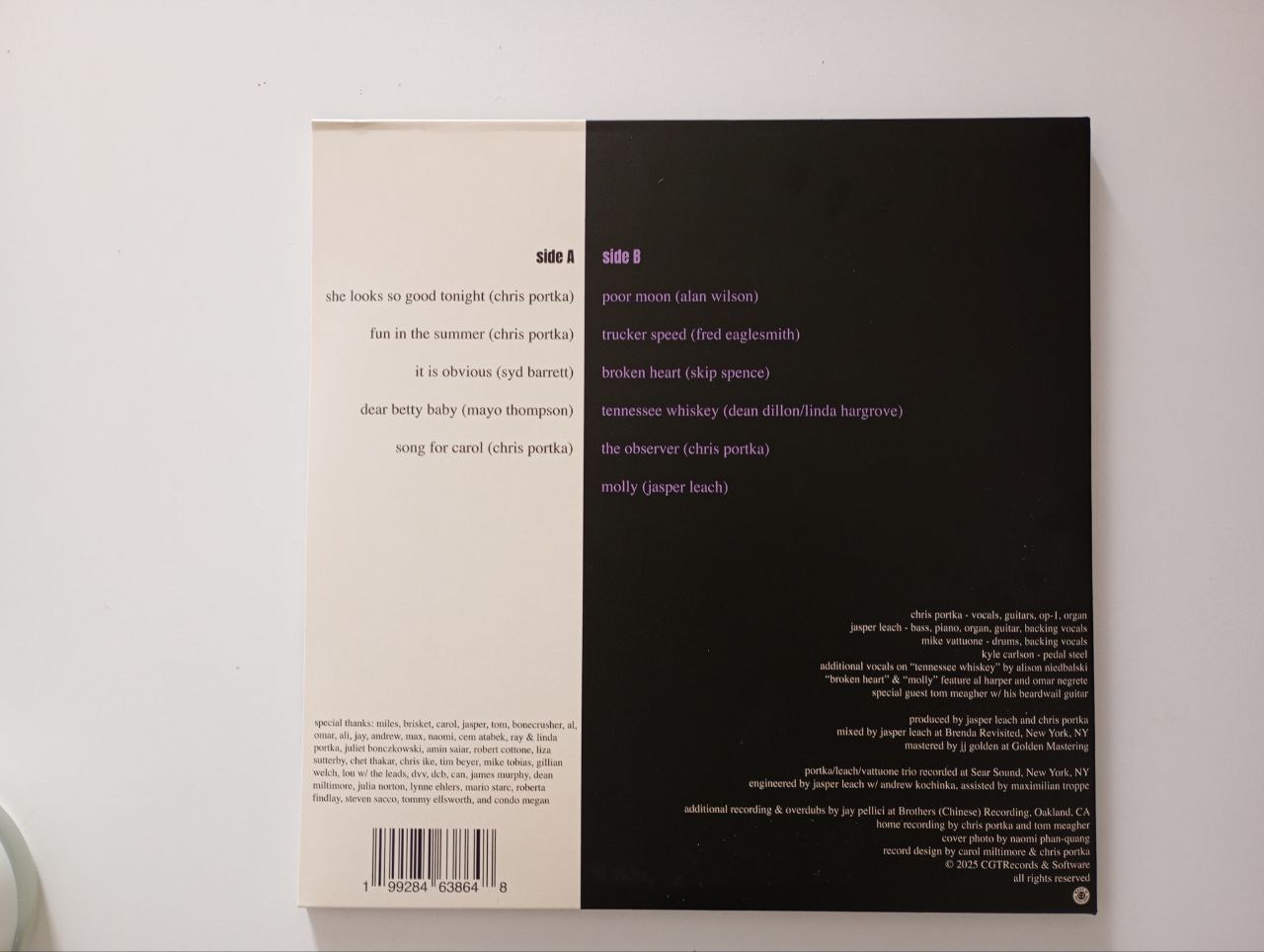
The covers on this album function as research. Portka presses the question most musicians avoid: what is a cover, really? If you refashion someone else’s song until it’s little more than the starting point, does it remain theirs—or has it become yours? Covers are usually little more than re-performances: same melody, same lyrics, maybe a swapped arrangement. Portka goes deeper. He keeps the DNA but builds an entirely new organism around it. Skip Spence, Syd Barrett, George Jones—their songs are raw material here, clay for Portka to mold into a personal narrative. The album is about American music, but also about how American music mutates, evolves, becomes something else altogether.
“The Observer” is an original—a folk-rock meditation on time and perception. Here Portka is in singer-songwriter mode: acoustic guitar, unornamented vocals, lyrics about watching yourself from a distance, about becoming the spectator of your own existence. Dylan and Cohen wrestled with similar themes, but Portka layers on a more modern fatigue: exhaustion with endless self-reflection, with life as perpetual performance.
“Molly” closes the album: a lullaby that turns into a nightmare. The melody is soft, the rhythm soothing, but the lyrics suggest something uneasy, unnamed, terrifying. Portka shapes the track like David Lynch: establishing calm only to unravel it from within. The sound remains beautiful, but beauty itself takes on menace. The album ends wounded, unresolved, with questions left open and anxieties unhealed.
The throughline is contrast. Country and noise. Tradition and avant-garde. Light and darkness. Sincerity and irony. Portka fuses elements that seem like they could only coexist in theory. In practice, they create a soundtrack for an imagined America—where George Jones jams with Syd Barrett, where pedal steel cuts through sheets of distortion, where every song is a gateway to a parallel reality.
Even the title, The Album Everyone Wants, works on multiple levels. It’s irony: this record is not, in fact, made for everyone. It’s challenge: try, understand, decode. It’s manifesto: music should be demanding, complex, multi-layered. It’s a return to the idea of the album as a unified statement, something to be heard from beginning to end, requiring time, attention, immersion.
The sound itself is part of the statement. Recorded at Sear Sound and Brothers Recording, the record carries a warm, analog tone that producers these days try to fake with plugins. Here, it’s all real: tape, live instruments, the resonance of the studio itself as instrument. Jasper Leach’s production moves between clarity and grit, hi-fi and lo-fi, crafting a texture that breathes and changes track by track.
This is an album built in direct opposition to the streaming era—against algorithms, playlists, background listening. The vinyl format is integral: you flip the record at the midpoint, you hear the needle crackle, you hold the sleeve, study the credits, feel the weight in your hands.
And once again, the leap from Trash Music to The Album Everyone Wants is astronomical. Chris Portka evolves at breakneck velocity, his trajectory pointing skyward. This is one of those rare albums that outstrips its predecessors across the board—ambition, execution, depth, bravery. It’s a bid for serious consideration, a place in the lineage, a sign that Portka’s music will endure and ripple forward.
The Album Everyone Wants is proof of concept. Proof that in 2025, you can make music that feels both archival and futuristic. That American musical heritage can be raw material for something radically new. That a cover can itself be an act of authorship. That the album, as a format, still matters, still wields power.
And beneath it all, this is an album about America—or rather, a parallel America, where music history flows under different laws, where boundaries blur, where everything connects to everything else. The America of motels and highways, sunsets and dawns, whiskey and cigarettes, loneliness and communion, memory and forgetting. An album-manifesto, an album-question, an album-discovery.
And yes, it really is the album everyone wants. Most people just don’t know it yet.
*This review was made possible by SubmitHub





 Indie Boulevard Magazine