
There’s something about industrial and gothic rock music that nobody tells you: it’s always been sensual, speaking truth through dark chords and thick fog. That’s why the Nancy-based duo -ii- (pronounce it aloud: “Two Eyes,” as if someone is watching you), consisting of Hélène Ruzic and Benjamin Racine, commands attention.
Their second album Apostles of the Flesh, out today, sounds as if the musicians are speaking about the most intimate, eternal, and spiritual matters through the prism of gothic rock and shoegaze energy. It’s over an hour of music that refuses to sit still or stay silent about desire. Hélène Ruzic’s voice oscillates between crystalline clarity and growl, while Benjamin Racine creates a sonic stream that sounds like you’re tiptoeing into a cathedral and experiencing ecstasy from its magnificence, innocence, and a sense of complete acceptance. –ii– added live drums from David, borrowing rhythms from maloya, traditional music from Reunion Island. But here’s where it gets interesting: -ii- use metaphors to express themselves. The duo follows a sex-positive approach—they’ve played at erotic art festivals and now consider BDSM parties and libertine clubs as future venues.They offer music that touches on themes of love, body acceptance, and exploring one’s sexuality in a healthy and conscious way. Well, –ii– are doing something truly beautiful: creating music that can genuinely help anyone ready to embark on a journey of sexual self-discovery. We met with the duo to talk about self-acceptance and body acceptance, their hypnotic rhythm as spiritual practice, and why their greatest compliment is knowing their music sounds like the soundtrack to someone’s orgasm.
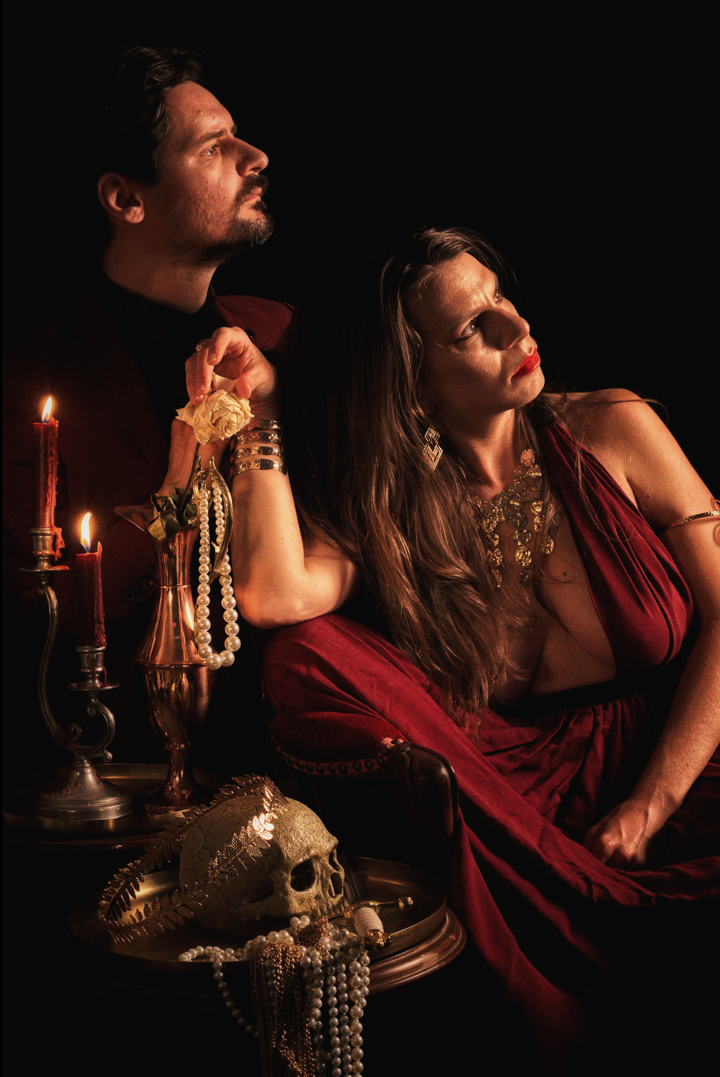
photo by Benjamin Racine
Hello guys, thank you for taking the time to speak with me! I’m listening to your new album and immediately notice live drums instead of drum machines. David hits the cymbals with such force that I want to check whether my speakers are still intact. Well, you’ve completely abandoned programmed beats and switched to organic instruments. Kayamb, xaphoon, bouzouki – instruments that usually nobody uses in industrial music at all. What specifically made you throw out the drum machines and record an album with a live rhythm section?
Hélène: Hello ! Thank you for your interest! When the pandemic hit, we wondered “what now” ? The idea of having more “organic” instruments came rather quickly. Especially when it comes to live performances. We felt enslaved by the use of backing tracks and we didn’t like it. Playing with Health in 2019 kinda woke us up : seeing Benjamin (Jared Miller) hitting these drums with such a tribal force has been a revelation and the confirmation we needed to look for other musicians.
Ben: Hi, thanks for having us! It’s been a long journey actually. We started in 2018 as a duo, using an SP404 to manage beats and synth parts. It was great because we could have refined arrangements on stage but as Hélène mentioned, we kinda felt alienated by the way it worked : we had to play on top of the sampler, not really with the sampler. As a live performer, it can feel a bit frustrating sometimes. So in 2019, we welcomed Stéphane for a beautiful tour that took us to Italy. He would play percussion, still while using the sampler but at least we had someone being the physical incarnation of the beats with a more three dimensional instrument. It felt really great and we were ready to incorporate this into the future… then COVID happened, putting everything to a stop. Time marches on, we record two confinement singles with Stéphane and then he moved on to focus on his personal projects. So it was the two of us, still in the midst of COVID lockdown and we had a choice : do we go back to the duo with machines or do we keep on exploring the more organic way ? It was obvious that we wanted something that felt more “live” sonde figured we would go full band and find a drummer and a bassist.
“The Birth of Venus” opens the album with the most powerful drum parts. The track immediately announces a change of course – there’s no familiar electronic backing here, but there are these tribal rhythms that David delivers one after another. Plus the song lasts more than five minutes, and the suspense builds throughout. Why did such an aggressive track become the album opener? Did you want to immediately show the band’s new face?
Hélène: At the very beginning, Lotis should have opened the album, because the former name was “Embryo” so it was pretty obvious to start with it. But Embryo became “Lotis” and with the title “The Birth of Venus”, it was the perfect opener.
Ben: The Birth of Venus was the first track we worked on as a quartet. I think it served as a test track of what we could achieve as a four piece. Conceptually and musically, it was the best way to open the album. Also, we didn’t want to open with something too atmospheric. We were used to open our shows with a powerful track in medias res, so it felt natural to start the album the same way, get that “in your face feeling”. The Birth of Venus was perfect for that.
Several years have passed between “Extinction” and “Apostles of the Flesh”. During this time you managed to work on other projects – Fournaise, Daski. Meanwhile, Maxime and David joined the lineup. It turns out the break was productive, because the album sounds completely reconceptualised. How much time did it take to find the new sound, and did you plan from the very beginning to make such a radical turn.
Hélène: We took 2 years and a half to work on this album and we definitely wanted to make such a radical turn. Also, we had two great musicians with us, and we really wanted to compose this album with eight hands, so they came with all their creativity to help us find our sound. We really took our time to make the best album we could. We didn’t want to rush anything.
Ben: we tried to make the best out of the COVID forced hiatus. As we were condemned to stop touring for a while, we tried to take as much time as possible to evaluate things, conceptually as well as musically. It was obvious we would take a radical turn, just by incorporating two new musicians to the process. The challenge was to make the transition: how can we write a music that is different sonically but yet keeps the core elements of what could constitute our own style ? We could’ve rush things and it would’ve worked, but we knew from experience that taking time is of the essence when you want to dig deep. So we took our time, and that gave us the luxury of approaching things with a clear head, making everything intentional.
Hélène, you grew up in Réunion and brought maloya rhythms to the album. This is traditional music from the island, usually performed with kayamb and other percussion instruments. An interesting mix resulted: French lyrics, Réunionese rhythms and European industrial. Have thoughts of using maloya in your music been brewing for long?
Hélène: Yes, definitely ! We already brought maloya rhythms on the track “Sitarane” on our last EP “ Under a Glass Eye”. Maloya means a lot to me. I grew up with this music and it reveals the whole History of Reunion Island : slavery, encounters and the melting pot of people coming from Africa, India and Asia. It’s important to me to highlight that I never saw another place in the world where so many different cultures and religions can coexist without any trouble.
You’re an artist with an angelic pure voice who sings against the backdrop of some industrial genre monster-creature called dark noise rock. This is particularly felt in tracks like “Sisyphus in Red” or “Where the Diamonds are Hurled” – your crystalline vocals literally float above this powerful wall of sounds. Still, there’s something almost demonic I sense in the vocals beneath that angelic surface. How consciously do you play with this contrast between vocal tenderness and instrumental aggression, or is this simply the natural sound that emerges?
Hélène: Thank you! I always loved to play with contrasts and I love to play with people expectations. When people meet me, they often see a girl who is a little bit shy and kind. But when I’m on stage and they watch me scream and jump all around the stage, they don’t believe it. I also love to challenge myself, so in 2018 , I learnt to do screaming vocals. Even if I knew, and some vocal coaches told me that I had a “light” and not very strong voice, I wanted to prove to them and to myself that I can sound big too ! On this album, you can hear me scream vocals on Lotis. Since last year and for the album recording I also learned by myself to do whistle notes and you can hear some of them on Sisyphus in Red, The Fountain of Helicon and When Beauty is a Crime.
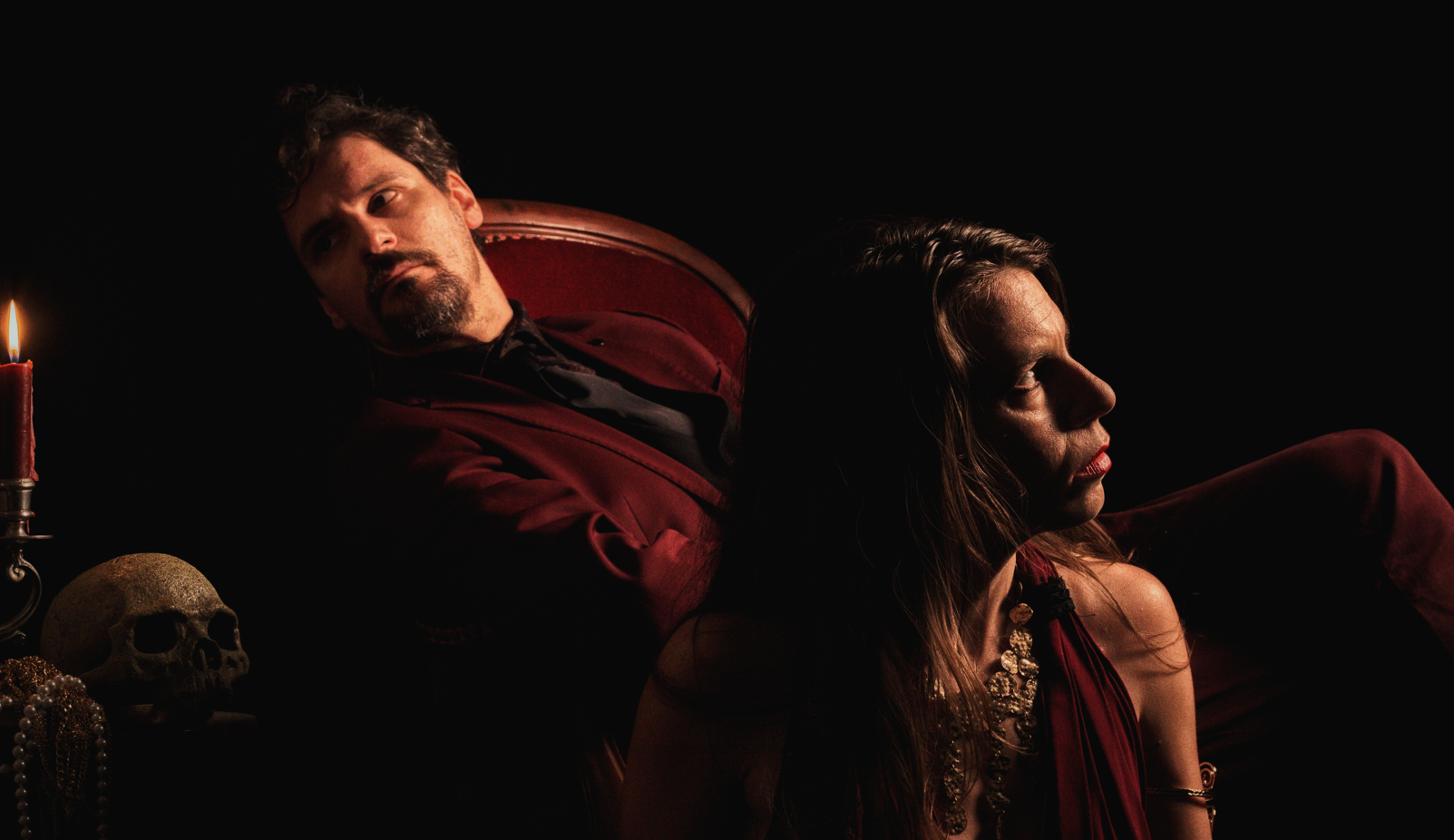
photo by Benjamin Racine
Benjamin, you produced the album independently. The mix turned out very dense – each instrument is heard distinctly, yet the overall picture remains cohesive. What main principles did you use when mixing this album, and how did the process differ from working on the previous release?
Ben: thank you ! This one is for the mixing nerds out there. We first demoed each tracks with just the band, see how it would hold up in a live situation. At first, we were thrilled to see how it would already sound pretty complete au naturel. But as production went by, we felt the need of going deeper and deeper. We had our epiphany while on a trip to Munich. We visited the Asamkirche, a wonderful, glorious and yet dark baroque church. It hit us : our first album Extinction was a gothic cathedral, massive, dark, cold, with sharp edges. This new album would be more baroque : full of gold, with plenty of details, introducing more light in the architecture.
It gave me a direction. Our music always has been “beat-oriented”, like I always considered the band as a Trip-Hop band more than a rock band. So now that the beat is been incarnated by live drums, I had to do everything to do justice to David’s parts and put them front row. We also really wanted this album to be different from the last one, so what’s the opposite of a cold drum machine ? Live drums with a full acoustic sound : no sample, no artificial reverb, just drums in a room. To fully achieve this, we went the “Songs for the Deaf” way : we recorded the shells and the cymbals separately. It gave me more control over the drum sound, with the lack of cymbal bleeding giving me the full potential of using the room mics (different kinds of stereo couples, ribbons and condensers as well as a trash mic fully hardly compressed as overhead). It really is just the mics, some slight EQ and compressing and that’s it. I just did the Prince trick on a couple of songs (sending the drums bus into an aux send with a pitch shifter taking the sound lower).
From this point, it was all a question of layering everything else around the drums, and maintaining some kind of equilibrium by having all these details playing with each other without having them overlapping over each other in the sound spectrum. We wanted to achieve something that felt intense, not because of heavy distortions and volume, but by using the full spectrum of sound : having something going on in every frequency range possible.
It was a great challenge because it was really different from the previous album, I had more freedom in terms of arrangements, and the possibility of having more acoustic instruments allowed me to go deeper in the production process as well as incorporating more light in this gloomy church.
The track titles contain many references to mythology and religion: “The Birth of Venus”, “Sisyphus in Red”, “Sisters of the Coven”. The album is called “Apostles of the Flesh”, which also sounds rather mystical. At the same time, the music truly creates the atmosphere of some ritual or ceremony. Can this album be considered conceptual?
Hélène: Mythology and religion are always a great source of inspiration. And it’s something people turn to when the world is falling apart as it is today. I really like the fact that our music can make people like being on a mystical-spiritual journey. When we are on stage, I see two kinds of people : those who are staring at us and don’t lose a crumb of the show and some who are eyes closed and I feel they’re making a deep inner trip within themselves. In that case, I love to see their smiley faces while they are softly swinging and their feet beating to the rhythm of the music.
Ben: it is something recurrent in how our music is being perceived and I’m glad that people feel this idea of a ritual. There’s something special about sacred music, it’s a feeling you don’t get anywhere else. I really like the idea of making sacred music for profane people. It’s also a way to reconnect with music in a deeper way. It’s not just a tune in the background while doing your dishes, it’s a full experience. So yeah, the album is somehow conceptual in that way.
Maxime Keller played in Dvne, Headbussa, Smash Hit Combo – quite heavy bands. David l’Huillier actually runs a drum museum. It turns out that two very experienced musicians with serious backgrounds joined your duo. How did rehearsals go with the new lineup, and did the musical chemistry between all members click immediately.
Hélène: We knew beforehand having them with us would be a great fit. We already had the chance of working with David on daski. In fact, David and Maxime already knew each other from playing in a band together in the past. Also Ben knew Maxime know each other for a long time and they shared gigs with their old bands. Nancy is not such a big town, everybody knows each other.
Ben: I was so psyched to have them on board with us on this venture. They’re old pals and already shared stages and parties with each other. It kinda felt like the stars were right and we could finally jam together (which I wanted to do for a long time). It clicked immediately and naturally, not because they’re just good friends, but also because they are amazing musicians and I’m so glad to have worked on this album with them.
I’m always interested in band name stories, especially when they’re as unusual as yours. -ii- reads as “Two Eyes” – two eyes. You’ve said something like these are “a pair of eyes hanging in the void like guardians, watching over our tormented, wounded souls”. Where did this name come from and what meaning do you put into it? Are these “two eyes” a metaphor or a specific image you had?
Ben: We find this symbol to be poetic… but it’s actually the worst band name ever in terms of web referencing! We liked the idea of having a name that’s more a symbol than a full name, something abstract that’s open to interpretation. People actually project on the logo “-ii-” and we had many different interpretations. We read it as “two eyes” but personally I see two candles. The image of these “two eyes hanging in the void” makes me think of a poem by Victor Hugo “La Conscience” where Cain, after killing his brother Abel, is being chased by an Eye that’s always watching him, even in the tomb.
The album lasts more than an hour, contains 12 tracks and sounds very ambitious. You clearly put maximum effort and time into it. Now the release is scheduled for October, then there will surely be concerts and promotional activities. What are your plans for concerts? Are there already specific dates and cities? And how many shows do you plan to play in support of the album?
As many we can !
So far, we have several shows to come, some as a duo and in full band
– 25/09: 648 Café – Marcellaz (duo)
– 27/09: Le Brassetorium – Nice (duo)
– 30/09: La Grange du Château – Gex (duo – private show)
– 17/10: Tattoo Legends Convention – Luxembourg Ville, LU
– 23/10: L’Autre Canal, Nancy avec BRUIT< et Alcest
– 26/10: Les Citrons Masqués, Yverdon-les-Bains, CH
– 27/10: Le Brin de Zinc, Barberaz
– 31/10: TBA, Nancy
2026
– 26/02 – TBA – Marseille (duo)
*Promoted content. All information provided is prepared in accordance with editorial standards and is intended to offer useful insights for readers.



 Indie Boulevard Magazine