
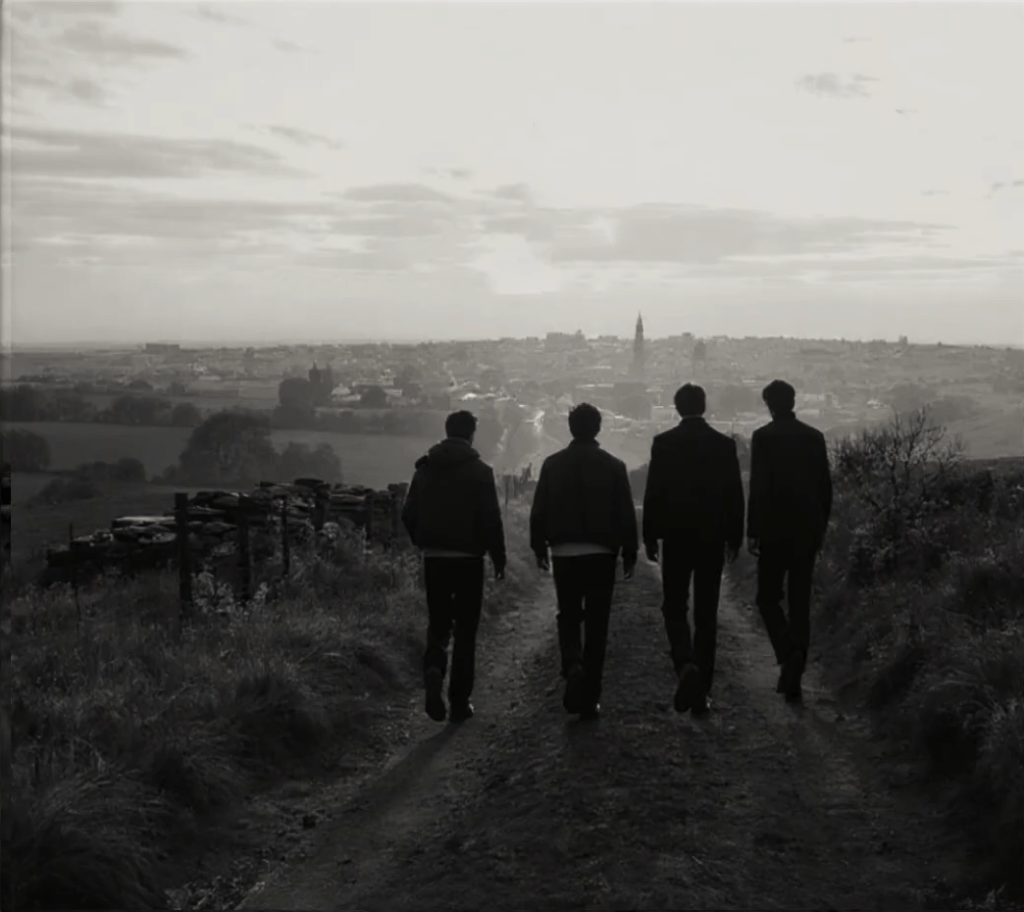
Humanity evolves, and musicians’ creativity finds new paths of self-expression. In this sense, the phenomenon of AI music is an integral part of the creative journey. Through the example of the mysterious band Fondly Kip and their digital album “The Velvet Way Home,” you can see how creativity made with the help of artificial intelligence makes its own contribution to cultural exchange and dialogue between art forms.
Creative consciousness expresses itself in different spheres and forms, including the formation of an extensive creative direction of AI music, behind which stands a real person, deep concepts, and the artist’s vision. Working with the musical art form is multifaceted, and each artist contributes their part to the cosmos of sonic possibilities, leaving their own distinctive mark. “The Velvet Way Home” is proof that AI can imitate human art and serves noble purposes—to inspire and unite people all over the world.
I like that Fondly Kip has an interesting poetic origin. Fondly Kip has its roots in 1968 Bristol, a port city filled with unquenchable creative energy. From this history, Fondly Kip takes its beginning, proving its deep development and significance. “The Velvet Way Home” is an album about values, about family and social consciousness, about the connection between nature and humanity, and the release also touches on themes of suffering and nuclear weapons. About themes familiar to everyone and troubling to many.
I’d like to highlight several tracks that hooked me the most. And this is undoubtedly the first one, “The Time Between Us,” a tender rock ballad filled with love and tenderness. This emotional, commercially accessible duet explores the interconnection of human relationships and mutual understanding. Stylish lyrics and a building climax discharge into the smooth sound of a light lead guitar imitating relationships with their flare-ups and moments of peace.
If you’re looking for vibes of classic rock sound with elements of soft country, then “Echoes of the Hourglass” is absolutely necessary to have in your playlist. Once again, a succession of changing voices surprises with its depth, and the video with an endless starry sky amplifies the concept of “Echoes of the Hourglass”—the flow of time and memory, unchanging parts of life.
I’m enchanted by “Guiding Light,” its lightness and airiness. I love the care and inspiration with which Fondly Kip speaks in “Guiding Light” about parents and their role in everyone’s life. Very touching acoustic guitar gives way to saxophone, adding drama to the track. In this context, the song “The Mirror of Truth” emphasizes the importance of honesty as something eternal, as a “flame that never dies.”
The swaying rock ballad “Mesmerizing, Infinite Affection” with stunning bright sound, ringing guitars, and rock vocals incredibly heats up the atmosphere. I admit this is one of those tracks that, once you hear it, stays in your consciousness for a long time.
The album concludes with the tracks “Ten Times a Smile” and “Echoes of the Signal”—these are very soulful songs that form the album’s closing thought. In “Ten Times a Smile,” cozy vocals, tender guitar, and soft track development calm and pacify. Emphasizing the importance of life, with its trials, situations, and energy that connects everyone on the planet. Undoubtedly. Meanwhile, the final “Echoes of the Signal” reflects on the digital age, on the possibilities this world opens before everyone for developing their own vision, inspiration, and unlocking inner potential. Soft saxophone cuts through space, woven with soft guitars and gentle electronics, giving a feeling of liberation and acceptance.
But let’s stop for a second and look at this album again—yes, this is an AI album. AI music is a tool, it’s a brush in an artist’s hands. Yes, a digital brush, algorithmic, but still—a brush. And what it paints depends on who holds it, what images and ideas guide its movement.
Right now, AI music provokes heated discussions, debates, even rebellions in the creative environment. But is this something new? Hasn’t it always been this way—always—when something revolutionary appeared? Remember: when photography was invented, artists cried that painting had died. They said that mechanical reproduction of reality would kill art. But what actually happened? Painting freed itself from the necessity of simply copying reality and went into Impressionism, Expressionism, abstraction—to where the pure emotion and vision of the artist lives.
Or take the electric guitar in the 1950s. Purists from jazz and classical music claimed that this wasn’t a real instrument, that it was noise, not music. And today? Today the electric guitar is the voice of entire generations, from rock and roll to grunge.
Synthesizers in the 1970s and 1980s—the same story. “This isn’t live music,” “these are soulless machines”—critics said. But Kraftwerk, Jean-Michel Jarre, Brian Eno proved that the synthesizer can create worlds that acoustic instruments simply aren’t capable of expressing.
And sampling? Hip-hop is built on samples, on rethinking other people’s melodies—and this became one of the most influential cultural revolutions of the twentieth century.
History repeats itself. Humanity without development degrades—this is an axiom. We either move forward or slide backward. Creativity doesn’t stand still, it breathes, mutates, seeks new forms. And in this sense, the phenomenon of AI music is an integral part of the creative path, another step in the evolution of sound.
Because ultimately, what matters is not what the music is created with. What matters is what it says. And if it speaks with soul—what difference does it make through which instrument this soul found its voice?
Fondly Kip offers a fresh perspective on a new form of digital art, creating conceptual music filled with living emotions, speaking about important themes, even if created through a digital path. This is painstaking work in forming images, searching for the right intonations, creating atmosphere. And as a result, a complete, unique world is born called “The Velvet Way Home” by Fondly Kip. AI in this context is not a replacement for the creator, but an expansion of their possibilities. What they do with them—that’s the question. And “The Velvet Way Home” gives quite a convincing answer to it.
*Promoted content. All information provided is prepared in accordance with editorial standards and is intended to offer useful insights for readers.









 Indie Boulevard Magazine