
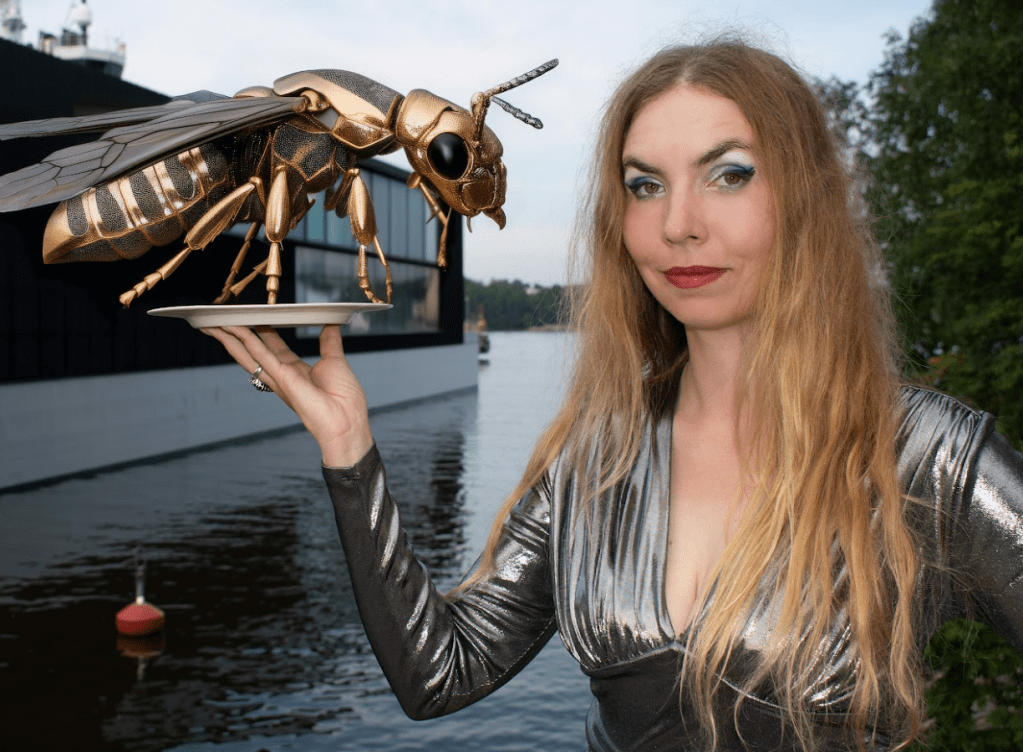
Diana Ringo doesn’t do anything halfway. The Finnish artist—classically trained pianist, film composer, BBC Radio 3 broadcast veteran, and director of three feature films—has spent years working in disciplines that demand precision, collaboration, and restraint. Her latest project demands none of these things.
CYBERWOLF, her debut vocal album is ten tracks of feral post-punk rage, darkwave claustrophobia, and experimental dissonance that she wrote, produced, and performed entirely alone. Born from insomnia and creative fury during a break from editing her third film, the album is a howl against digital alienation, a middle finger to emotional commodification, and—as she puts it—”a virus in the feed.“

Getting Ringo to sit still for an interview proved predictably difficult—between post-production on The Curse of Modigliani and the album rollout, she’s been operating in multiple time zones and creative registers simultaneously. But when we finally connected, she was characteristically unfiltered: sharp, self-aware, and uninterested in smoothing out the rough edges. We talked about why she chose Russian and English as her lyrical languages, what it means to name the digital wolf that’s eating us alive, and whether real love can survive in an era of holograms.
Hi Diana, thanks for taking the time to talk with me — I know you’ve been very busy lately. You started out as a classically trained pianist, you composed film soundtracks, your work was broadcast on BBC Radio 3, and eventually you became a film director. In other words, you moved in a sphere where instrumental music and academic discipline were your artistic language. And then — CYBERWOLF: vocals, post-punk, aggression, political cynicism, tracks born out of insomnia. Was there a moment when you realized that instrumental music could no longer contain what you needed to express? Or was it more like an explosion that had been years in the making?
It wasn’t one single moment — more like pressure building over years. Instrumental music gave me an incredible palette, but eventually I realized I had words I needed to put to music and CYBERWOLF demanded a human voice. Towards the end of post-production on my third film The Curse of Modigliani, my first English-language feature, I suddenly felt the urge to start a side project — to recharge my energy in order to avoid creative burnout. Film editing can’t be rushed, and stepping away for a couple of months gives you new clarity. I avoided singing for years, but something shifted when I started writing lyrics I truly cared about — lyrics I could feel in my bones. Suddenly I found the voice which was hidden for so long. The album took just 2–3 months to make—a relatively quick process, yet one in which I grew a lot in both songwriting and production. CYBERWOLF is a howl against alienation in our non-stop connected world — an album about broken love and illusions, about the machinery of violence, and about clawing back something human in a system that feeds on conformity.
You once said that CYBERWOLF is a mirror of the feed you scroll through at three in the morning. But Indie Boulevard exists inside that same ecosystem: we write reviews that themselves become part of the feed, part of the noise. How do you feel about the fact that your music — your own “cry into the void,” as you’ve called it — inevitably becomes content, swallowed up by the very digital wolf you’re describing? Do you ever feel that any act of resistance online is doomed to be commodified?
I’m very aware of that paradox. You howl into the void, and the void chews you up and spits you out as a hashtag. But the fact that art gets commodified online doesn’t mean you stop making it. The emergence of Suno and other AI music generators only serves to depict how generic many music compositions are, when autotuned vocal “perfection” can be replicated with a click, it’s worthless— so today only music with personality, that breathes with real fire can possibly have any meaning. I see CYBERWOLF as a virus in the feed — a shard of something human dropped into the cybersystem that wants all the rough parts smoothed out. I’m not chasing numbers or meaningless hype — I’m making music for eternity.
“Happy Mealz” — your debut single — is, as you put it, “a post-punk synth requiem for the emotionally extinct,” a satire of prefab happiness. But there’s something almost provocatively brutal about choosing that track as the world’s first introduction to CYBERWOLF. Most artists open with something more accessible, more “safe.” You, on the other hand, go straight for the jugular — attacking the very idea that happiness can be packaged and sold. Why “Happy Mealz” as the starting point?
Because it’s not safe. It’s nasty, it’s angry. It’s the opposite of what people expect from a debut. I didn’t want to ease listeners in — I wanted to show them immediately what kind of territory we’re entering. If you can’t handle Happy Mealz, you won’t handle the rest of CYBERWOLF. It’s my manifesto: the prefab happiness, the fake smiles, the “emotional extinction” we’re living through. Happy Mealz is me saying: “This is the real temperature of the room, be careful — you might just get burnt.”
Were you trying to push away a certain kind of audience from the outset — or test who was truly ready to follow you further down the path?
Not pushing away — filtering. There’s a difference. I’d rather be too much than wallpaper. I want to reach the ones who are awake enough to want more. I respect audiences too much to lure them in with something “easy.” It’s definitely a middle finger to anyone who thinks women should either be looking pretty and singing pretty songs or shut up. I’m not trying to be liked — I’m making art. As an alternative artist, I have the privilege of releasing the kind of music I want to hear — not the kind big corporations and lazy listeners demand. I don’t want everyone — I want the ones who haven’t lost the ability to think.
Your album moves between Russian and English. You’ve said Russian gives you a wider poetic range, while English offers a minimalist punch and bluntness. But in 2025, Russian has become politicized — a trigger, a battlefield. What does it mean to you to sing in Russian on a post-punk album called CYBERWOLF? Do you feel a sense of responsibility in making that choice — or is language, for you, just an instrument free of context?
I wasn’t really exposed to Russian pop-culture when growing up — I had to discover it later, which only deepened my fascination. Many of my friends were exiled from Russia for opposing the war or fled Ukraine under bombardment, and with all of them, I speak Russian. To demand that Russian-language art be reduced to propaganda or erased altogether is absurd — censorship, from any side, only serves dictatorships. Russia now bans Western media, communication services, blocks YouTube, and makes it impossible for me to share my music or films there. The war machine wants the people to be isolated, helpless and stuck in a bubble of non-stop propaganda. At times it feels like we’re on the edge of World War III. That’s terrifying — but it’s also when art can become rebellion and a source of comfort. I’m Finnish, I never lived in Russia, but through my mother I am grateful to know the language. Of course, I want to keep exploring different languages in my art as each language has its own distinct colors, I am interested in singing in Finnish and German as well. I’m also drawn to the sound of French and Italian, but unfortunately, I don’t speak them—yet.
On “Dislike,” you described the track as “a rap exorcism, a middle finger to vacuous online haters.” But an exorcism suggests casting out something external, a demon that doesn’t belong to you. What if the haters aren’t an outside threat at all, but rather a symptom of the same digital wolf that lives inside each of us?
Exactly — the cyberwolf isn’t just “out there,” it’s inside us. That’s what makes Dislike uncomfortable. Haters online aren’t some alien force; they’re mirrors of the same digital toxicity we all carry in smaller doses. They’re what happens when people give in to that wolf completely. When I think about haters, what strikes me is how hollow their lives must feel. So many of them are lying to themselves — stuck in jobs they hate, with partners they don’t love, scrolling endlessly while starving for validation. And the only way they know how to feed that hunger is by spitting venom. It’s not just teenagers — it’s adults, professionals, people who should know better. That’s what makes it tragic. But I don’t waste energy fighting them, I’m not interested in proving myself to strangers. If I have emotions to spare, I’d rather pour them into my art, where they can live as music instead of bile. Dislike is me holding up a mirror: “This is what you’ve reduced yourself to, and it doesn’t look good.” Writing it as a rap track was liberating — it’s my first attempt at rap, and it worked because the lyrics came straight from the gut. I wasn’t pretending to be anyone else; I was exorcising the wolf by spitting it out.
You’re also a filmmaker — you’ve directed films, controlled visual language, narrative, actors, the whole machinery of cinema. Film is a collective art form: you work with teams, producers, budgets, endless compromises. And suddenly CYBERWOLF is an album you wrote, produced, and performed entirely yourself. That’s a shift from collective control to total autonomy, from the visual to the sonic, from cinema to music. What changed for you? Did you simply grow tired of having to constantly explain your vision to other people, and want to do everything on your own? Or did cinema just feel too slow, too indirect a medium for what you needed to say?
Cinema is a beautiful and complicated synthesis of arts, the process of making it is slow and unpredictable, everything depends on weather, actors’ health, budgets, etc. With CYBERWOLF I wanted to be completely feral. To build a new world in a single track, and ten worlds in an album. Every track became its own strange experiment; I didn’t want to limit myself to one genre or sound, I’ve always been driven by the desire to try new things, and this creative surge took so long that I found myself almost overwhelmed by all kinds of inspirations. I love film — but I needed a medium where expression could be instant.
“Hologram of Warmth” — the title itself is a paradox. A hologram is an illusion, a projection, an image that looks real but has no substance. Warmth, on the other hand, is the most tangible of sensations, something we feel in our bodies. You sing about a love that has been lost — or maybe one that never existed at all. In an era where so many relationships unfold through screens, texts, and likes, do you think “real” love is even possible anymore? Or are we doomed to always fall for holograms?
Real love is possible — but it’s harder to recognize, and it rarely arrives in the packaging we’re trained to expect. Hologram of Warmth (Russian: Gologramma tepla) is about the warmth you reach for, and your hand passes straight through. A hologram can trick your eyes, but not your skin. Love isn’t dead — but we need to fight harder to feel it in the flesh, and sometimes a single touch can mean more than a thousand embraces. Love requires presence. The paradox at the heart of Hologram of Warmth is that tension: we crave something alive, yet so often we’re left with only memories. A hologram looks real, but when you reach for it, there’s nothing there — and many people today have known that experience in relationships, the sense of closeness without substance, love without love.
How do you picture the ideal CYBERWOLF listener? What do you imagine they’re doing while they’re playing your album?
The ideal CYBERWOLF listener is a rebel with a cause, even if they haven’t figured out what that cause is yet. They’re probably caught between worlds — old school and new, analog and digital. They’re the kind of person who can’t quite let go of what’s real, but they’re also fascinated by what’s fake. They might be dancing in a dark room, or maybe they’re just sitting, working, waiting for the next shift in the matrix. Either way, like me, they’re searching for meaning in the digital cobwebs.
Finally — you’ve written that if there’s any hope in CYBERWOLF, it lies in “calling things by their real names and spitting them out.” But naming is always an act of fixation. You give names to the digital wolf, to falling stars, to a hologram of warmth — and by putting them into language, you make them real, you anchor them. Does it ever worry you that in naming these things, you might actually be giving them even more power over you?
The danger of silence is always greater than the danger of naming. The demon you refuse to name grows stronger in the dark. By naming it, you drag it into the light, pin it down, and start to dissect it. That’s what I did with Satanizer. On the surface, it’s a joke: sanitizer turned satanic. But the metaphor is not just about hygiene theater — it’s about how people try to “cleanse” their lives with things that are actually poison. They embrace habits, ideologies, substances, or even relationships that destroy them, all in the name of self-improvement. The “cleanser” is really the toxin. When I give names to these things — the cyberwolf, falling stars, holograms of warmth — I’m not surrendering. I’m cutting them open, forcing them to show their insides. Naming is the first cut of the knife. And once something has a name, you can fight it, laugh at it, or spit it out.
*Promoted content. All information provided is prepared in accordance with editorial standards and is intended to offer useful insights for readers.



 Indie Boulevard Magazine