
Cinema exists at the border between illusion and reality, and the best films know how to convey the unbearable through visual metaphor—in such a way that the viewer, regardless of their background, grasps the essence. Theater operates by the same laws. Both forms transform image into information, mirage into impulse for action.
Lux Griffith, the stage name of Jordane Sagot, builds his forthcoming EP People Are People To People precisely on this foundation. He is a multidisciplinary artist, balancing music, theater, writing, and other creative pursuits, with years of experience on theatrical stages where he honed the art of conveying ideas through vivid imagery. This EP essentially becomes an attempt to translate that theatrical experience into the language of pop music—with all the attendant risks and possibilities.

photo by PIINOVA
The origin of the name Lux Griffith reads like a surrealist screenplay where the unconscious dictates the terms of reality. Jordane Sagot—his birth name—dreamed of a daughter named Lux, a phantom child whose imagined energy became a psychological anchor in moments of crisis. One day, desperately needing fire to light a cigarette, the artist found in a random drawer a matchbox with the inscription “LUX”—the coincidence read as a cosmic sign. The surname Griffith, borrowed from the ambitious demon in the manga Berserk: the name of a man-monster building an army around his own vision. Sagot appropriates this energy, declaring kinship with creatures that society places beyond the perimeter of normality.
Conceptually, Griffith works on two levels simultaneously. The first is cinematic: through visual illusions and metaphors, a narrative is constructed where important moments are highlighted like key scenes in a film. The second is psychological: self-rejection, social masks, childhood traumas, destroyed connections. But Griffith balances between these extremes, offering material capable of triggering real change in the listener—or at least pushing them toward uncomfortable questions.
The four tracks on the EP create a deceptive impression of modesty. Griffith unfolds themes with elegance, selecting for each song an individual rhythm and particular interpretation of the pop format. And of course, the cover art by Babayaga Pepperland develops this aesthetic of damage as decoration. Flowers here are markers of trauma that grow through the psyche with the persistence of weeds. Where society sees defects requiring correction, Griffith discovers strange beauty.
“Bruised Knees” opens the EP with an ambivalent message. The lyricism of the exposition is constantly interrupted by an accelerating tempo, creating tension between softness and insistence. Griffith‘s vocals here function as a guide through an urban labyrinth—full of energy, they paint a portrait of how people move in physical proximity but emotional isolation.
The production relies on the minimalist approach of chamber pop from the early 2010s—the era of Perfume Genius and Sufjan Stevens, when artists sought ways to package personal pain in elegant arrangements. But where Stevens chose baroque excess and Perfume Genius radical frankness, Griffith maintains theatrical distance. His vocals sound like the voice of an actor playing himself—close enough for emotion to register, but distant enough to preserve dignity.
“Batshit Crazy” sharply shifts the temperature. Here defiance and self-irony dominate—Griffith‘s vocals weave mockery, audacity, and tenderness into a single intonation. The sonic palette reflects this duality. Guitar parts cut into the mix with childlike directness. Bright, almost celebratory chords sit alongside muffled drums, as if filtered through cotton—a sonic metaphor for self-deception.
“Mood Swing” is the riskiest thing on the EP. From the first seconds, the song evokes joyful anticipation: guitars and drums intertwine into a melody that chases away melancholy. But Griffith manages to dampen this brightness, running it through a filter of Western melancholy. Perhaps this is one of the most commercial and catchy songs on the EP.
The title track “People Are People To People” closes the EP, the most vintage, most retro track with elements of light psychedelia. Griffith applies the cinematic technique of an establishing shot—a panoramic view of a city where thousands of trajectories create an illusion of connection amid complete absence of contact. The vocals are processed so they sound simultaneously close and infinitely distant—a technical move that becomes a metaphor for emotional distance. The track blends longing, pain, and fragile hope for change. Even if it takes years.
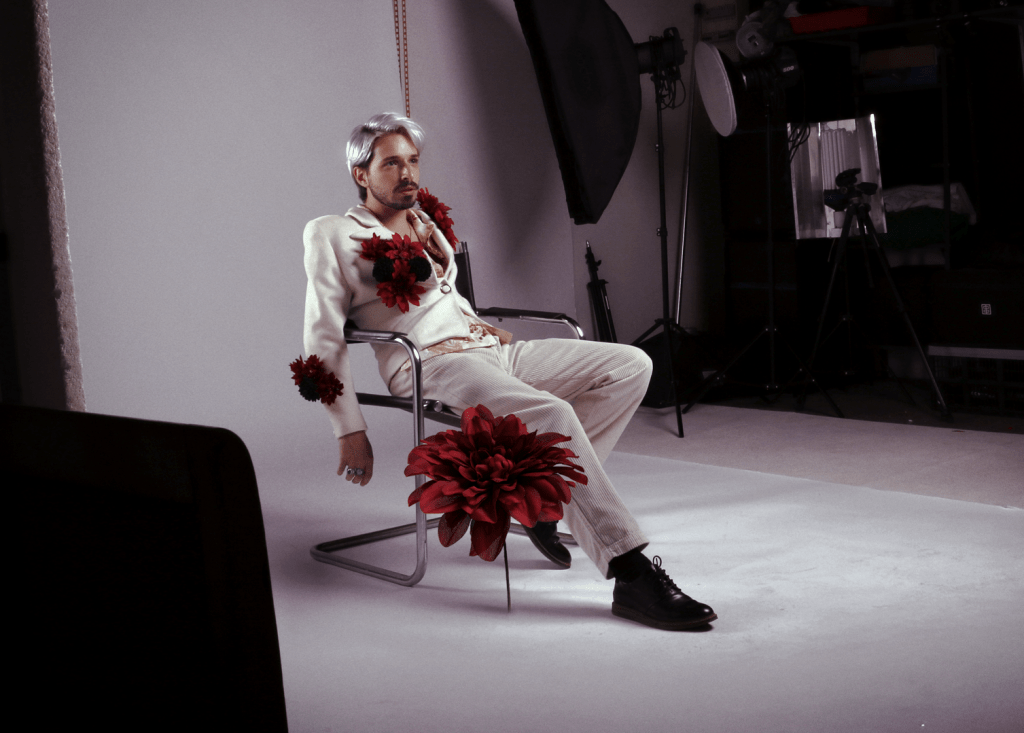
photo by PIINOVA
The EP’s dramaturgy betrays Griffith‘s theatrical background: exposition (“Bruised Knees”), conflict (“Batshit Crazy”), crisis (“Mood Swing”), and a resolution that’s no resolution at all (“People Are People To People”). This is the structure of a classical play, compressed into four tracks and translated into the language of chamber indie pop.
Griffith has worked the material so that the listener discovers themselves in the tracks—their own problems, their own pain, their own questions. His vocals work as an unobtrusive guide: they suggest direction but leave decisions to the listener.
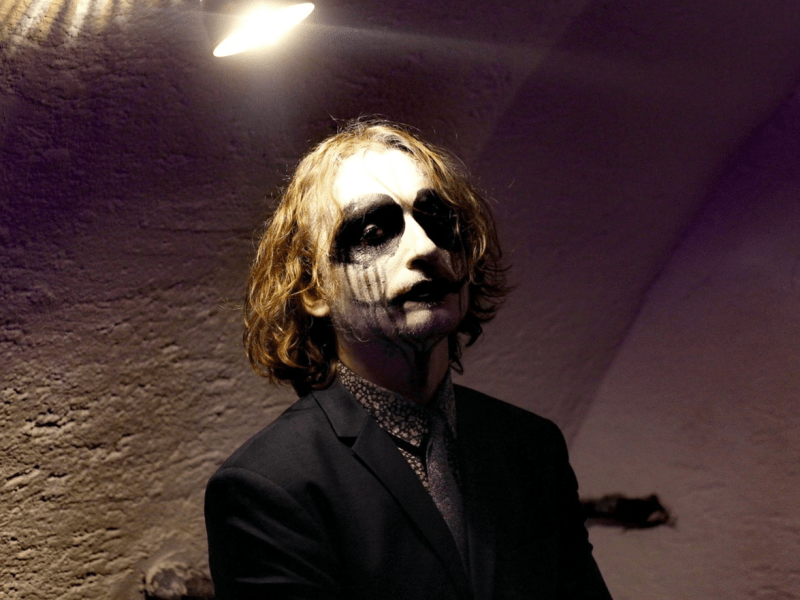
Right now, contemporary pop music is dominated by two extremes: unbridled optimism and demonstrative depression. Griffith offers a third path—honesty without narcissism, vulnerability without exhibitionism. The influence of David Bowie—the artist’s declared idol—can be traced in the very approach to the project: Griffith understands music as total art, where sound, visuals, performance, and narrative interweave into a unified statement. The planned music videos, conceived as experiments with genre cinema, promise to expand the project’s mythology. The artist speaks openly about the desire to create monsters and become them, using visual effects and makeup. This transformative passion—to slip between identities, to try on foreign skins—connects Griffith with the tradition of glam rock and art pop, where performativity becomes a form of truth.
My main grain of salt, if it can be called that, lies in the brevity of the format itself. By the final track, the listener is only beginning to fully immerse themselves in the created world when it already ends. The artist himself calls this work “test notebooks” for a future records, which explains the sense of incompleteness. However, this incompleteness can also be read as an artistic device: the EP functions as a prologue, as a promise of a more complex narrative that will unfold later.
Well then, the French indie scene gets a figure capable of competing with English-language counterparts—an artist for whom pop music becomes the medium of personal mythology, where childhood traumas, monsters from horror films, and social alienation fuse into a cohesive artistic vision.
For now, Griffith offers these eleven minutes as an introduction to his own universe—a place where pop melodies grow through layers of psychological complexity, where monsters turn out kinder than people, and flowers on scars bloom year-round. People Are People To People comes out November 7, and that’s a date worth marking on the calendar.
*Promoted content. All information provided is prepared in accordance with editorial standards and is intended to offer useful insights for readers.








 Indie Boulevard Magazine