
Twenty years old—an age when identity becomes a battlefield. When every decision feels final, emotions—well, they’re nothing short of apocalyptic. Marina Laduda understands this better than most of her peers making music. Born in California to a family of Latin American and Slovak roots, Laduda has spent recent years wandering—first the Czech Republic, where she went through the meat grinder of local music television shows X Factor and Superstar, then Italy, where the Neapolitan streets left their mark on her sound.
This biography could have become a simple story of self-discovery if Laduda played by the rules. She ignores them. Hot Mess—her debut album—exists in a conflict zone between genres, between languages, between who you’re supposed to be and who you want to become. Here, aggressive pop collides with jazz improvisations, electronics dissolve into acoustic ballads, and the lyrics switch between English, Spanish, Slovak—it’s just a proposal, and self-acceptance is the only currency.
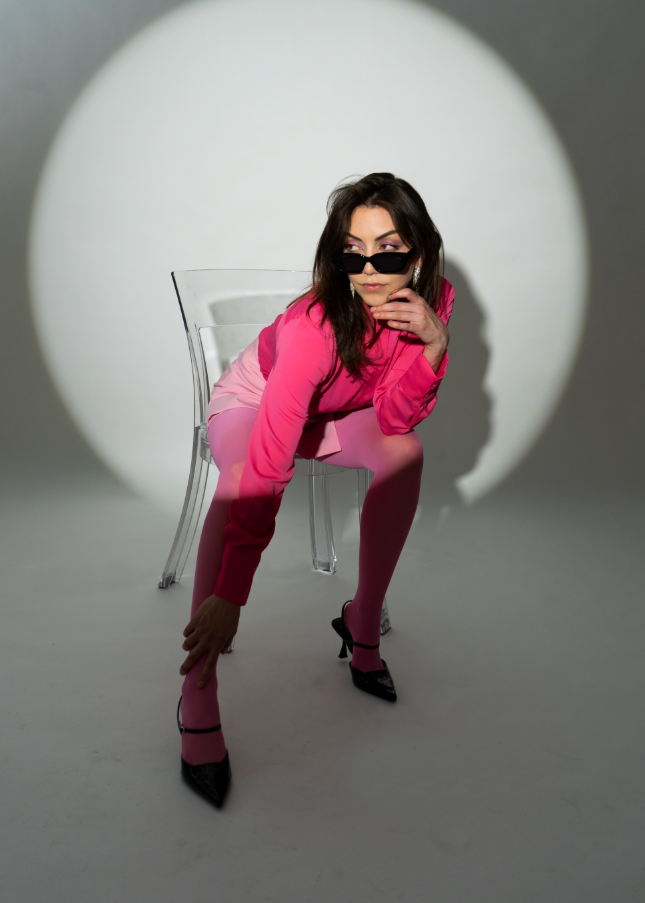
The nine tracks of Hot Mess work as an emotional map of youth’s internal catastrophes: love, rage, ego, loss. Laduda has built a conceptual structure, and though the title contains the word “mess”—well, it all seems quite “in order” to me. The album opens with the track Take Two, and the first seconds immediately explain the intentions. A loud electronic rhythm crashes into the space, keyboards sway with an almost nervous energy, and Laduda‘s voice bursts in like an adrenaline explosion. Her vocals here are a weapon, sharpened for attack. The lyrics are quite provocative; she sings loudly about what is often silenced. This defiance of rules flows through the singer’s music. But if you look deeper, behind the sharp and exposed phrases lies a profound meaning about rejection, humanity’s vices, pain, and greedy attempts to find true love.
Then the album takes a sharp turn to Soledad—a cozy pop ballad where passion gives way to vulnerability. Laduda‘s voice here is completely different: sensual, tender, almost pleading. The keyboards create an intimate space, enveloping the listener in soft waves of sound. It’s interesting how the track dissolves in moments when the acoustic pop sound reveals its Neapolitan roots—those very influences that Laduda absorbed while living in Italy.
I love the wordplay in the title Soledad. This word reflects hope, sun, and loneliness, loss in one moment. Undoubtedly, the very lyrical approach in the song texts of Hot Mess is an integral part of the album.
The next track, Colors, is a very light and summery pop-funk-electro track created for the warmest airwaves. This track sounds completely new for the release’s overall sound, and it reveals Marina Laduda as an artist capable of working in any genre if the song’s concept requires it. The lyrics reflect the joy of life, the diversity of colors as a metaphor for the fullness of life, feelings, and relationships. I like the light atmosphere of 2005 pop music, which only intensifies the sunny atmosphere.
I would like to highlight the track Marian Labuda, reflecting her Latinx and Slovak roots. The song is written in two languages, English and Slovak. Combined with the song’s title, this creates a very deep semantic context. This track reflects the singer’s roots and influences on her, and her diverse cool influences, the various countries she has lived in, could well have influenced her and enriched her with different cultures. Therefore, the phrase “I’m not what you think… but that’s not my name!” shows how much Marina Laduda is not going to fit into limitations and frameworks. And she has gone far beyond even such a primary limitation as a name.

Undoubtedly an important track, Album of Scars, with amazing jazz sound, conveys a feeling of doubt and uncertainty. The magnificent lyrics emphasize this, leaving enormous space for reflection. Uncertainty is frightening and can seem boundless, like cosmic space.
However, Marina Laduda has prepared something absolutely stunning in the finale of Hot Mess. The track Home (away from home), which is also the central and main single in the release, fully shows her sound and sonic identity. The mix of genres, styles, both in music and vocals, demonstrates the refined diversity of Marina Laduda. Her voice spans several octaves, feelings, energy, and literally descends through stunning jazz melismas from soft pop vocals to a low rock tone. You cannot predict how the next part of the track will sound, in the next second. An absolutely amazing mix of styles that captivates and secures Marina Laduda‘s place as an avant-garde singer on the pop scene.
The final track, Aeternum, concludes on a dark commercial pop tone. The passionate melody merges with Marina Laduda‘s slow vocals, which dissolve into a hazy dark pop sound. Elements of classical vocals completely change the album’s familiar sound, adding vintage gothicism, while the voices and ambient environment return you from dreams to reality. Undoubtedly, Aeternum is one of the most touching and complex songs on Hot Mess. The lyrics are philosophical and deep, covering themes of the cosmos and infinity. I won’t hesitate to say that this is my favorite track on the album.
Verdict
Hot Mess is an album that rebuilds the boundaries of what pop music can be when an artist refuses to play it safe. This debut is simultaneously a statement of intent and an act of self-liberation. There’s no attempt to please everyone, and I don’t think Marina has any desire to fit into radio or playlist format—she’s already been through all that. Instead—there’s honesty that takes your breath away, and experiments that take risks.
The themes on the album are quite universal, but Laduda‘s approach makes them fresh. She takes the banal emotions of twenty-something life and transforms them into art that transcends age. On a deeper level—this is an album about cultural identity, about how personality is formed when you live between worlds, languages, traditions. Laduda uses her Latin American, Slovak, European, Italian roots as a palette, and the result is a sound that belongs everywhere and, as it were, nowhere at the same time.
Musically, Hot Mess is ambitious almost to the point of recklessness. Laduda throws herself between genres with an ease that could seem chaotic in the hands of a less confident artist. But here, this unpredictability becomes a strength. Aggressive electro-pop neighbors jazz improvisations, ballads transition into funk, dark pop merges with elements of classical music. This is an album that refuses to be one thing because its author refuses to be one person.
If Laduda continues down this path—uncompromising, bold, free—she will become one of the most interesting voices of her generation. For now, this album stands as proof that the best pop music is born where the artist refuses fear and creates exactly what they must create. Without compromise. Simply honest.
*This review was made possible by SubmitHub








 Indie Boulevard Magazine