
Cold wave in 2025 exists in a strange temporal paradox. A genre born in the late seventies as a reaction to overheated punk and the excesses of prog-rock, it has today itself become an object of nostalgia and imitation. Young bands across Europe reproduce the sonic characteristics of Joy Division and Bauhaus with archaeological precision, but rarely ask themselves why they’re doing it. The result is predictable: endless variations on Peter Hook bass lines, reverberating guitars, and baritone vocals devoid of any individual statement.
Romain Le Lavandier and Maxence Thulievre from Angers, working under the name Lunar Lock, started precisely there. Their early EPs Holy Quarrel (2022) and The Dream of Sad City (2023) followed established genre protocols so obediently that the local scene dubbed them “the sad band from Angers.” Their new debut album Stay Low For A Reason documents an attempt to escape this trap, and while the result is uneven, the attempt itself deserves close attention.
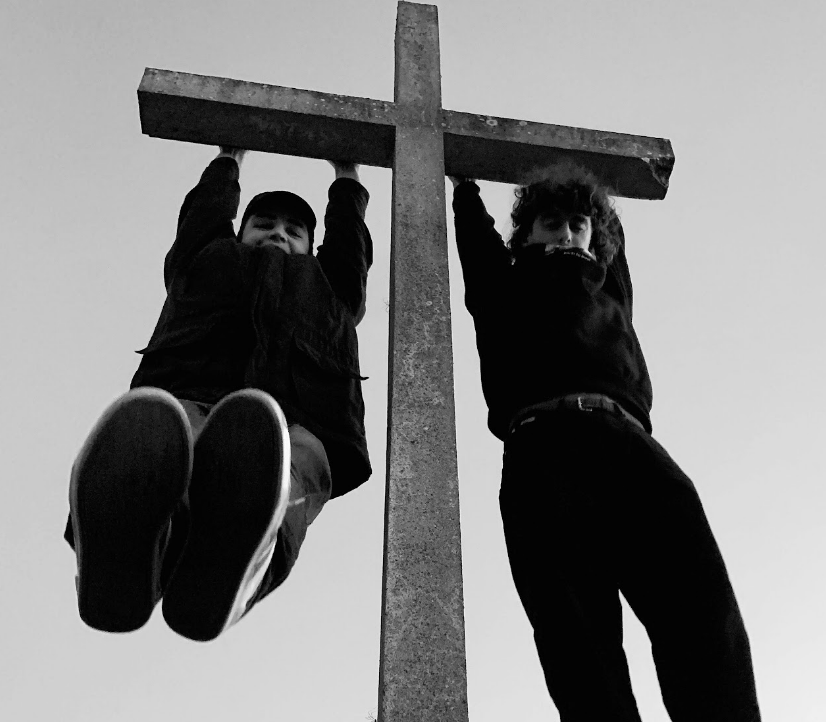
photo by Julia Ghiloni
Three years working on the material—a timespan that now seems geological—allowed the duo to step away from direct copying and begin asking questions about what they actually need from this music. Le Lavandier explains the shift directly in interviews: they grew tired of the gothic image they never consciously chose. The desire to move toward “a more mature sound” may seem like standard young band rhetoric, but on Stay Low For A Reason this desire materializes in concrete compositional decisions.
The album opens with Juno, where Le Lavandier’s synthesizer parts avoid obvious drama. Instead of the mounting tension characteristic of classic cold wave, the track works with horizontal movement—melodic lines repeat with minimal variations, creating a state of suspended animation. The vocal processing places the voice in some intermediate space between source and listener, an effect that simultaneously distances and draws closer. Lunar Lock consciously rejects the emotional straightforwardness of early post-punk in favor of a more complex affective geography.
Blind At Heart intensifies this shift through vocal delivery. Le Lavandier sounds warmer here than on previous releases, his voice acquiring a quality that could be described as intimacy without confessionalism. The instrumental palette of Stay Low For A Reason is built around limitation. Thulievre’s bass is the only electric instrument on the recording. Le Lavandier synthesizes everything else: guitar textures, violin lines, keyboard landscapes. This decision could have led to sonic monotony, but instead forced the duo to think in terms of timbral architecture.
The middle section of the album—My Angel Is Gone, Us Against The World, If It Ever Was?, —represents an attempt to integrate hooks into a dream-pop structure. My Angel Is Gone adds a groove element through Thulievre’s bass line, which here works with a syncopated pattern borrowing rhythmic mobility from funk. This is a risk: funk elements in the context of cold wave can sound like stylistic schizophrenia. Lunar Lock avoid this trap through overall sound design.
I Need To Find Some Time introduces rhythmic elements that the band describes as “almost march-like.” The term is accurate: the percussion here works with the regularity and accentuation characteristic of military marches, but the tempo is slowed, the aggression muted. The vocals in this track recede into the background, becoming part of the textural layer, while the rhythmic structure comes to the foreground.
No Regrets returns to slower tempos and contemplative atmosphere. But Soldier Of Crimes stands out for its vocal intensity. Le Lavandier here uses range and power that he kept in reserve throughout most of the album. The voice cuts through the mix while maintaining timbral softness—a technically complex task requiring breath control and understanding of how voice interacts with processing. The result creates a dramatic moment without sliding into theatricality.
The final track 2027 functions as a deliberate return to a darker aesthetic. The keyboards here are denser, the bass heavier, the overall atmosphere approaching the gothic rock the band tried to distance itself from. The track’s title points to a futuristic perspective, but the music looks back to the genre’s past. This duality is a conscious compositional choice: the album concludes with a reminder of its roots, but Le Lavandier’s vocal line carries a different quality—an optimism that prevents complete immersion in darkness.

photo by Julia Ghiloni
The lyrical content of Stay Low For A Reason remains intentionally abstract. There’s talk of “the evolution of the world,” “memory,” “authenticity,” and “refusing to follow the crowd”—themes broad enough to accommodate multiple interpretations. This strategy follows the post-punk tradition where specificity often yields to suggestion and atmosphere. However, this approach has a flip side: overly general formulations risk becoming empty vessels into which the listener projects their own meanings without resistance from the text.
Yet the album has a structural problem that three years of work on the material exacerbated rather than solved. The middle section—roughly from the fourth to seventh tracks—demonstrates a certain homogeneity that, during passive listening, transforms the songs into an undifferentiated sonic stream. My Angel Is Gone, Us Against The World, If It Ever Was?, and No Regrets work with similar tempos, comparable harmonic structures, and identical sound design. Each track, taken separately, is competently executed, but together they create the impression of one long piece. Lunar Lock command their aesthetic so confidently that sometimes they rely on it too heavily, allowing formula to replace invention.
The album’s production, entirely self-managed, demonstrates technical competence and understanding of spatial sound engineering. The mix gives each instrument its own place, the use of reverb creates depth without blurring details, the drums are pristine, dynamic range is preserved without compressive flattening, and certain DIY elements fit precisely. For self-production this is a high level, especially considering the band members’ youth.
The question of why young musicians born decades after cold wave’s heyday would turn to this aesthetic remains open. Simple answers—nostalgia, escapism, romanticization of the past—explain the genre’s popularity among listeners but say little about creators’ motivations. Lunar Lock offer a more interesting answer through their approach: they use cold wave as a toolkit, then ask what else can be done with these tools. The result still resembles an experiment more than a completed statement, but the very fact of the experiment matters.
Stay Low For A Reason documents a young band in the process of finding their own voice within a genre with established rules. A debut album is rarely perfect—its function is more to indicate direction than present a finished result. Lunar Lock succeed at this task: they demonstrate understanding of tradition, technical competence, and a desire to evolve beyond direct copying.
Whether this approach remains viable long-term, time will tell. The music industry rewards visibility and activity; the choice to stay “low” requires confidence in the value of the work itself. Lunar Lock demonstrate such confidence on Stay Low For A Reason, and while the result is far from perfect, it points to a band that knows what it wants and is willing to take the time to achieve it.
*Promoted content. All information provided is prepared in accordance with editorial standards and is intended to offer useful insights for readers.









 Indie Boulevard Magazine