
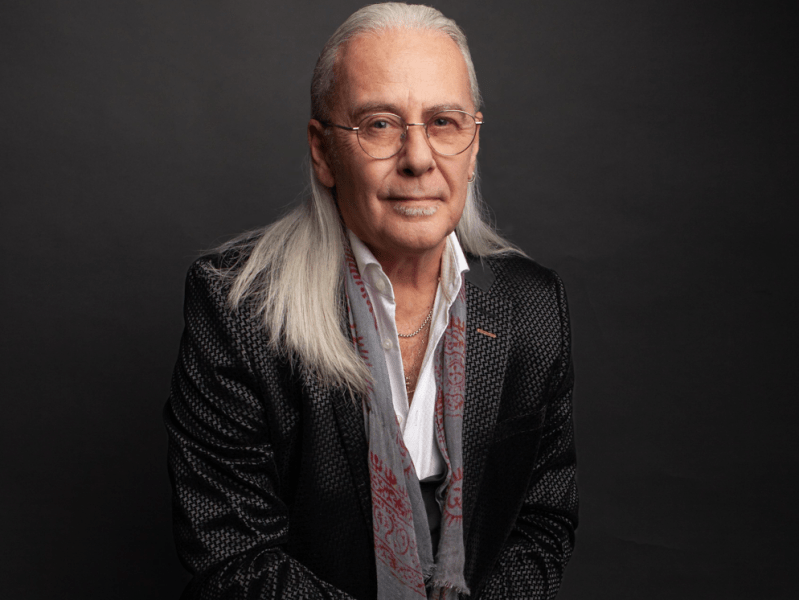
Today we have something different! An interview with artist and musician Piergiorgio Corallo from the Italian region of Puglia, who has just released his debut album In via di sviluppo. And you know what? Getting this person to talk was quite the quest. A visual artist who works in solitude, doesn’t do social media, calls himself a “solitary wolf” basically, a true recluse. But we managed, and it was worth it.
Piergiorgio is doing something really interesting. He takes alternative rock, blends it with laconic electronics, and constructs from it a post-apocalyptic soundtrack of everyday life. Picture Southern Italy – olive groves, Baroque churches, the Adriatic Sea, and now add to that the largest steel plant in Europe, smoke over beaches, and digital alienation. That’s what In via di sviluppo is an album about a region, a country, and a person stuck “between moments of great brilliance and profound shadows.” And today we’ll talk about how visual art transforms into sound, why the voice is just another canvas, and what Mediterranean tranquility and the relentless engine of progress have in common.
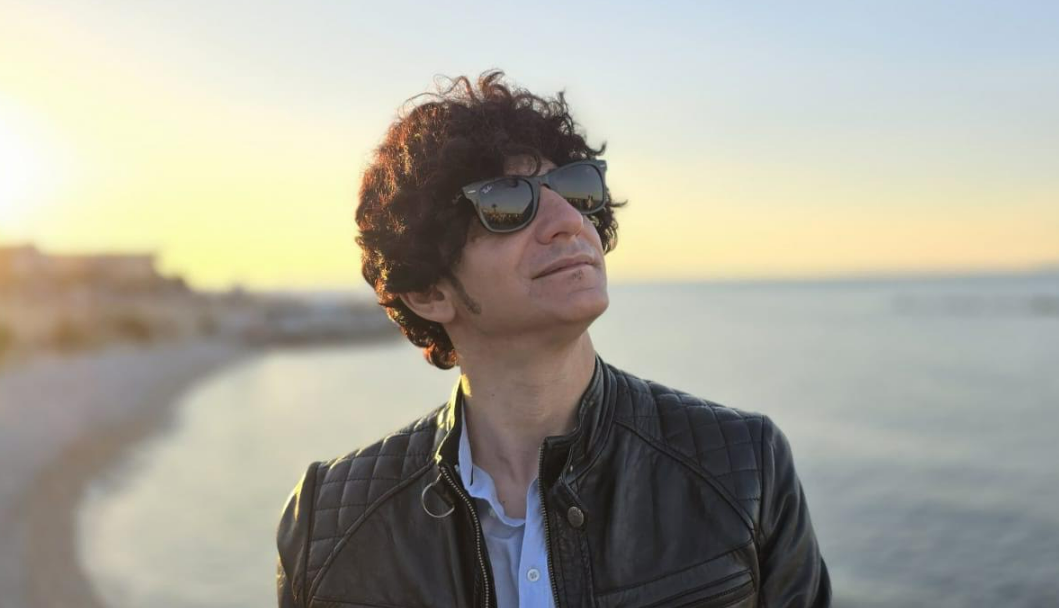
Hello Piergiorgio! Thank you for taking the time to talk about yourself and your work. There’s something deeply symbolic in how you chose the album title “In via di sviluppo”. This phrase is usually applied to countries, economies, stuck in an eternal state of “almost, but not quite.” Puglia, the south of Italy in general, has existed for decades in this suspension between tradition and modernity, between oblivion and renaissance. And in this incompleteness there is its own aesthetic, its own punk ethos. What guided you in choosing the name for your debut album “In via di sviluppo”?
Thank you for the opportunity. The album title can be read from several angles. The first is an inner one: in via di sviluppo is where both I and the listeners stand. The record speaks about the contemporary human being, caught in a constant conflict, unable to reach any definitive form of self-realisation. The second perspective is strictly musical. I come from the applied arts, and I’m not used to choosing one technique over another; in that sense, what is still “in development” is the musical language itself, the genre I might decide to fully commit to, because I’m equally drawn to dark rock and to electronic music. So I remain, to some extent, in a limbo—like my region, like our time. I deeply feel this instability, and also the contradiction of our territory, suspended between moments of great brilliance and profound shadows.
Some musicians work in solitude, while others strive for recordings in noisy studios and collaborations. You came from visual art, where the artist more often works alone in the studio. What does your music creation process look like – is it solitude or dialogue?
Mostly solitude. For this record I brought together friends from the various musical projects I’ve been part of over the years, but at its core the writing and the underlying idea remain a solitary process for me. It’s how I think, how I find an expressive form, how I feel at ease wherever I am, layering one element after another. I’m a solitary wolf.
Mark Rothko once said “The people who weep before my pictures are having the same religious experience I had when I painted them.” You spent years working with form, subtraction, material in visual art – essentially creating a language without words. Now you’ve added music to this system, which, no matter how you look at it, is a more direct, more emotionally medium. In your guitar parts, the same architectural approach can be heard – as if you’re carving out spaces in sound. What has changed in your expressive capabilities with the transition from canvas to sound?
I needed to speak, to physically feel the sound. I realised I knew my own voice very little, and in this album I laid it out, sampled it in places, stretched it, distorted it—like clay—pushing it to excess. I’ve always played acoustic guitar, and I see songs as objects, as structures; I really perceive their architecture. The final sound is a kind of chemical composition that forms slowly, through emptiness and density, much like physical, material brushstrokes layering on a canvas. I write and compose the music together with the words, but I start from the ground up, from the riffs, and build everything above them. With music, I’ve almost discovered the power of hearing as an artistic medium capable of reaching people directly.
The laconic electronic textures that you weave into alternative rock – this is an interesting choice, because electronics are usually associated with the future, with cold precision, with cities that work like machines. But you use it in the context of Puglia, a region of olive groves, Baroque churches, washed by the Adriatic and Ionian seas. I hear in your music this collision – the Mediterranean tranquility of nature and the relentless engine of progress with digital alienation. How did you manage to convey this duality in In via di sviluppo, and is there a message between the lines that you left for the attentive listener?
I’m deeply connected to the South and to Puglia, and this is the vaguely post-atomic landscape I bring into the album cover. A region that is beautiful and green, shaped by tourism, yet hosting the largest steel plant in Europe; the sea and the swimmers, with smoke hanging over their heads; Roman aqueduct columns and the remains of Magna Graecia standing opposite the blast furnaces. No city, really—except perhaps Berlin, or certain corners of the marshy London that was later reclaimed—but very few places are as evocative and as “naturally” punk as Taranto. That monster marks the album and stands for a promised development that failed to arrive, for the collapse of the modern project. The cybernetic boy who no longer knows how to touch or feel, because he has beats instead of real heartbeats, is the darkest vision of a form of development that can become very cold, and above all very cruel toward the social classes that will never truly be able to benefit from it—just as the first personal computers were for my generation, just as the great illusion of prosperity represented by the Ilva steelworks in Taranto.
Your voice in the songs – it’s something truly unique. In rock, the voice often has to be powerful, a dominating instrument. But you are a visual artist, for you vocals are another material, the same as guitar or canvas. How do you think about your voice as an instrument?
The voice is an instrument that must adapt to expressive necessity, like any colour. You can shade it, blend it, layer it, with one truly essential rule: respecting the style you are working within. I have a deep respect for rock and punk, both as musical languages and as vehicles for positive cultural and social change; when I feel that the voice is not perfectly aligned, I tune it as much as possible to the style. Some rock voices are so iconic that they stand on their own; everyone else, I think, has to find a personal approach to avoid slipping into mere revival, to experiment—at least to try—while maintaining the highest level of respect.
You describe your album as a post-apocalyptic view of everyday life. But you work from Molfetta, a place that for most of the world is on the periphery, in a zone that is commonly called “developing.” How does the album “In via di sviluppo” convey this everyday life that you see as post-apocalyptic?
Molfetta is the city where I’ve been living for the past few years. It’s beautiful: the cathedral facing the sea, fishermen standing opposite it. I love the colours, the green window frames of the houses, a light that always feels very clean, so much white, so many trees, traditions that seem outside of time. Precisely this blatant outward beauty clashes with my everyday difficulties, which are the same as everyone else’s. In the album, the city becomes a place where inner states are projected, and I see cages, streets folding in on themselves, demons, smoke, as if after a war. The rough sounds, some FM effects, the ever-present drums, are meant to express a kind of anxiety. But it’s all in my head.
Previously, music was sold on physical media: tape, vinyl, cassettes, CDs. Now it’s files, streams. But you are an artist, you understand the value of a material object. A record in your hands is not the same as a weightless track on Spotif, different feelings, almost a ritual. Have you thought about the physical embodiment of the album?
Absolutely. I’m passionate about vinyl—both 33 and 45 rpm—and I’m building a small collection that I imagine as a kind of large rock playlist. Contemporary formats bring you closer to the audience, but they also consume the message and the experience much faster, which can sometimes make the connection more superficial. A CD version will be released, followed by a limited vinyl pressing, because that background crackle of the needle fits perfectly with the album’s sonic dynamics, which were conceived from the outset as those of a physical record.
You worked with photography, and in your approach to music there is something photographic, you capture moments, urban landscapes, memories. But photography stops time literally, while music can only evoke the feeling of a stopped moment. In your tracks, this attempt to create a sonic snapshot can be felt, where there is focus and blur, sharpness and background. How do you capture memory in sound?
In this album I made an attempt—only partially successful—to offer a real experience, closer to film than to digital photography. I tried to capture moments through honesty, and the sequence of tracks tells that story: first we vent, then we reflect, then we dream, then reality arrives, then we deceive ourselves again. I barely embellished anything; the sound is rough. I wanted you to feel the particles of polluted air, the smoke, the grain. What remains is the necessary compromise with the linear nature of sound, which cannot be stretched beyond a certain point.
A cinematic view of reality is a certain way of seeing, where every frame has meaning. You work with photography, your album is described through visual categories. Does cinema influence how you hear music?
Yes, because I’m the first to be unable to experience a song simply as entertainment or a pastime. I stay focused on the structure, I isolate each instrument in my mind and listen to how it merges with the others, as if I were standing behind the camera. The same thing happens with films: I lose that suspension of disbelief because I remain attentive to the technique, to the framing, to how a scene might have been constructed.
Social media has changed the way musicians exist in the world. Previously, there was distance between the artist and the listener, mystique. Now you’re expected to have stories, posts, direct communication. For a visual artist this can be natural – you’re used to showing works. But music has always been more intimate. How do you think about relationships with the audience in an era when it’s desirable for an artist to be “loud”?
Art is different from music: it sustains itself and doesn’t truly require media exposure, despite appearances—there are exhibitions, museums, collectives. Photography was what really opened this very intimate channel of communication between people. I don’t have social media; I struggle with it, but I’ll open myself to these platforms because I now see it as a form of gratitude toward those who chose to give me an opportunity. So I feel I should give something back in return—it’s the least I can do.
*Promoted content. All information provided is prepared in accordance with editorial standards and is intended to offer useful insights for readers.




 Indie Boulevard Magazine