
Jazz has long ceased to be simply a genre with a defined set of rules. Somewhere between the dissolution of the Miles Davis Quintet and the emergence of Kamasi Washington, a quiet schism occurred: some musicians retreated into academic virtuosity, others into endless experiments with form. illo.trio belongs to the second category, but their approach differs radically from most contemporary post-jazz projects. Instead of deliberate complexity, they chose simplicity that deceives the listener with its apparent accessibility.
“Wandering“ is ten tracks that function as chapters of a unified narrative, where instrumental music becomes a language capable of expressing what words have long lost the ability to describe. Over the course of a year, the trio played 70 concerts in Berlin, Barcelona, the Paris Conservatory, International Bucharest Jazz, and Golden Apricot 2025 in Armenia. Such a concert schedule explains much: the “Wandering” turned out essentially the same way.
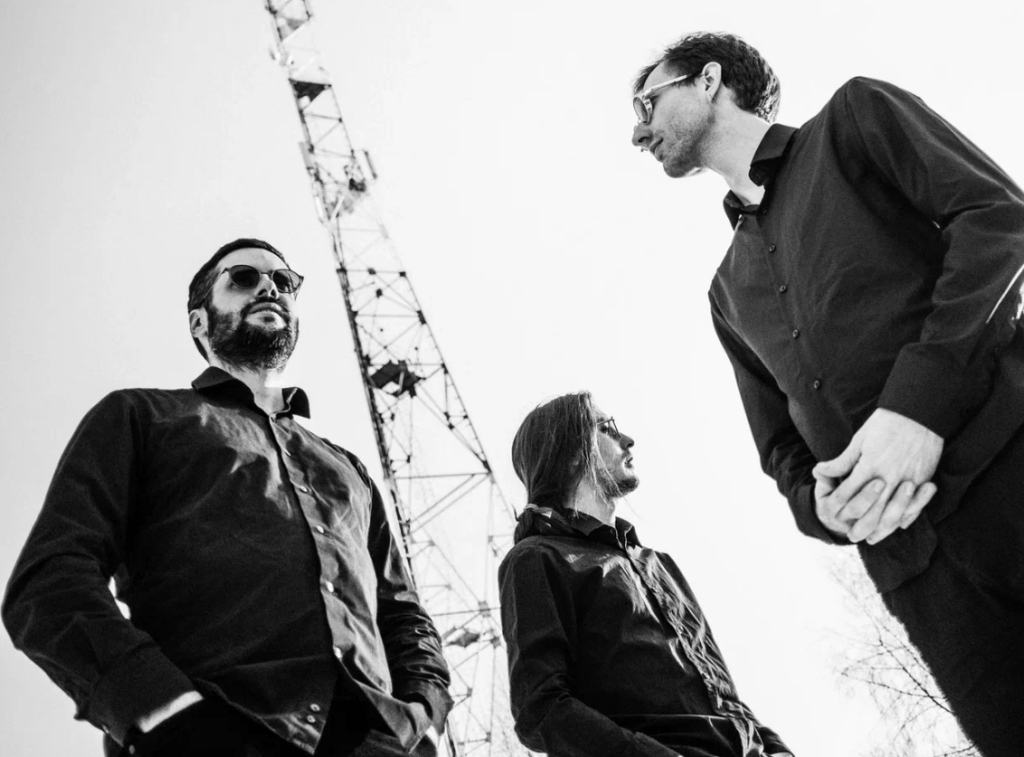
The album’s ten tracks are structured like chapters of a novel where the protagonist has no name, only a direction of movement. The concept is simple: exploring the world, searching for oneself, accepting life as it is. But illo.trio avoid grandiose declarations—instead they play jazz that has absorbed ambient, lo-fi, psychedelia, and retro-electronics. The result is cinematic, but without Hollywood saccharine. Rather, as if David Lynch decided to make a film about musicians who wander through Europe recording the sounds of empty waiting rooms.
The opening “Music from Videogame“ runs 5 minutes 39 seconds and immediately sets the tone for the entire album. The jazz melody dissolves into experimental textures, approaching ambient and lo-fi aesthetics. Here the trio demonstrates their understanding of contemporary sound: the neon coolness of electronics meets the warmth of acoustic instruments, creating a space where the retro-futurism of eighties videogames collides with jazz improvisation. A paradox that the trio successfully realizes throughout the entire album.
“Sleepless“ returns the music to classic jazz sound, but familiar lines and time signatures are restructured, twisted, losing their predictability. The airiness of this track borders on weightlessness—the rhythm section barely outlines a pulse, giving the soloing instruments freedom to float above the structure. The trio offers a surprising mix of jazz styles: here one hears echoes of cool jazz, modal jazz, and even ECM aesthetics, but all of this is melted down into illo.trio’s own sound.
“Glass“ becomes a turning point. The ambient environment, reverberant textures, and slow unfolding of jazz melody against a background of light crackling and rustling create volume, a three-dimensional sound space. This experiment with spatiality recalls the work of Jon Hassell or Nils Frahm, but the trio goes further, using recording imperfections as part of the artistic statement. “Lynch” continues this line but ventures into darker territory. Reversed textures, endless drone, and dominant low tones drag the atmosphere into a dense fog. The track’s title not coincidentally references David Lynch—here is the same work with discomfort, with beauty hiding within anxiety.

However, the album avoids uniformly dark mood. “What“ and “City“ acquire romantic and poetic sound, demonstrating jazz’s ability to be soothing and reflective. The central “Wandering” presents the album’s culmination. The melody hurries like spring wind, keys shimmer in the opened free space. This track returns to reality after long wandering among the fog of previous chapters. Here the trio allows itself maximum freedom.
The final “From the Past“ concludes the story on an experimental note, returning the sound to a meditative lo-fi atmosphere. The trio releases its inspiration freely, allowing experiments to capture the music. The mix of styles, genres, and approaches paints a picture of a peaceful future where past and present exist simultaneously. The title “From the Past” works on several levels: it is simultaneously an appeal to the origins of jazz, to the origins of the trio itself, and to the personal history of each listener.
VERDICT
70 concerts in 11 months—a figure that explains the main thing about “Wandering.” This is an album forged on stages, where studio tricks are useless and only honest playing remains. The recording conveys this live energy—the tracks breathe, you can hear the space between instruments. The cover, based on a real photo taken by Alexander Murzakov in Elbrus, features a striking lenticular cloud and has a grand, expansive look.
The album demands time and attention. This is work for deep listening, and such a format is rare today. illo.trio is definitely taking a risk because they’re betting on the audience’s patience, but the risk is justified. “Wandering” unfolds layer by layer, revealing with repeated listens details that escape on first hearing.
The trio’s main achievement is that they somehow managed to slip through somewhere between tradition and experiment without contrivance. The musicians play what they feel, and this sincerity is physically audible. The album’s cinematographic quality deserves separate discussion. The trio thinks visually—tracks create color, mood, atmosphere. “City” paints streets in the rain, “Lynch”—abandoned industrial spaces, “Wandering”—a spring park after a long winter.
And while contemporary jazz is torn between commercial slickness and deliberate complexity, the trio from Berlin has found a third path—to play honestly, without looking back at trends and expectations. The result turned out convincing.
*This review was made possible by SubmitHub







 Indie Boulevard Magazine