
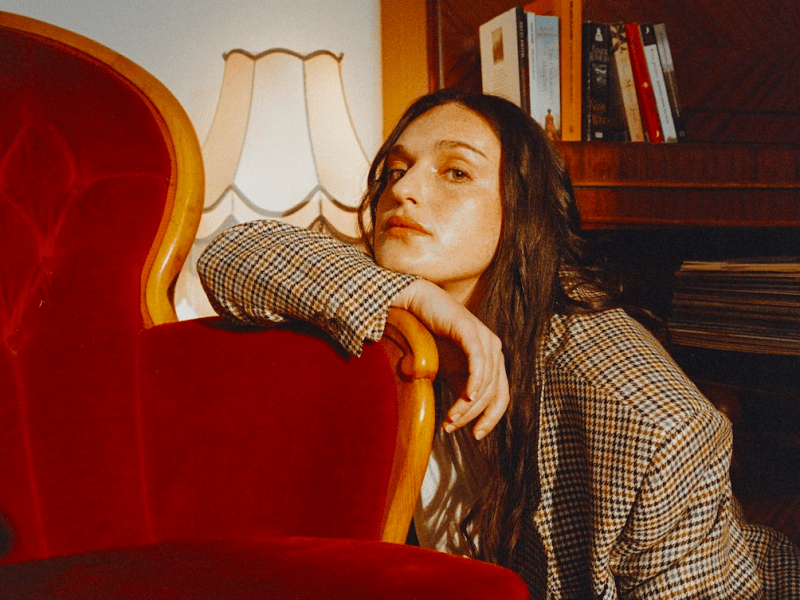
Paula Tartell spent one night in her Brooklyn bedroom writing a song under the name someone used to diminish her. “Sugar Tits” started as a nickname in a relationship where being adorable mattered more than being real. Now it’s an electronic track that compresses people-pleasing, acting out, and the specific rage of pretending you’re fine into three minutes.
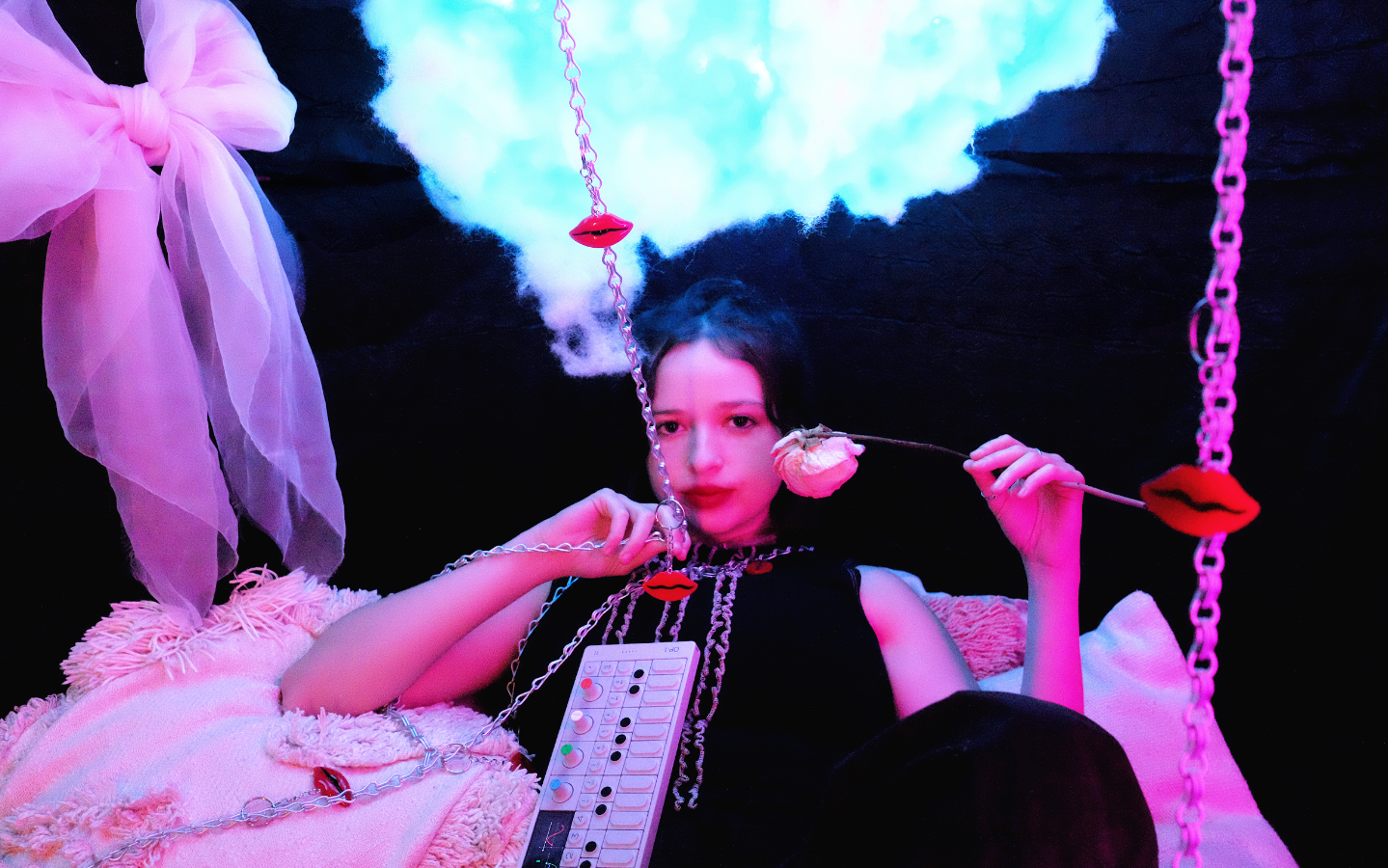
The single drops February 3 under her PAULA T project, and it sounds different from her debut. “Canary” was bubblegrunge electropunk, the kind of thing that got music bloggers calling her “one of the most intriguing and original voices in contemporary music.” The new single, produced with Eli Heath, pairs melodic hooks with sharp contrasts—repression and release happening in real time. Visuals involve lip-adorned chains and LED clouds, shot in the same bedroom where she made the music, with friends Viviane Eng and Sariel Friedman.
She calls the music industry’s categorization obsession ridiculous. The release show is February 2 at Night Club 101, where she’ll play the studio version while dancing, then the live punk version with her band. In this conversation, she talks about reclaiming insults versus staying in conversation with the person who gave them to you, why she thinks everyone is a creative genius with the right conditions, and her theory that art must always outnumber doom.
Hi Paula, it’s a real pleasure to speak with you! You know, there’s something fascinating about the trajectory from “Canary”—this bubblegrunge electropunk statement with live instrumentation—to “Sugar Tits,” where you embody this persona that emerged from a painful nickname. It feels like you went from letting the machines speak for you to wrestling the microphone back from whatever forces kept you quiet. I’m curious about that night in your bedroom when you wrote “Sugar Tits.” What was the exact moment you decided to become the thing someone else tried to reduce you to, and did it feel more like an exorcism or a coronation?
A real pleasure to be speaking with you again! It was an intentional moment – simultaneously a songwriting, music production, and self-therapy exercise. I was feeling resentful of that nickname, of being treated like a caricature of myself. Of feeling adored, but not truly seen. Of being poured over, but only conditionally and without asking for my needs to be met. So, I wanted to cultivate a powerful and fun moment for myself and turn my woes into a bop – I suppose it was a coronation!
Who is Sugar Tits sonically? What would she say? Would she crawl on her knees, would she throw a banger for her friends? A little of both? Would she meander, would she croon, would she beg for love, or would she act out? Is she sweet or distorted? Sweet and distorted? Once I got started, it was definitely more of an exorcism. I was bopping my head the whole time, aware that I was making something fun and unique, and it felt awesome.
Beyond that moment just for me in my bedroom, I’m releasing Sugar Tits as a little prayer for everyone to find power and joy in the things they’re ostracized for, and to find safety in expressing that freely! Sadly a tall order in this world…
The conservatory-to-synthbug pipeline is honestly underrated as a character arc. I mean, you spent years learning the “proper” way to make music—all that classical rigor, the accepted canon, the rules—and then you basically said “fuck it” and started making electronic punk with an OP-1. Do you ever feel like you’re smuggling your conservatory training into these songs like contraband, or has the muscle memory of those years become something you actively have to unlearn?
Someone actually told me you can hear my classical background in Sugar Tits, and I wear that with a badge of honor! I think years of studying piano scores can only be a strength and grow one’s intuition for songwriting – surely not something to be unlearned. Piano music is my heart; it taught me just how much I can love music, and that music’s the way I most prefer to express myself.
Okay, I have to ask because the internet definitely wants to know, and because song titles matter—especially ones that feel like reclaimed slurs or loaded terms. “Sugar Tits” is obviously provocative, and you’ve explained the personal origin story, but it’s also a phrase with this whole gross cultural history, right? Mel Gibson, misogyny, the works. When you decided to name the song this, was there any hesitation about people missing the irony, or were you kind of like, “good, let them be uncomfortable—that’s the point”?
While I hope for people to listen with intention to my music, and at times feel challenged, I’m not interested in alienating people for the sake of it! Quite honestly, at first I didn’t think twice about the song potentially being controversial (and am only just now learning the association with Mel Brooks!). There are multiple towns in the US called Sugar Tit; it’s a historical name for a pacifier! It’s not an expletive phrase, and the song is radio-friendly. Artistically, I certainly enjoyed the dissonance in the name; to me, it sounds as playful and funny as it is provocative. Being called Sugar Tits clearly pissed me off, and it sounds misogynistic out of the mouth of a misogynist, but it also sounds like it could be a term of endearment from your eccentric great aunt! I thought the concept was hilarious for an electronic banger.
It wasn’t until someone in my life in the older generation expressed displeasure with it that I realized it could be controversial. At that point, I was very thoughtful about it – I asked a lot of friends and colleagues what they thought. My overwhelming experience with the song has been that people connect to it, and they think it would be ludicrous not to share it. Ultimately, what I’m not interested in is neutering a harmless, joymaking moment of self-expression because it could lead a hypothetical person, somewhere, to judge me. I’m happy to grab Sugar Tits out of Mel Gibson’s grubby hands and reclaim it! I’ll make Sugar Tits chic!
As someone who pulls from pop, electronic, punk, rock, folk, R&B, noise, experimental, and classical—basically the entire Spotify algorithm having a nervous breakdown—how do you navigate an industry that’s still obsessed with categorization?
To be honest, this is something I’m figuring out in real time, especially as I release this second single. I know in my heart it’s a special song! It’s catchy, the production is awesome, people consistently flip out when I share it with them. The .wav file on my Google Drive has taken on a life of its own pre-release, making appearances in DJ sets, friends’ long car rides, and even a mutual friend’s top surgery party! But curators do NOT know what to do with it—especially with its somewhat unconventional song structure—and I’ve faced a lot of rejection this month reaching out to playlisters and blogs. It’s been really difficult and sad for me.
But the music is one thing I can’t compromise. I’m releasing music from a place of deep love and a desire to connect, not to blow up or get rich or whatever. I want to make music that reflects the resplendence of the universe, and I’m not going to dilute myself or try to be anyone else just to fit on some internet rando’s “Indie Vibez” playlist. The whole thing is honestly so ridiculous, and throughout this process I’ve reconnected to the fact that my love of music is joyful and transcends arbitrary industry-constructed boxes.
You wrote and arranged “Sugar Tits” in a single night, which is either the most punk rock thing ever or a sign that you’d been subconsciously writing this song for months or years. There’s this mythology around overnight creative breakthroughs—Patti Smith channeling “Horses,” Kanye making five beats a day for three summers—but those stories often obscure the longer gestation periods. What was actually percolating before that night, and do you think the song arrived so fast because you’d finally given yourself permission to be as defiant as the music demanded?
I adore this question! I don’t think it’s mythology – I think that’s very real. Creative inspiration feels like something divine, almost like something that’s channeled through you and not yours. I truly believe everyone is an artist and a total creative genius with the right conditions!
I would definitely say this song is a product of finally giving myself creative permission, and deliberately exercising the creative muscle after years of suppressing it. I was very in touch with myself in that moment—tapped into a sense of play, anger, and engagement with the world around me.
I took a wonderful School of Song songwriting course with Laraaji, and he reinforced for me that you can set yourself up spiritually to have these types of creative breakthroughs. He would talk about “adorning your space.” That means literally making your space feel wonderful and generative, but also meditation and chants, wearing something that makes you feel great (in his case, orange!), movement, taking walks, etc. And very, very crucially: having fun! Not taking yourself and your art too seriously. I interpreted “adorning your space” as a lifelong discipline, of treating yourself with love, so that you can be ready to deliver when the inspiration comes from the universe.
Of course, that doesn’t diminish the craft, work, and knowledge that goes into a lot of art. And, crucially, the immense privilege of having the space to prioritize creativity! I may have made the beat and had a song sketched in one night, but I’m sure years of prior work laid the groundwork, and it wasn’t until months later that the song reached its final product (including key contributions and changes from producer and trusted collaborator, Eli Heath!).
Apologies for ranting – I just feel really passionate about this and think about it a lot! I want to take art and the Kanye-conception of genius off a pedestal. Art is for everybody, and it’s basically god, and we shouldn’t take ourselves too seriously as part of that equation! Sorry if that’s off-topic!
I love that you made this release’s visuals—lip-adorned chains, LED clouds, all very surrealist-bedroom-fever-dream—with your friends Viviane Eng and Sariel Friedman in your apartment. Do you see your bedroom as a deliberate rejection of expensive studios and slick production, or is it more about maintaining control over every aspect of the aesthetic universe you’re building?
If anyone wants to give me money to make incredible visuals for my songs, I would not say no! There’s definitely a higher budget version of this waiting to be made.
You are onto something with the bedroom – it was definitely an intentional artistic choice. My bedroom is where I made the song, for starters. The bedroom also evokes many of the tensions explored in the song. Bedrooms can mean safety and empowerment, or they can be a site of trauma and emotional danger. They are a symbol of childhood and play while also being one of adulthood and becoming. They reveal power dynamics. They are creative spaces. They can be a site for self-liberation or of repression. There’s so much there, and it’s so universal!
Come to think of it, the DIY process with Viv and Sariel was all about empowerment, and it’s something I’ll treasure forever! Given the themes of the song, we were all on the same page about not including cis-men in this particular project, which meant learning and exploring new skills instead of asking friends for help with tasks like gaffing. As we drilled holes all over my ceiling and experimented late into the night with LED lights, I kept exclaiming, “Just a buncha girls making things!” One of the great joys of life is making awesome things with people you love. That’s what this is all about for me!
You’re billing yourself as a producer, singer, songwriter, multi-instrumentalist, and political organizer. That last one doesn’t usually make it into artist bios, and it feels intentional that it’s there. In your statement about “Sugar Tits,” you explicitly connect defiant self-expression to resisting “an increasingly fascist, repressive, and robotic world.” How do you see your political work and your music intersecting—or do they? Is PAULA T a form of organizing, or is it the thing you need to do so you can keep organizing without burning out?
They more than intersect! Art is inherently political even when it doesn’t want to be, and I have a deep interest in being intentional with and honing that power. For me, making music is an opportunity to envision and embody the world I want to live in. I’ve learned through my political work that people need that vision—the idea that the world can be different—to come together and take action. It’s a powerful organizing tool. Those that seek to extract wealth want us to be isolated and despairing, and they want to steal our attention away. But music, especially live music, is an antidote; it pushes us to connect with ourselves and each other!
Believe me, with a song like “Sugar Tits,” I am under zero impression that I’m Pete Seeger. But if it leads one person to tap into their rage, dance with some friends, or even just lift their chin for a moment as they doomscroll, I think my effort is well-spent. Art must always outnumber doom!
The persona of “Sugar Tits” as you describe her is this people-pleaser who’d rather be wanted than seen, but the song itself is anything but people-pleasing—it’s got these stark contrasts, these harsh electronic edges. It’s the sound of someone breaking their own programming. When you’re performing this live with your punk band and your OP-1, do you feel like you’re playing a character, or has PAULA T become the most honest version of Paula Tartell?
Truly both! I’m really enjoying exploring different characters through songwriting and performance, but at the same time, every part of that process feels like coming into myself. Making music feels like self-actualization. It truly feels like the most “me” thing to be doing, and I think a lot of musicians feel that way.
Critics called you “a masterful storyteller,” which is interesting because your work seems to be more about embodying a feeling than telling linear narratives. I’m thinking about how electronic music and punk both have complicated relationships with storytelling—sometimes it’s abstract, sometimes it’s visceral and political, sometimes it’s just pure sonic aggression. What does “storytelling” mean to you when the story might be more about texture and tension than plot, and do you think people are looking for narratives in your work that you’re not necessarily trying to provide?
It’s funny. My job is in political communications, which is all about storytelling in the most coherent and accessible manner possible to meet a political goal. But storytelling can also just be vibes! It can be about making something—anything—from the bottom of your heart, and if it’s done in an earnest way, someone will take something meaningful away from your experiences.
If I had to guess, I think I’ve been called that because I made these songs with a boatload of heart and spirit and didn’t try to hide my earnestness to be cool or aesthetic. I really don’t think it’s about craft or delivering any one narrative successfully. People are welcome to draw whatever they want from my work – the idea that they’re actively engaging with it at all makes me the happiest person I can be!
Last thing—you’re playing Night Club 101 on February 2nd, the night before the single drops, which feels very “you had to be there” in an era when most people will just stream it the next day. There’s something almost defiant about prioritizing the live moment over the algorithm’s timeline. If someone comes to that show having never heard “Sugar Tits,” what do you want them to walk away feeling—not thinking, but feeling—and is there a difference between the bedroom recording and the live performance that can’t be captured any other way?
I am unfortunately more caught up with the algorithm than I’d like to be, but, yes, the live experience is a massive priority! I chose to do a single release show because I want people to have a visceral, real-world connection to my song beyond streaming. I don’t really care what people feel, as long as they feel something, and feel it alongside others! I want to cultivate a connective and jubilant experience for my community.
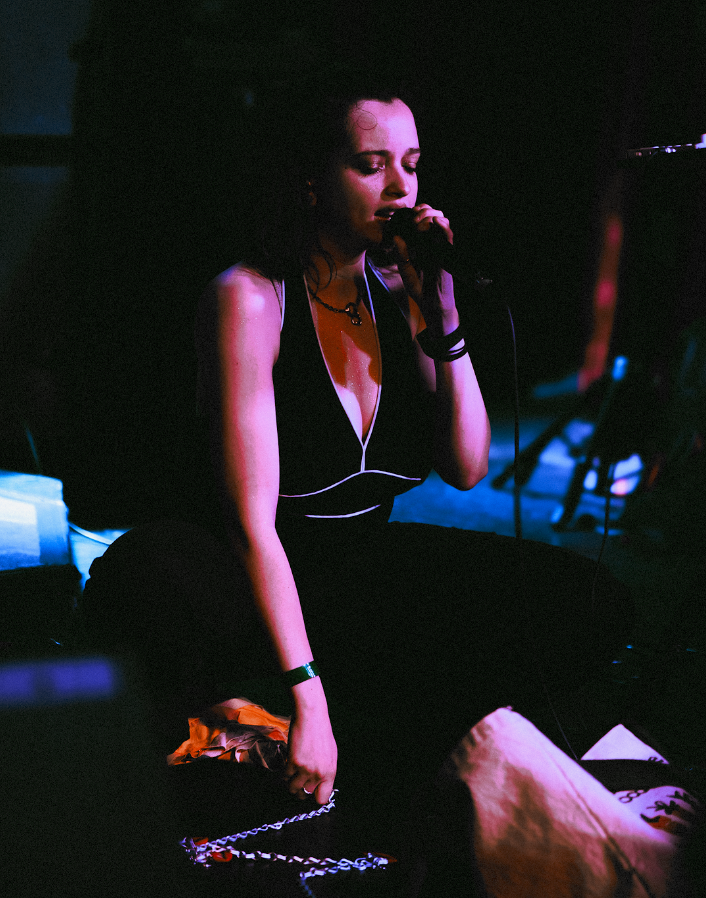
The live version and bedroom recording are very different. The bedroom version is all electronics, processed samples, and heavily layered vocal effects—no instruments. Click track, some selective tempo automation. The live version is more punk rock, where the synth is just one of the textural elements amidst grungy band magic. The vocal melodies are stupid difficult to sing live, especially while playing the synth lead simultaneously, and my band likes to play the song really supercharged and fast—plus the tempo always accelerates—so it’s certainly its own rollercoaster. I think at the release show I’m going to share the studio version and dance around to it, and then afterwards play the song through with the band. I think the contrast will be super fun and drive the crowd nuts!
I’m so excited for February 2. If you’re a person on the internet, based in NYC, and reading this before release day, please come through! There will be amazing openers: Polly Vinylchloryd and CHARMANIA!
Anyway, thank you so much for this thoughtful interview, Indie Boulevard! I appreciate you providing a platform for my strange little tunes. Love y’all.
All information provided is prepared in accordance with editorial standards and is intended to offer useful insights for readers. Please note that the opinions, interpretations, and evaluations expressed by the author may substantially differ from the viewpoints of our readers or the general public at large, and we respect the diversity of opinions.



 Indie Boulevard Magazine