
A tribute album demands a concrete answer to a concrete question: why? The anniversary of the Count Basie Orchestra is a recognizable and respectable occasion. The question remains. And the way Deborah Silver answers it is precisely what transforms BASIE ROCKS! from a calendrical event into a musical one.
Count Basie Orchestra is an ensemble that set the jazz standard for musicians across decades. That influence worked much the way a building’s foundation does: everyone inside feels its presence, yet it rarely gets spoken about directly. Silver chooses a direct conversation: she takes a repertoire belonging to rock culture and pop history, places it in the hands of one of the most significant orchestral ensembles in existence, and invites the listener to watch what happens at the intersection.
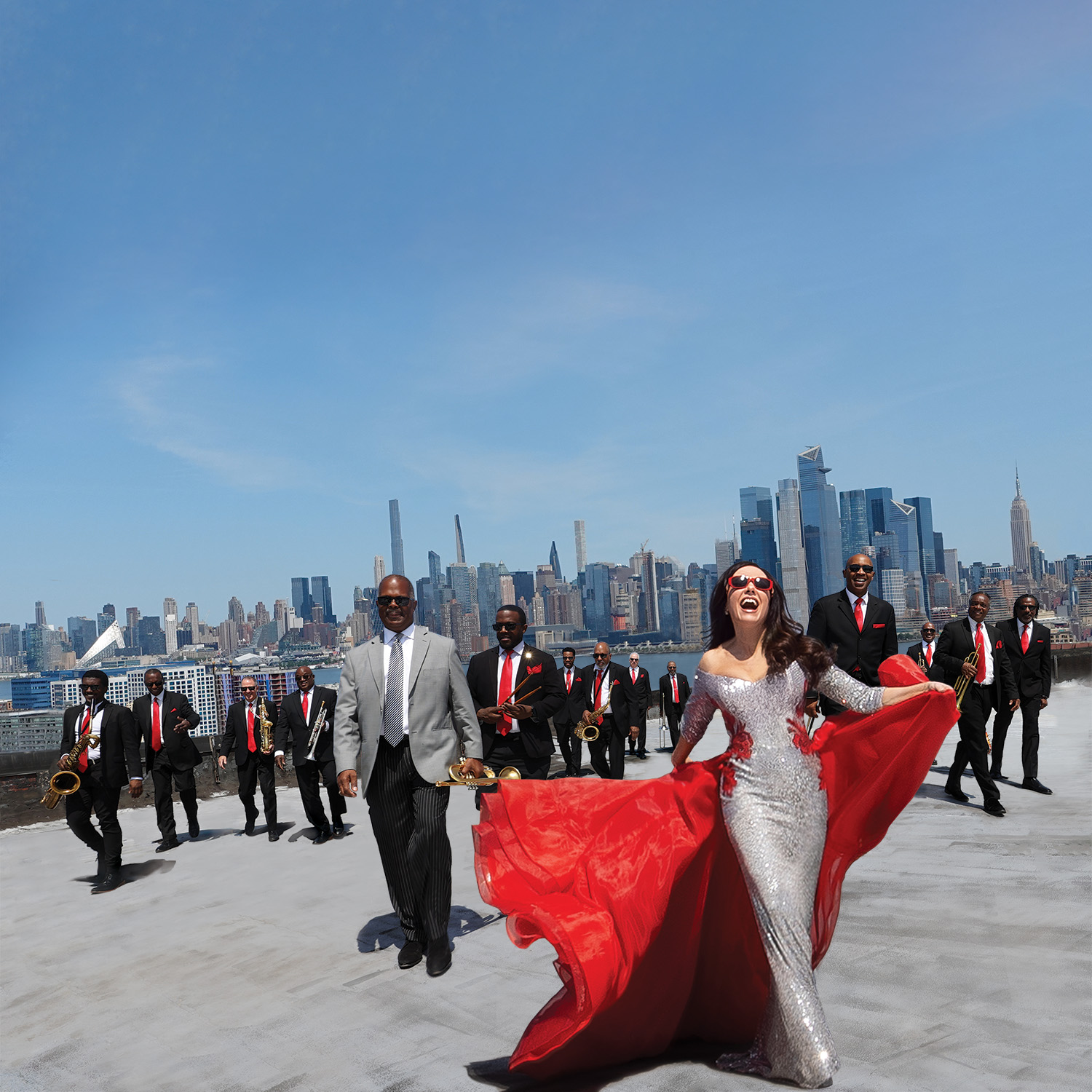
photo by Fadil Berisha Photography
The roster of contributors immediately signals the scale of the ambition. George Coleman — a saxophonist whose biography began with Miles Davis. Arturo Sandoval — a Cuban trumpeter whose name, in any jazz context, sets a particular level of conversation. Peter Frampton, a ten-time GRAMMY® winner. Trombone Shorty, Kurt Elling, Bill Frisell, Scotty Barnhart. Silver assembled people with history and conviction — and each of them holds a specific position: improvisation as real-time thinking, and the solo as a statement rather than a display of technique.
The opening “Paint It, Black feat. Arturo Sandoval and Pedrito Martinez” establishes the rules of the game from the very first bars. Bossa nova as the entry point for the Rolling Stones — bolder than it sounds in description. One of the most recognizable riffs in rock history is recoded through Latin rhythmics, and both layers — the original and the new — coexist in the same space, demanding that the listener be simultaneously present in two different times. Sandoval and Martinez know exactly what to do with that space. Silver‘s voice within it sounds like an equal instrument.
“Bennie and the Jets” is one of the album’s riskier choices. Elton John‘s original is already maximally theatrical — it already contains within itself a glam-inflected self-parody — and it’s easy to push this material into overload. Silver and the orchestra find a different angle: intimate candor in place of pageantry. The track sounds as though the show has ended, the hall has emptied, and the soloist is allowing herself the luxury of singing for herself.
“Baby, I Love Your Way feat. Peter Frampton” is the gravitational center of the album in terms of lyric. Frampton appears here as a vocalist, and the duet with Silver is built on a contrast of registers and temperaments. It’s a cinematic track with a retro quality — slow, spacious, full of air inside. Tenderness without pathos as a deliberate genre choice.
“Tainted Love” with Kurt Elling becomes a full-blown noir. Elling is a singer with a rare ability to sustain narrative within jazz phrasing, and the duet with Silver acquires a dimension that simply did not exist in the Soft Cell original. An adventurous track in which improvisation functions as plot.
photo by Fadil Berisha Photography
“Joy To the World feat. Trombone Shorty” is the most energetic moment on the record. The duet operates on the collision between voice and trombone, and the orchestra here takes the position of an eager spectator, flirting with both. The track lives off the tension between two forceful statements.
“Fly Like An Eagle feat. Bill Frisell” reveals Silver‘s voice from a different angle — louder, freer, staking a claim on territory that big band jazz has traditionally considered masculine. Frisell brings a guitar texture that makes this the most airborne track on the album.
“Every Breath You Take feat. George Colligan” is a deceleration and a reimagining. The Police, in this reading, become morning music — almost intimate. Colligan holds the harmony with restraint. The paranoid tension of the original yields to an entirely different conversation — about the same subject, but approached differently.
“Old Time Rock & Roll feat. Mychelle Rock” — Bob Seger through the lens of a club performance. A track about pleasure and movement, and Silver and the orchestra treat it exactly that way: honestly, without pretension to anything greater.
“Life’s Been Good feat. Scotty Barnhart” closes the album with a balladic opening that unfolds into a full jazz show. Barnhart and Silver close the circle with the same energy with which the album opened — having passed through ten different territories and returned with everything they borrowed from the Count Basie Orchestra.
Verdict
There is one honest question to be asked of BASIE ROCKS!: the album works with material that belongs to others — the rock repertoire, the orchestra’s legacy, the guests’ names — and it is precisely through this borrowed material that Silver articulates her statement. The artist’s own mythology recedes to the background here. It is a conscious choice that deserves respect — and at the same time, it leaves a territory that could have been explored more deeply.
That said, BASIE ROCKS! proves what matters most: an outstanding tribute is a rare thing, and Silver has created one. Count Basie Orchestra always understood that great jazz requires a body, and Silver adds to that a specific musical argument: rock and pop-culture repertoire, handled correctly, belongs to all genres simultaneously. That understanding, committed to record, is worth one’s time and attention.
There is an old debate about what music does: whether it reflects time or creates it. The tribute as a form exists at the intersection of both answers — it looks backward and speaks forward at once. BASIE ROCKS! operates precisely in that interval. The anniversary of the Count Basie Orchestra becomes here an occasion to ask a question with no expiration date: what remains of a sound once it ceases to belong to the era in which it arose? Deborah Silver answers through action — she takes material that already seems to have an owner, and demonstrates that music has no owners. There are only those who know how to handle it.
All information provided is prepared in accordance with editorial standards and is intended to offer useful insights for readers. Please note that the opinions, interpretations, and evaluations expressed by the author may substantially differ from the viewpoints of our readers or the general public at large, and we respect the diversity of opinions.







 Indie Boulevard Magazine