
There is an old argument about what happens to a musician who knows too much. The academic version goes like this: breadth kills depth, erudition smothers intuition, and what you end up with is a beautiful, precise, entirely dead record. The counterargument is less articulate but more persuasive — it sounds roughly once every few years, when an album appears that disproves the first thesis simply by existing.
Swirls by Zenekar is that album. Not because it resolves the debate theoretically, but because you can hear, in it, four people with completely different musical biographies — Queensland Symphony Orchestra, Lion King, Trichotomy, Doch Gypsy Orchestra — sitting down in one room and stopping thinking about what they know. Catharina Kemp, John Reeves, Samuel Vincent, and Dave Kemp have made a debut studio album in which accumulated experience functions as material rather than baggage. The distinction is fundamental, and it’s audible.
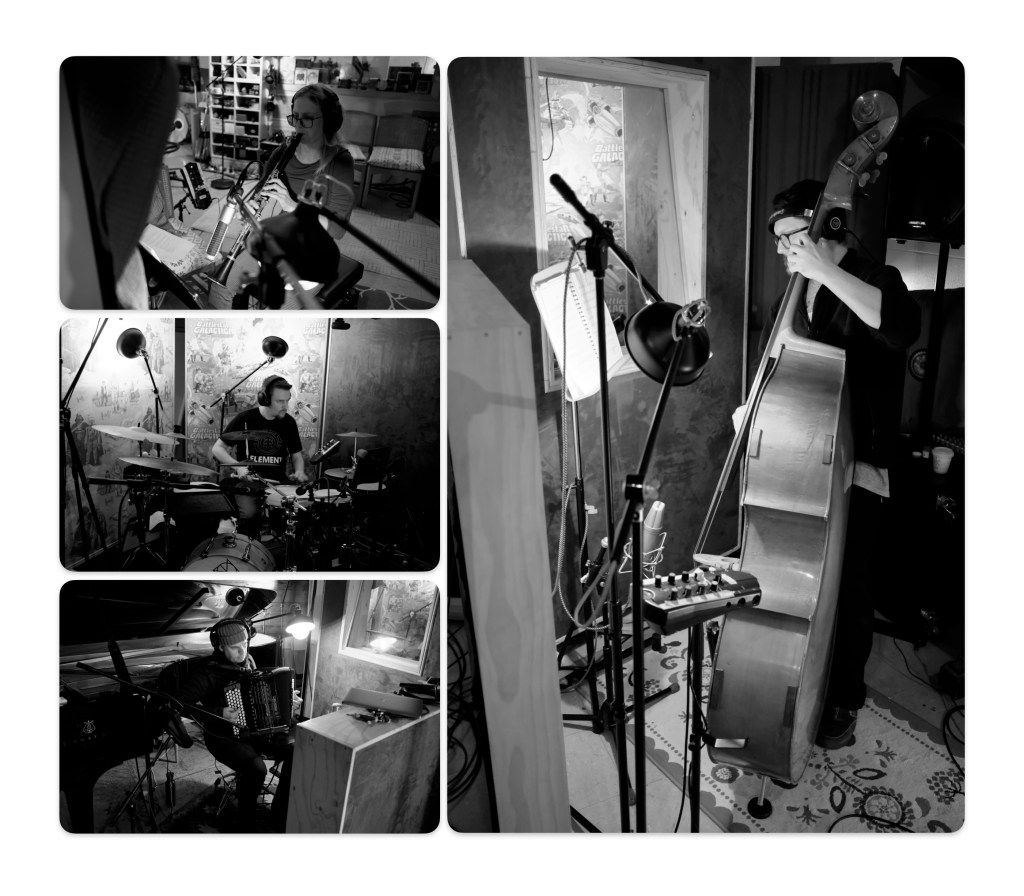
The present moment is captured here in the most literal sense. During the recording sessions, Samuel Vincent ran into a technical problem with the double bass — the kind of thing where anyone else would have said “stop, let’s redo it” — and kept going, finding workarounds in real time. It stayed in the recording. The gong at the end of Native Gardenia didn’t land on the final chord; it was adjusted in the studio, but the very fact that the solution was sought rather than the part simply re-recorded says something about the approach. John Reeves was recording on button accordion for the first time, having switched to it shortly before the sessions.
Ten tracks spanning Hungarian modality, Argentine tango, Cuban contradanza, African polyrhythms, Balkan march traditions, and Byzantine melodic shapes. Geographically, this sounds like a pitch for world domination — and this is precisely where you might expect things to fall apart, because when an album tries to be everywhere at once, it risks ending up nowhere. Zenekar sidestep that trap by letting each track exist according to its own internal logic, making no attempt to explain itself through its neighbors. This is an album with a consistent level of seriousness, and that holds it together more effectively than any overarching concept.
Dark Waltz opens the album and fairly quickly breaks the expectation. Triple meter is one of the most recognizable and, frankly, one of the most exhausted formats in the history of European music. Dave Kemp takes it and densifies the harmonic fabric to the point where the waltz stops being a dance form and becomes something closer to Bartók.
Native Gardenia is Catharina Kemp‘s track, and here clarinet and accordion are given the room they weren’t afforded in the opener. Cuban contradanza and habanera as a foundation — not as quotation, but as a way of thinking about rhythmic momentum.
Flat Five Jive is the most physically energetic track on the record. Samuel Vincent launches it with a double bass riff, and from there the ensemble accelerates through bebop and ’50s rock toward drum-and-bass. This is also where that moment is fixed: the bass clarinet drops below the double bass in frequency — the registral hierarchy inverts — and this adds an extra layer of disorientation to the track, which is entirely appropriate here.
The title track, Swirls, is among the most focused on the album. Dave Kemp wrote it as an attempt to convey the sensation of sounds moving around you from every direction, with a clarinet melody above the chaos serving as the only navigational point. The concept is straightforward; the execution is dense.
Lament for a Holiday Tango — a tango written during a period of movement restrictions. The Argentine genre knows how to work with nostalgia and loss with clinical precision, and Kemp finds the right form for that mood.
Hemiola is the track where Dave Kemp unfolds the rhythmic principle of two beats against three — the foundation of countless traditional African rhythms — into a constantly shifting statement. Academically, it sounds complex. To the ear, it grooves, and that matters more.
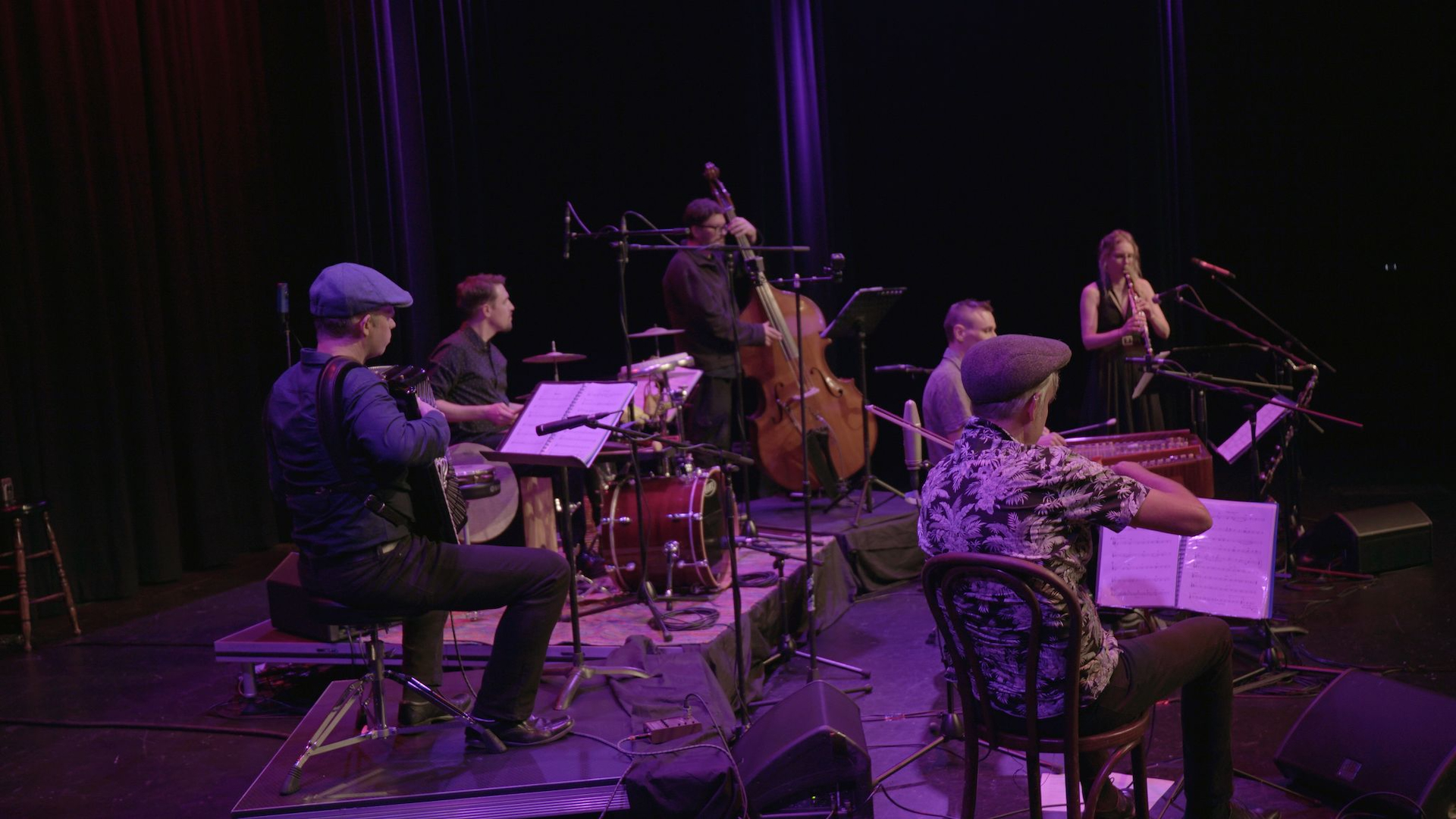
Byzantine is the only track co-written by Catharina and Dave Kemp. An ancient Byzantine melodic shape layered with rhythmic cycles that reference Turkish usul systems.
October Rain Dance is a track that, by all appearances, came together precisely because nobody took it too seriously. A Brazilian harmonic vamp, a playful clarinet melody that arrived on a rainy afternoon. Out of a muted October mood, something uplifting emerged.
Dirge and Dance is a direct consequence of Dave Kemp‘s experience with Doch Gypsy Orchestra. The Romanian and Balkan tradition of funeral and celebratory march — one of the oldest narrative transitions in music: from lament to celebration within a single movement.
After the Bell Tolls closes the album with Cuban rhythmic drive over a classic blues progression. A finale you can and should dance to, and it’s the right call: an album that opened with a reimagined waltz ends with an invitation to move.
The one thing worth taking issue with: as a debut, Swirls scatters its geographic and genre coordinates so widely that the listener needs real effort to hold a single image of the ensemble in mind. Ten tracks, ten different planets — and Reeves isn’t wrong when he talks about “little musical universes”: they really are small and self-contained. That’s a strength, and simultaneously the source of a mild diffuseness — the album doesn’t construct a through-line emotional arc from start to finish; it offers a set of discrete experiences instead.
At the same time, the album poses a genuine question: what do you do with a record that refuses, on principle, to have a single center? But there is an honesty in that very dispersal.
Swirls is an album that expands the map rather than deepening one territory. For a debut, that’s a confident and candid opening statement.
All information provided is prepared in accordance with editorial standards and is intended to offer useful insights for readers. Please note that the opinions, interpretations, and evaluations expressed by the author may substantially differ from the viewpoints of our readers or the general public at large, and we respect the diversity of opinions.







 Indie Boulevard Magazine