
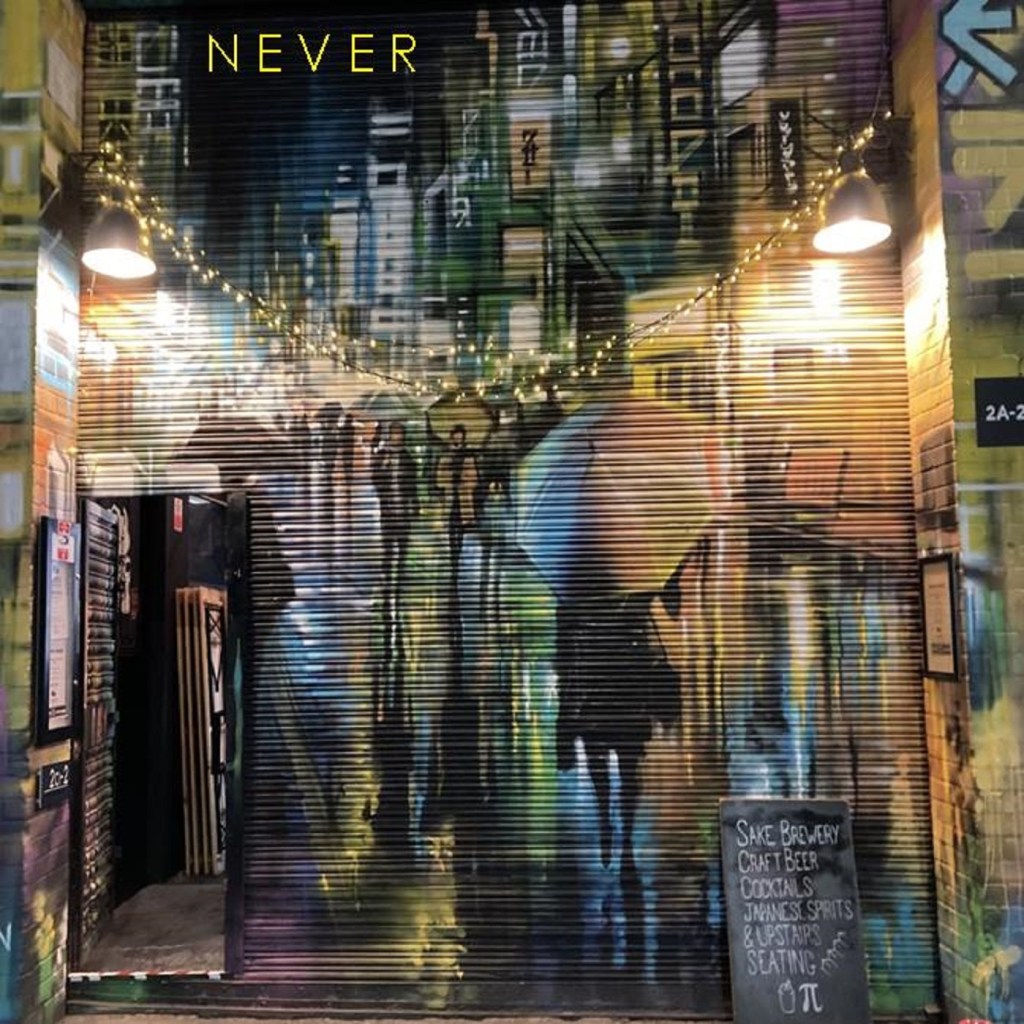
A painting on the wall of a brewery. A random visual impulse that triggered a chain reaction in one man’s mind and ultimately turned into twelve tracks. It sounds almost anecdotal — the starting point for the new album from one of the most prolific indie songwriters turned out to be that mundane, that earthbound. But make no mistake: it is precisely in this mundanity that the charm of Never resides. Simon Talbot takes a moment from reality — rough and concrete — and draws from it a thread leading to something that, by his own account, may one day become a book. Twelve tracks are merely a fragment. A glimpse from behind a curtain at a story that exists somewhere in its entirety, while all we have been given so far is its sonic silhouette.
Never is a fragment by design. Simon Talbot says so openly: twelve tracks will one day become a book, and for now what lies before us is only the sonic silhouette of a larger story. A glimpse from behind a curtain. And here an intriguing situation arises: from the very start, the album exists in a state of promise. It tells you that you are seeing only a small part, that the main body is hidden, that you should wait. It is a risky move, though Talbot employs it quite often — betting that incompleteness will spark curiosity, and that the aftertaste of twelve tracks will prove strong enough to hold your attention until the story is told in full. But it is precisely in this risk that the temperament of Never reveals itself — the album goes all in from the very first second, and it has the audacity to declare: this is the beginning of something larger, and you either step inside or walk on by.
The idea of duality runs through the entire album as a through line. Reality or imagination? Lived experience or dream? Simon Talbot poses this question and leaves it open, inviting the listener to choose their own shore. Two sides, and between them — an abyss. The album exists right inside that abyss, navigating between the sensation of documentary and fantasy.
The title track “Never“ opens the release and immediately sets the tone. A dense guitar line, a thick bass, vivid electric guitars — all of it works as a canvas, a backdrop on which the voice is laid. Simon Talbot‘s vocal reveals itself in multiple shades here: it shifts in texture, it is fluid, and the lyrics from the very first seconds mark the two central themes — love and duality. The track sounds confident and purposeful — it gives the album its name and gives the listener a coordinate system.
“Mysterious Man” tilts the atmosphere toward the mystical. The space of the track fills with something otherworldly, and Simon Talbot‘s vocal becomes nearly weightless, light, spectral. It is an interesting move — the voice here functions as an instrument of mood-making, and the mood itself draws you in. The fourth track continues this line but takes it to another level: it is faster, carrying a sense of wind, a swaying rhythm, heavy alt-rock guitars, and hypnotic vocals. The transition from mystical slowness to speed is handled organically — the album gathers momentum.
At the midpoint of the release, “Humanoids” completely overturns the atmosphere. It is one of the lightest and most enigmatic songs on the album. There lives here a feeling that is difficult to name and difficult to fully believe — it slips away, dissipates, sustained by experimental harmonies in the chorus. These harmonies create an effect of instability, and the track benefits from it.
“Big Trouble in Little Never“ deserves special attention, not least because of its music video. Here, the romantic side of Simon Talbot reveals itself — that romanticism which can be felt in his words and metaphor-laden lyrics. The video complements this side visually, and the track becomes one of those that transcends the purely auditory experience.
Toward the album’s close, “Highway Home“ bursts in with punk-grunge energy. A vigorous rock arrangement, a gripping vocal — the track sounds hopeful and charged, carrying the feeling that you could forget everything and rush headlong into a real adventure. The closing “Utopia“ brings the album to an end with soft keys that ring high and soaring, yet the guitars and drums maintain a dense alt-rock veil. Simon Talbot‘s vocal tells a story of hope and anticipation, and after the final note a faint sense of something left unsaid lingers — the album breaks off precisely where you want to hear what comes next.
And here the central paradox of Never emerges. The album declares itself a fragment of something larger, a glimpse from behind a curtain. This is both its strength and its vulnerability. Its strength — because the listener is left with the desire to know more. Its vulnerability — because an album that exists as a preview of a future book risks being perceived as an unfinished statement, a promise yet to be fulfilled.
Never is an album that still relies too heavily on atmosphere. Atmosphere is a powerful instrument, but it demands anchors. Where tracks are sustained by mood, by texture, by the spectral quality of Talbot‘s voice, one sometimes craves a more rigid framework — a melodic line that cuts into memory and lives on independently of context. At Never‘s best moments, that framework is there: “Highway Home” with its punk-grunge charge, the title track with its dense guitar wall. But between these peaks, the album at times dissolves into its own haze, and it takes effort to hold on to the thread.
However — and this is the key point — Simon Talbot succeeds at what matters most. Never is an entirely self-contained work. With a carefully constructed dramaturgy, with dynamics that move from mystical slowness through alt-rock drive to a final contemplation. The album travels a path from the dense, dark sound of the title track to the weightless hope of “Utopia,” and this journey feels intentional. There is an arc here. There is movement. There is a protagonist with enough presence to hold your attention across all twelve tracks, even when the story deliberately withholds.
Was this story real? The question remains open. Never is built precisely on this irresolvability — and within it, finds its form. An album born from a painting on the wall of a brewery ultimately becomes such a painting itself. You stand before it and try to understand what exactly you are seeing — a real event or someone’s dream. And while you are thinking, the album has already done its work: it made you stop. Simon Talbot draws the curtain across the story, reveals a sliver — and waits. Never is an invitation to peer inside. And the decision to accept it or walk on by belongs to whoever stands on the other side.
All information provided is prepared in accordance with editorial standards and is intended to offer useful insights for readers. Please note that the opinions, interpretations, and evaluations expressed by the author may substantially differ from the viewpoints of our readers or the general public at large, and we respect the diversity of opinions.






 Indie Boulevard Magazine