
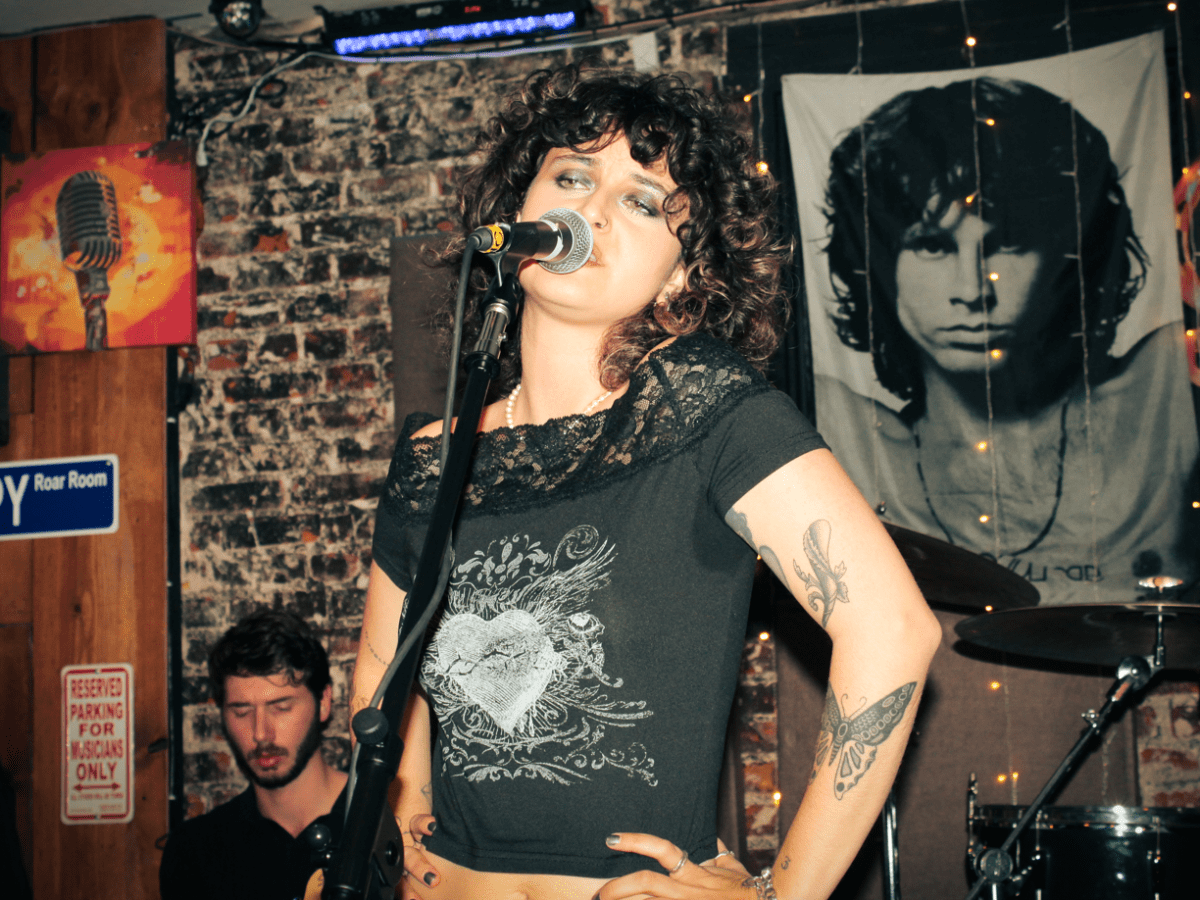
Most people who land on Broadway before high school end up chasing that feeling forever. Ava Della Pietra went somewhere else entirely. After School of Rock and Les Misérables, she started writing her own songs — and kept going until 27 million streams and 1.5 million followers proved she’d found something worth holding onto.
Right now, Della Pietra is splitting her time between Harvard and Berklee through a joint program in biology and music theory, releasing pop music independently, and doing all of it with a quiet stubbornness that makes her hard to categorize. She has no interest in fitting a lane. She has a voice memo she recorded late one night when she couldn’t sleep, which eventually became “3AM.”

The new single is a breakup track built around a deceptively simple idea: a person who keeps telling herself everything is fine at three in the morning, because admitting the truth would mean walking away. The production stays warm and restrained — verses that hold back, a chorus that opens up, a bridge where the whole thing finally cracks. Della Pietra’s theatrical instincts show up in the song’s emotional arc, but the delivery is raw, close, almost confessional.
We talked to her about where “3AM” came from, how Broadway shaped the way she writes, what happens when streaming logic and music theory collide in the same brain, and the question she gets asked a lot: why music, when she could have chosen almost anything else.
Hello Ava! I’m thrilled to talk with you about your music and the release of your new single “3am”. This song explores the lies we tell ourselves to hold onto relationships that are already falling apart. Tell me about that specific moment or realization when you knew this theme would become the center of the song.
Hi! I’m so excited to talk with you too. One of the inspirations for this song came from watching a close friend go through a difficult breakup after a long-term relationship. Watching it unfold made me reflect on how easy it is to stay in a situation out of habit or hope, and that doesn’t just apply to relationships. The idea behind the song came from noticing how often we convince ourselves everything is fine, just because facing the truth might mean having a difficult conversation or making a hard choice. If “3am” helps someone feel a little less alone in that push and pull, or reminds them that they’re strong enough to step back and choose what’s best for them, that would mean a lot to me.
You describe “3am” as a song born from a real moment of personal stress. Walk me through that moment — what was happening, where were you, what was the catalyst for picking up a pen and starting to write?
It started late at night when I had a big decision to make and was feeling pretty stressed about it. A friend told me, “Take the night, think it over,” and that phrase stuck with me. I recorded a voice memo of myself singing what became the first line of the chorus, then went to bed. The next morning I finished the song. That moment turned into the story of an on-again, off-again relationship that keeps unraveling in those late hours when everything feels more intense.
With your Broadway background in School of Rock and Les Misérables, how does your theatrical sense of dramaturgy manifest itself in the structure of “3am”?
I think my theater background definitely influences the way I think about songs. In theater you’re always thinking about emotional arcs and how a character evolves over the course of a scene or a song. I approach songwriting in a similar way. In “3am,” the narrator starts out almost in denial, slowly becomes more aware of what’s really happening, and by the end finds the clarity to walk away. That kind of emotional progression definitely comes from my theatrical instincts.
The track is described as a transformation of personal experience into a broader emotional narrative. Tell me more about this process — how exactly did your personal story evolve into a universal statement about deteriorating relationships?
My personal experience was the starting point, but my main focus is on the emotional situation rather than the specific details. 3am is an inherently vulnerable time. It’s when your thoughts tend to spiral and everything feels a little heavier than it might during the day. In the song, 3am became a symbol of that mindset and of a relationship that feels uncertain but is still being held together by hope.
The production of “3am” is characterized as lush yet restrained — which is quite unusual for contemporary pop. How did you work on creating this sonic balance in the studio?
The balance really came from thinking about how the music could mirror the emotional story. The verses are more restrained and rhythmic, which reflects the narrator holding things in. The chorus opens up more emotionally, and the bridge is the most expressive moment because that is when she realizes she has to break the cycle. Working with my producer Alex Koste, we focused on letting the production support that emotional progression.
Many have noted that the vocal performance on “3am” is one of your most vulnerable to date. Tell me about recording the vocals — how did you prepare emotionally, how many takes did it require, was there a moment when you knew you’d found the right performance?
Recording the vocals was really about finding the emotional tone that matched the story. At first we recorded a cleaner, more laid back version. But the song is about someone trying to convince herself everything is okay, so I wanted the performance to feel slightly desperate. Once we leaned into that idea, we re-recorded the vocals and adjusted the production so the emotion came through more clearly.
The lyrics of “3am” contain specific lines or metaphors that describe self-deception in relationships. Which of these lyrical lines was the hardest for you to write, and why?
The line “Nothing bad’s gonna happen at 3am” was actually really interesting to write. On the surface it sounds reassuring, but it’s really the narrator trying to convince herself that staying in the situation won’t hurt her. Of course, the truth is that a lot can go wrong at 3am. That tension between hope and denial is really the heart of the song. At one point I also played with a line like “Nothing good ever happens at 3am,” which would have made the narrator more self-aware. But the version that stayed in the song reflects that she’s still trying to reassure herself, even though deep down she knows better.
I was reading this piece about how TikTok has basically destroyed the concept of a deep cut—every song is potentially a single now, every moment is optimized for virality. But you’re making music while simultaneously studying music theory in an academic setting, which presumably teaches you to think about albums as cohesive statements, about tension and release across 40 minutes, about art that unfolds rather than immediately gratifies. You’ve got 1.5 million followers, so you clearly understand the attention economy, but you’re also in rooms discussing harmonic complexity and compositional structure. How do you reconcile those two completely opposed philosophies of what music is supposed to do? Or do you even try?
I actually think they can complement each other. Studying music theory gives me a deeper understanding of harmony, structure, and songwriting craft. But when I’m writing songs, I try not to overthink it. The most important thing is still emotional storytelling and a strong connection with the listener. Theory just gives me more tools to explore ideas and experiment along the way.
You’ve racked up 27 million streams as an independent artist, which is legitimately impressive, but you’re also studying music theory at Berklee, which means you’re in an environment that takes music seriously as art, not just content. I’m curious how those two value systems collide in your head. You’re navigating both worlds simultaneously—do you ever write something you know is interesting from a music theory perspective but would be suicide from a streaming perspective?
Sometimes I do write ideas that are a little more experimental musically, or less immediately hook-driven, and maybe not the most obvious choice if you’re thinking purely in terms of streaming strategy. But when I’m writing, I try not to think in those terms. I usually start with whatever the song seems to be asking for in that moment and follow that instinct. If the emotion feels right, I trust that and let the song develop naturally, even if it takes a slightly unconventional musical path. At the end of the day, what makes a song resonate is the feeling behind it. People connect with music when they recognize their own experiences or emotions in it, so even if the structure or sound is a little unexpected, honesty tends to carry it.
This question might sound stupid, but I’m genuinely curious: why? You have a spot at Harvard, you could become a biologist, a researcher, a doctor—professions that objectively make the world better, save lives, solve problems. Instead, you’re dedicating an enormous amount of time and energy to making music. I’m not saying music isn’t important, but I want to understand: what exactly does music give you that science can’t?
Not at all stupid! I’ve thought about this a lot. Music has always been a huge part of my life, and it feels very inherent to who I am. I don’t write songs because I am thinking, “I need to get my next release ready!” I write because it naturally happens. I have always written songs to express my thoughts and work through my emotions. Music is very cathartic for me, and I was doing it even when I was little and did not really know how to write a song yet. My family actually has videos of me at six years old improvising a ten minute song about my day. It has always just been something that comes naturally to me.
All information provided is prepared in accordance with editorial standards and is intended to offer useful insights for readers. Please note that the opinions, interpretations, and evaluations expressed by the author may substantially differ from the viewpoints of our readers or the general public at large, and we respect the diversity of opinions.



 Indie Boulevard Magazine