
Getting time with Alex Kilroy isn’t easy — not because of handlers or label gatekeeping, but because the man simply doesn’t stop moving. Between Nashville sessions, a young daughter, and a debut album that’s been years in the making, his calendar reads less like a schedule and more like an act of faith.
If you haven’t encountered Kilroy yet, the backstory alone deserves its own film treatment. Born in Transylvania, classically trained, spiritually rewired by a Stevie Ray Vaughan record, he spent years fronting a blues tribute band across European festival stages before doing what he’d apparently been planning since childhood — leaving for America. Not metaphorically. As a kid, he told his mother he was just visiting Romania. There was a flag on his bedroom wall to prove it. The road from there to Nashville was exactly as unglamorous as you’d expect: wedding gigs to raise cash, cold calls to Buddy Guy’s Legends, visa paperwork that could break a lesser person’s will. But Kilroy held onto something his late father told him — respect the tradition, then find your own voice inside it. Break My Chains, produced by Trace Sasser and mastered by Ted Jensen at Sterling Sound, is the sound of someone finally doing exactly that. We talked about all of it.

photo by @sophiamedinamusic
Alex, great to finally sit down with you. I keep coming back to one image — the American flag above your bed in Transylvania, and a kid telling his mother he’s “only visiting.” Kids say things like that and forget by dinner. You organized your entire adult life around it. Conservatory, tribute bands across Europe, visa paperwork, wedding gigs bankrolling the next move — years of forward momentum aimed at a place you’d never been. At what point did that childhood declaration start costing you something real — and what was the first price you paid?
Thank you for the interview! Growing up, I always felt a strong sense of belonging in the United States. The music, people, humor, mentality, landscape, and even the architecture of the cities and towns I saw in movies and video games seemed incredibly familiar to me. It was almost as if I had been there before, creating a strange feeling of homesickness for a place I had never actually visited.
When I set out my goal to make it “back home” through music, nothing felt like it was costing me anything. When you love what you do, you don’t feel like you’re paying a price, even if it is there. There were summers when I spent all my time practicing in my room while my friends were out on the lake having fun. I did miss a lot of that, but I was fortunate enough to have great friends who didn’t exclude me from the friend group because I was missing most of the gatherings. One real price I’m paying is not seeing my fiancée and my daughter as much as I would like to, and the other was being away from my parents for so many years. I missed holidays, birthdays, and valuable time with my father that I thought I could make up for, but now I can’t.
You trained classically. That world has its own gravity — rigorous, hierarchical, built on centuries of codified technique. And then Stevie Ray Vaughan enters the picture, which is practically a different religion. How do those two systems coexist in your hands now — do they collaborate, or does one have to get quiet so the other can speak?
My musical journey began in first grade at the Music School in Bistrița. Before we started lessons, my teacher asked my parents if they wanted me to pursue an amateur or professional career. They chose professional, almost like selecting the difficulty level at the beginning of a video game. And professional it was. One hour of lessons turned into four. My teacher would strike my fingers if I didn’t maintain the correct hand position, and there were the screams. It was like a scene from Matilda. This harsh training took the joy out of music for me, making me hate piano and classical music. My parents had to beg or threaten me with no TV, no PC, if I didn’t practice regularly.
During this time, my father’s guitar, which had been collecting dust in my room, whispered, “Hey, I’m your way out.” This realization came when my father bought a car from the US and shipped it over to Romania. It happened to contain the 1985 Stevie Ray Vaughan Live at Montreux DVD. As soon as I saw it, something clicked in my mind, soul, and body. I knew exactly what I wanted to do—play guitar. I shared my decision with my parents, but they weren’t thrilled at first. I was getting quite good at playing piano and winning awards, even though I didn’t enjoy it. My father made me an offer I couldn’t refuse: learn three Stevie Ray Vaughan songs (Scuttle Buttin’, Pride and Joy, and Lenny) by the end of summer, and I would switch my school profile from classical piano to classical guitar.
Once I broke my chains from classical music, I didn’t even listen to it or touch the piano for many years. However, during the 2020 pandemic, I started listening to movie scores by composers like Hans Zimmer, Howard Shore, and Danny Elfman. I was curious about how they created such incredible scores, which led me back to classical music. This time, I listened to it from a different perspective, and I fell in love with it for the first time. I draw inspiration from classical music when I write my songs because it has the most clever ways of moving through chord changes. For many years, these two worlds didn’t coexist, but now they make the best team.
You spent years playing weddings to fund your path forward. There’s a version of that story where someone frames it as noble sacrifice, and another where it quietly eats away at you — performing someone else’s playlist on the most important night of their lives while your own ambitions sit in the parking lot. What did those gigs teach you about performing that you couldn’t have learned anywhere else?
I played guitar for the artist my father used to manage. He was popular in Romania at the time, and he still is. While it was a noble sacrifice that consumed my passion, every time I stepped on stage, I remembered the reason behind my pursuit. I played hundreds of weddings to achieve my dreams. During my time playing for this artist, I learned discipline and patience. I experienced what it meant to be a sideman and realized that that role doesn’t fulfill me, but it taught me how to communicate and treat my bandmates.
Your father gave you this idea: respect the tradition, find your own voice within it. That sounds clean and elegant as a philosophy, but in practice, tradition has gatekeepers. Blues especially — there are purists who will tell you what belongs and what trespasses. Where have you felt the tension between honoring the form and pushing past its boundaries, and how did you decide which side to land on?
I decided to participate in the International Blues Challenge for the first time in 2023 in Nashville, Tennessee. My fiancée and I wrote a song that is part of my upcoming album titled “Angel,” which I performed at the Blues Challenge. Unfortunately, I was disqualified for not being “Blues enough,” even though I believed I was putting a fresh spin on the genre. Of course, the judges disagreed with me. That was my first encounter with the “Blues Police,” and I didn’t give up on the challenge. I tried again the following year, 2024, with songs I specifically wrote for the genre. This time, we made it through the Nashville stages and were selected to represent in Memphis. However, we were disqualified in the semifinals for apparently the same reason. Despite this setback, I saw it as a positive sign. I’m bringing something new to the genre, and when the “Blues Police” are upset with you, it’s an indication that you’re on the right track. Let’s be honest, blues music originated in the Mississippi Delta and has influenced all the genres of music created in America and most of the Western world on a daily basis. The blues is not dead or dying, it’s continuously evolving. Everything I write is even influenced by the classics of Europe or the masters of the Mississippi Delta.
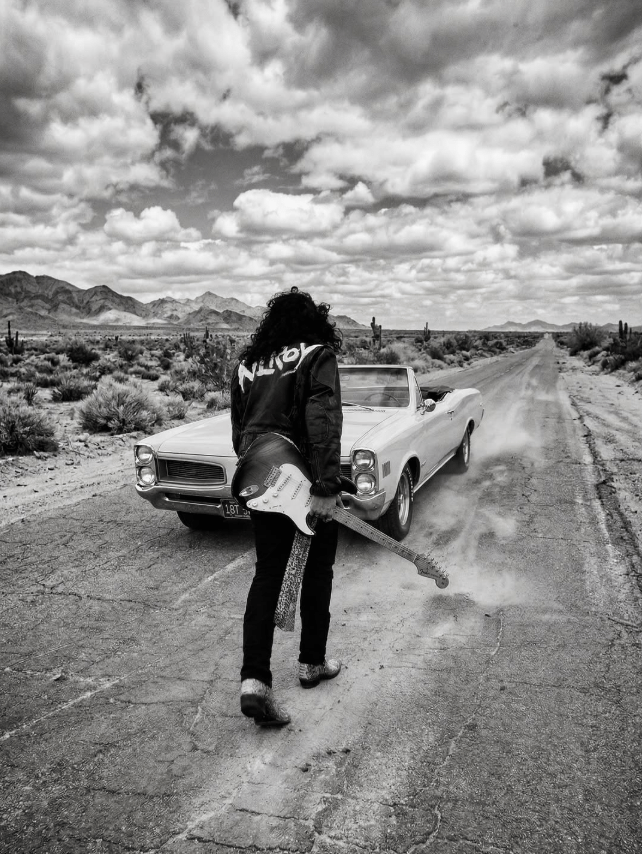
Let’s talk about the record, your debut album. Break My Chains was recorded with a small, handpicked group and produced by Tres Sasser, then mastered by Ted Jensen at Sterling Sound. Nashville has an endless supply of session players who deliver flawless takes on demand. You went the opposite direction — a tight room, a curated circle. What were you listening for when you assembled that room — and how much of the album’s sonic identity came from the chemistry between those specific players versus a blueprint you walked in with?
The record-making journey began when Tres Sasser called me, expressing his interest in producing my album. At that time, the album was merely a distant dream in my mind, and I found it incredibly coincidental that he reached out to me at that very moment. I was already residing in Orlando, Florida, and was actively gigging, writing songs, and searching for a band.
My band came together when I performed at a small cafe, and the synergy between us was palpable that night. The bass player, Berlan Henri, approached me and asked if I would like to join his church band, as their guitarist had recently left. One of my dreams was to perform in an African American church, drawn by the high musical standards and the genuine passion of the musicians. Therefore, I eagerly accepted the invitation.
Berlan introduced me to an incredible group of musicians in Orlando, known as On1 Band. Meanwhile, Tres and I were diligently working on the pre-production of the album, writing new songs, critiquing them, refining them, and even abandoning some that didn’t resonate with us. I was creating demos for the songs in my home studio. I brought one of the songs to the band, and when we played it, it felt perfect. The sound I had envisioned was now coming to life through the PA system. That’s when I knew we were ready to record an album.
As I was nearing the completion of the material for recording, the universe conspired and brought Clyde Harris(manager) to one of my shows. He played a pivotal role in securing the management deal I signed with the legendary music manager Pat Armstrong. Clyde took me to Pat’s office, where I presented my demos. Shortly after, we had a budget and a team ready to record my debut album. Since my family, management, and band were all based in Orlando, I decided to record at a studio called Studio Live USA in Oviedo. Tres flew down from Nashville, and for a week, we worked tirelessly, 12-hour days.
Tres suggested we hire Joe Costa from Nashville for mixing and Ted Jensen (Sterling Sound) for mastering. Once again, the way the album sounded in my mind was now being realized through my car speakers. It was an incredible feeling.
The title track centers on breaking inherited patterns — creative ones, personal ones. And you recorded this after losing your father, whose philosophy has been a compass throughout your career. How do you carry forward his influence while also freeing yourself from the weight of it — and did writing that song change the way you understand what he gave you?
I wrote the song while my father was still alive, and I’m so happy that he had the opportunity to listen to the entire album shortly after we received it from mixing. As I was writing the verses, I envisioned the feeling of driving away in a car until you run out of gas. It was a sense of liberation, not fear or anger, but pure bliss and joy of being free. Sophia, my fiancée, heard me working on the song and came in to suggest a hook. She’s an incredible songwriter and a master of hooks. While she listened to what I had written, she came up with the line“Break My Chains” and the “Oh Lord” part. It perfectly complemented the rest of the song. The concept behind the song is about breaking free from the routine. Imagine this: on your way to work, instead of taking the usual exit, you keep driving to a place you’ve never been before. You stop at a cozy little restaurant, have a cup of coffee, and strike up conversations with people you’ve never met. Something extraordinary might happen to you or you might just get fired, but that could also be a blessing in disguise. For many years, I misunderstood my father. He was my biggest critic, and at times, that made me feel like I was not good enough, as if I couldn’t meet his expectations. However, in reality, all he wanted to do was inspire me to be my best self and constantly raise the bar. He taught me how to be honest with myself. I’ll carry that with me and also teach my daughter that same lesson.
Classical discipline, gospel energy, Southern rock textures — those three live on this album simultaneously. Walk me through how those influences actually collided in the studio. Was there a track where the blend clicked immediately, and one where it resisted until you forced a solution?
Growing up, I had a diverse musical experience. My parents would switch between Classical music, Romanian folklore, Alan Jackson, Pink Floyd, Stevie Ray Vaughan, and Diego El Cigala. Over time, these various musical textures became an integral part of my mind. When I write music, I draw inspiration from all the cultures I grew up listening to. The band brings a blend of Urban, RnB, and Gospel elements to my sound, and it all works perfectly. We rehearsed for about two months before entering the studio, which allowed us to get the recording done in a short amount of time.
You’ve mentioned songs on the album inspired by your fiancée and your young daughter. Writing about the people closest to you operates under different stakes — they’ll hear it, they’ll live with it, it becomes part of your shared biography. A love song kept private stays yours; a love song on a record belongs to strangers too. How did you decide what to reveal and what to protect — and did either of them hear the songs before anyone else?
Sophia has co-written with me three tracks for the album, and she’s featured on one of them. She’s listened to the songs from their initial stages to the final product, and there are quite a few songs that are still in the vault. Perhaps one day, we’ll let them fly. Our daughter was even present in the studio while we recorded the duet, and she seemed to genuinely enjoy music. It’s possible that we have another singer-songwriter in the family.
Ted Jensen mastering at Sterling Sound brings a specific kind of clarity — his work has a reputation for precision that can either elevate material or expose every seam. And Tres Sasser’s production seems to lean into warmth and dynamics. Those two sensibilities pulling in different directions could create productive tension — or a tug-of-war. When you heard the final masters for the first time, what changed about the record — was there a moment where a song revealed something you hadn’t heard in the rough mixes?
Tres Sasser and Joe Costa have collaborated on numerous projects, showcasing their exceptional efficiency and precision. Upon receiving Joe’s mixes, I was thoroughly impressed by the expansive, pristine, and radio-ready sound he produced. Ted Jensen further enhanced Joe’s work, adding a polished touch that sealed the deal. He delivered the sound I had envisioned, and I can’t wait to share it with everyone.
You’ve described a path full of friction — visa setbacks, financial scrapping, cultural displacement, years of proving yourself in rooms that had zero reason to let you in. And now the album is called Break My Chains, mastered at Sterling Sound, coming out of Nashville with real infrastructure behind it. The arrival is tangible. But arrival implies a destination. What does the landscape look like from here? Is there a version of Alex Kilroy that exists after the chains are broken, and what does he want?
The journey here was not an easy one, but it was absolutely worth every moment. There are numerous musical paths that I intend to explore. I find the concept of reinventing oneself, constantly learning, and seeking new experiences incredibly appealing. I firmly believe that life is all about exploration, both within and without. Alex Kilroy will continue to write about the experiences he encounters as a soul navigating the complexities of human existence.
All information provided is prepared in accordance with editorial standards and is intended to offer useful insights for readers. Please note that the opinions, interpretations, and evaluations expressed by the author may substantially differ from the viewpoints of our readers or the general public at large, and we respect the diversity of opinions.








 Indie Boulevard Magazine