
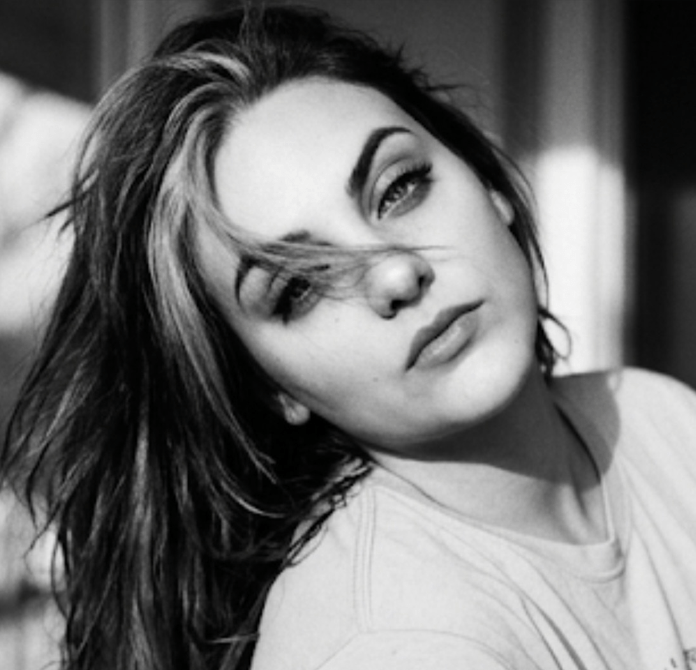
Layla Z is an indie rock musician from New York, a mother of two, and the author of “Filthy Dirt” — a track recorded at two in the morning on pure adrenaline and anger. She’s 31, has been writing songs since her teenage years, listens to Nirvana and Alanis Morissette, adores Amy Winehouse and Elvis, and describes her sound in one word — dirty.
In May, she’s shooting a music video on a country dirt road, a bouquet of roses in hand and a concept of revenge on camera. Her music lives in that zone where the voice cracks, words fly out before you have time to think them through, and the production is deliberately left with scratches and rough edges. “Filthy Dirt” is fierce feminine energy in the spirit of “You Oughta Know,” filtered through country dust and New York concrete. Layla Z openly says she wants to sound rough and honest — in an industry that has spent years polishing voices beyond recognition, that’s a statement. Her kids watch their mom write and sing almost every day, and that fact matters to Layla: she wants them to grow up understanding that a woman in rock music is normal, and that loudness and tenderness coexist perfectly well in the same person. We talked about how to tell the difference between a raw recording and an unfinished one, why you leave imperfection in a track, and why rock and roll in 2026 is a personal political statement.
Hey Layla, thanks so much for taking the time — really excited to dig into your world today. You’re navigating that landscape as a musician and as a mother of two, which adds an entirely different layer of gravity to every decision you make. The indie path is a tightrope, and yet here you are, leaning all the way in. What does independence actually feel like on the days when it stops being romantic — when it’s just hard?
Thank you so much for interviewing me today. It’s a pleasure to be featured in your magazine. Yes, I agree the indie path is tightrope. What I am trying to accomplish is something more raw. Independent musicians all have something that sets them apart. I believe the raw feeling is what I want the listeners to feel. I want to connect to the audience on a deeper level. Independence is a blessing, on days when It gets hard I try to focus on the positive. There are days I can’t write or sing. Writers block or life gets in the way. Making music is definitely a form of independence that
makes me feel happy.
“Filthy Dirt” is a title that grabs you by the throat. It sounds like something you’d mutter under your breath after surviving something ugly, or maybe something you’d scream into a mic at 2 a.m. The rawness feels intentional — you wanted the listener to feel the grit under their fingernails before the first chord even hits. Where did that phrase come from — was it a feeling first, or did the words arrive before you even understood what they meant?
“Filthy Dirt,” was definitely made at 2am. I may have been screaming into the mic as an emotional release. To be honest, the words came to me naturally. I wanted the listener to feel the emotion of anger. So many artists I love have created raw angry songs. For example Alanis Morissette, “You oughta know.” It’s an angry chick anthem. That’s what I wanted to make. The phrase “Filthy Dirt,” is intentionally supposed to be angry. The words just flew out of my mouth. When I wrote that song, I knew exactly what I was trying to say.
Rock and roll has always had this complicated relationship with motherhood. Society tends to frame them as opposites — the chaos of rock versus the structure that parenting demands. But some of the most visceral, honest music comes from people who have something real at stake, something bigger than themselves to protect or fight for. Has becoming a mother made your music more dangerous — and do people ever seem surprised by that?
Rock and roll and motherhood are entirely two different worlds. My kids are indeed my everything. My music helps me create my own identity aside from being a mother. My children see me sing and write almost every single day. I often wonder if they will grow up to be musicians themselves. I think becoming a mother has made my music better. People are surprised that my lyrics are more in your face. They aren’t polished or refined. Maybe they expect me to keep my lyrics tame since I’m a mother but, my mission is to do the opposite. I’ve birthed two children, been through a lot. I have more experience in life now, than I did when I was younger. I’m only 31, and there is no way I will stop rocking any time soon.
You describe your music as raw and real, which in 2026 is almost a political statement. So much of what gets pushed through algorithms is polished to the point of anonymity — edges sanded down, vocals tuned into submission. Choosing to leave the mess in, to let the song breathe and bleed, is a conscious act of resistance whether you frame it that way or you frame it differently. When you’re writing, how do you know the difference between something that’s genuinely raw and something that’s still unfinished?
Everything today sounds so polished and mass produced. I wanted to leave the mess and grittiness in every one of my songs. It was a conscious act that I stand by. When I write, it comes entirely from my heart. I genuinely don’t know the difference between raw and unfinished songs. I guess I like to leave my songs open, if I plan to go back and change something. I truly want to stand out from this mass produced society we live in today. All the music sounds the same. I just want to be different.
You’ve got a music video shoot coming up in May for “Filthy Dirt,” which is exciting because visuals can completely recontextualize a song. A track can live one way in someone’s headphones and become something entirely different when there’s an image attached to it. That’s a huge creative responsibility — you’re essentially deciding how people will remember the song. What world are you building for this video — is it literal, abstract, or somewhere in between?
I would say that the music video for “Filthy Dirt,” is literal in some aspects. I plan to film the music video on my country dirt road. My vision is to carry a bouquet or roses around and kick dirt in between the scenes. There will be some abstract elements and a storyline to the music. Theres this concept of revenge that I want to relay in the music video. The creative responsibility is exciting and I can’t wait to see how people will interpret the video.
New York has this energy that seeps into everything you create whether you invite it in or you try to keep it out — the noise, the pace, the way strangers’ lives bleed into yours on the subway. But rock and roll itself is a genre that was born in the American South, passed through Detroit and London, and keeps getting reinvented by whoever needs it most. How much of your sound is New York, and how much of it is something you carried with you before the city ever got its hands on you?
New York is definitely a vibe, there are so many musicians I know from New York that are unapologetically themselves. A lot of my sound comes from New York. I am also inspired by artists overseas like Amy Winehouse and Shakira. I’ve also carried a lot of my sound from before. Growing up I listened to Lisa Marie Presley and Elvis and those are two musicians from the South that I look up to. Yes, I have New York running through my veins, but I am inspired by so many musicians from across the globe.
Songwriting and performing are two very different skill sets that people often collapse into one thing. Which one saves you, and which one costs you something?
Songwriting has saved me, it’s such an amazing energy release to write my words down on paper. There is always a cost when it comes to performing. People judge you on how you look or sing when it’s live. That’s the nature of the beast. I like performing, but songwriting is my thing.
The rock bands you love — and you’ve made it clear you love them — they all had a moment where the sound clicked, where the identity locked in. That moment rarely happens in public. It usually happens in some unglamorous rehearsal space or at three in the morning when you accidentally play the wrong chord and realize it was the right one all along. Have you had that moment yet — the one where you heard yourself and thought, “Oh, that’s who I am”?
Every single rock band I love has established their sound earlier on. Nirvana, Metallica, some of the greatest. I’ve had my fumbles with my sound where I didn’t quite like the way my voice turned out. A lot of discovering your sound is through practice. Through practice, I’ve discovered who I am. I just want people to know there’s a beauty to not being perfect. It’s best to embrace yourself. Whether people like you or not is irrelevant.
Is there a line you’ve written that means something completely different to you now than it did when you first put it down?
There’s a line from a song I wrote called “What I’ve become( Zombie).” In the song the line that stood out for me was, “ Your a shallow person, I barely feel alive. Keeping me in a catatonic state.” It feels the same as when I wrote it. A lot of my feelings are pretty genuine. That song in particular means a lot to me. Some people want to drain your energy. I think I wrote that song as a form of expression. Every time I write something it’s extremely personal.
Your kids are growing up watching their mom make music — as a real, serious pursuit, the center of everything. That’s a powerful thing to witness as a child. They’re learning, whether they know it or yet, that art is worth the sacrifice, that a woman can be loud and tender in the same breath, that rock and roll belongs to whoever claims it. What do you hope they understand about what you’re doing — the why behind all of it?
The art is definitely worth the sacrifice. I hope my kids decide to venture into the music path. I want them to grow up learning that it is extremely liberating. As a woman in the rock industry there are so many biases and scrutiny. I want to break the mold. I want my kids to see that it’s okay if you aren’t everyone’s cup of tea. The why behind it all is that I want to show that women can rock just as hard as men can. I hope they understand that if you are yourself opportunities will present themselves to you. The key to success is just being yourself. That’s the major takeaway.
All information provided is prepared in accordance with editorial standards and is intended to offer useful insights for readers. Please note that the opinions, interpretations, and evaluations expressed by the author may substantially differ from the viewpoints of our readers or the general public at large, and we respect the diversity of opinions.


 Indie Boulevard Magazine