
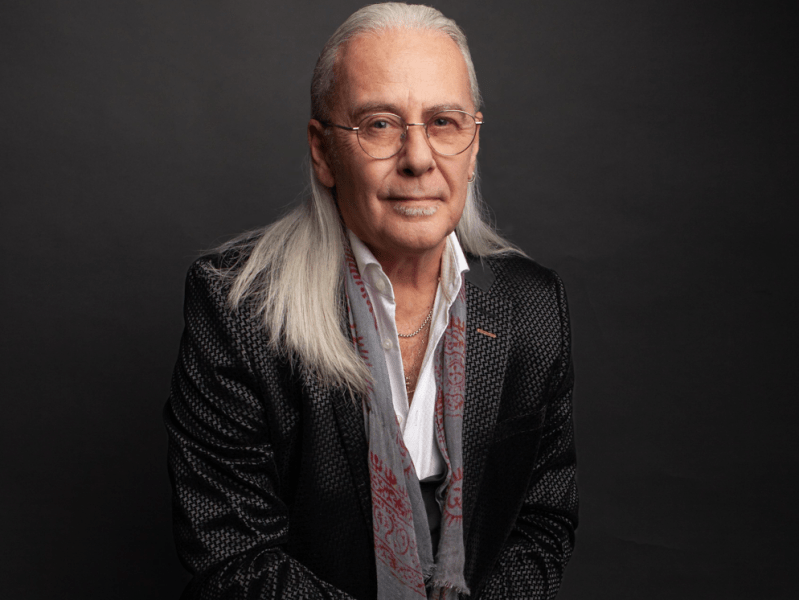
‘Poetry in Exile’ showcases thirteen of Andy Smythe’ meticulously arranged and crafted songs, drawn from his diverse palette as a multi-instrumentalist. This album marks his second self-produced endeavor, following the critically acclaimed ‘Hard to be Human’ released in 2022.
On the streets of London, where every stone is soaked in history, and every corner breathes culture, I met Andy Smythe himself at the incredible British Museum. It was an unusual place for a meeting, but as soon as Andy suggested it, I felt that it would be something special. Why the British Museum? This question is worth asking Andy himself. His answer was simple yet profound: “A place that holds so much history and culture seems like the perfect place for a meeting and a conversation about our own creativity.” In his vision, there was a special wisdom – combining one’s own creativity with the richness of cultural heritage. From the very beginning of our conversation, Andy was incredibly open and kind. His passion for music and art was infectious, and the inner fire of his creative inspiration only intensified the atmosphere of our conversation. As we wandered through the halls of the museum, every statue, every artifact seemed to be part of our dialogue, embodying the spirit of past epochs and inspiring new creative heights. One of the main topics of conversation was his new album “Poetry in Exile.” In addition to a detailed analysis of the new record, we discussed the upcoming tour, musical experiments, and much more.

photo by andysmythesolo
First of all, congratulations on the release of the album ‘Poetry in Exile’! It has truly been a long journey, full of challenges and creative discoveries. In this album, you explore the idea of defining oneself in a world rife with corrupted politics. These are quite complex themes, especially considering the prevailing trends in contemporary music. Why did you choose this theme as the focal point of the new album?
My songs reflect my own ‘inner world’ at any given time. I guess the album is similar in approach to Lennon’s personal approach, he wrote songs like ‘Nowhere Man’ and ‘Help’ when he felt isolated by Beatlemania. I have recently experienced some tough times, where I have witnessed first-hand instances of ‘corruption due to power’, ‘betrayal’, ‘ambition without morality’ and some of the less pleasant sides of ‘being human’… it was hard! I guess I experienced it on a micro-scale, but the trick of song writing is to project such experiences onto a macro-level and to generalise them. There are many other things going on in the world which I think then subconsciously influenced the songs, such as the conflict in Ukraine and the Brexit catastrophe/abuse of lockdown by politicians in England. I did go through a very dark time, but someone wise said to me ‘this might be for the best Andy you might discover a side to yourself that you couldn’t previously imagine’. When I felt something break in my spirit, perhaps my mind became more malleable and open to reaching out in a different direction. It was from ‘this pull’ that the album was born and manifested itself, like it had a life of its own, a restless energy that I could not contain.
“Poetry in Exile” seems like another milestone in your career. Looking back, how would you describe the evolution of your sound and storytelling from the early 2000s to this latest release?
In the early 2000’s again I was writing positive experiences, my music celebrated the beauty of the world, the discoveries of childhood, finding love, having children, discovering that I had a musical talent that people would pay money to hear. The music was celebrating ‘light’, I can feel that infuse my first few albums. The first few albums were recorded on analogue tape, so the music is warm and it ‘is live’. They were recorded in a ‘shed in Greenwich’ which has now been sold and is a multi-million-pound housing development. I have great memories of that time, the music was about love, positivity, and communication between the musicians. With the most recent release, it is largely a solo effort recorded at home using Logic on a Mac. Probably age and experience have taught me more about life ‘being grey’ and celebrating both the ‘light and shade’ in the songs. I would say that I have developed as a writer as I have experienced more life. The songs are better because they contain ‘more of the darkness’. I think that desperation and the extremes of human experience make you a better writer. If I look at my favourite artists like Springsteen, you can hear the same desperado in the album ‘Born to Run’. His management had mortgaged to the hilt, he puts his band through 18-hour days, runs through multiple arrangements of every song. If you want to make a classic album you must suffer!
From a technical perspective the advantages of recording solo are that you can determine your own metric, design your own riffs and hooks and take time over perfecting the right vocal approach. Whilst I might not be as technically adept as some of the session musicians on guitar and bass that I used on my early work, I am able to design the riffs and paint the palettes that I feel compliment the lyrics in the songs. The other advantage is that you don’t ‘have to perform’ at a given time and place, you can choose a time when your vocal feels right and really nail the performances. Recording as summarised by George Martin is ‘a deception’, you are trying to conjure magic and combine the spontaneous with an iterated perfection.
The album’s title track suggests a sense of detachment and longing for a place of belonging. Could you share more about the inspiration behind the title “Poetry in Exile”? It’s a captivating phrase that seems to carry layers of meaning. What significance does it hold for you personally, and how does it encapsulate the themes and emotions explored throughout the album?
The album is about being ‘exiled’ from something that you have devoted your life to. I have had a parallel experience to being a musician that has been teaching children in inner city state schools. I have given every ounce of my energy to this vocation, I even ran a football team for them at weekends for twelve years. In the ‘bad experience’ I had the whole legacy of all of that devotion was ‘regarded as worthless’ and that’s an incredibly tough message to try and digest. It ultimately felt like being spiritually exiled from your previous sense of self. My way of coping, was to deliver my ‘own therapy’ through music, write the songs that best encapsulated the experience and turn it into poetry. I used the negative experience to drive myself beyond the limits of creativity that I had previously imposed on myself, to sing higher and lower, to perfect every note and riff and to strive to get the desired emotion in each performance. I think it would be fair to say that the album took several thousand hours, there were lots of dead ends and re-interpretations until I felt that I had captured each song ‘like a Genie in a bottle’. I owed it to myself to drive myself to those extremes to re-invent myself. It felt like a personal metamorphosis.

photo by andysmythesolo
Andy, your music seems to draw from a diverse range of influences, including the likes of Ovid and Bob Dylan, who themselves navigated the complexities of exile and self-discovery. What aspects of their experiences resonate with you the most, and how do they shape the narratives within your music?
I discovered the Roman poets through reading a book about Dylan. The books called ‘Why Dylan Matters’ by Richard F Thomas and it’s a masterpiece. Dylan doesn’t reveal much, but it turns out that at school in Hibbing his favourite subject was Latin and he loved it so much that he would have considered becoming a classics teacher if he hadn’t made it as a musician. I consider one sentence uttered by Dylan to be the most profound sentence I’ve ever heard, it’s buried in an old 80’s video, he says ‘life’s not about things, it’s about creating yourself. If you look at his career there have been a set of incredible re-inventions, the most recent of which is the ‘gnarled old blues singer’. I think that if you trace Dylan back that that metamorphosis occurs first in the album ‘Oh Mercy’, it is my favourite Dylan album recorded in New Orleans with Daniel Lanois. He says that he had the epiphany about ‘how to recreate himself’ in a bar in hotel listening to an old blues singer. He felt creatively lost and had to reinvent himself. I think I felt the same but in an even more extreme way, suddenly at a more mature age life has taken a whole different direction, music has literally saved me from spiritual oblivion. I have recreated myself through song in producing this album.
As regards Ovid, he was exiled by Rome by Augustus as his love poetry didn’t resonate well with the personal morals and the state policies of Augustus. He was physically exiled to Romania on the edge of the Black Sea. Apparently, initially he veered towards hatred and vengeance in his work and gradually with time grew to accept his fate and try and use it to have a creative re-birth. I can empathise with this, in my ‘situation’ I was effectively exiled from ‘a court’ much like Ovid, and the initial emotions were the same as Ovid’s. However, to survive as a valuable human being, you cannot let yourself be destroyed by such as experience, you must ‘see the bigger picture’ and whilst forgiveness of individuals can be difficult, you must at least understand their circumstances and why they made the decisions that led them to their actions. In the song ‘Poetry in Exile’ on the album I cycle through this series of emotions… anger, vengeance, retribution and eventually empathy and personal redemption. In the song ‘Don’t be a Fool’, I try and reflect on the experience.
5. As someone who has been a part of the music scene for several decades, how do you view the evolving relationship between art and commerce, particularly in an age of streaming platforms and algorithm-driven recommendations?
I think that machines and humans are morphing already, and that music is mirroring that evolution. On the album I do a song called ‘Ghost in the Machine’ which was inspired by how you can edit on logic – even to the extent of changing the vibrato levels in our performance. I should add that I resisted the temptation! I can imagine a dystopian future where popular music is 100% artificial and where a new Beatles album could be generated by AI from their voices and song-writing techniques. I think we will be there soon… at that point I visualise a ‘musical revolt’, where organic music might return and musicians might set up their own distribution, festivals and communities insisting on 100% human art. I think that humanity is driven by the need to create, the addition of more machine learning will diminish ‘what it means to be human’. I can see a revolution!
Could you share with us which of your albums is your personal favourite, and what makes it stand out to you among the others?
I can honestly say that my new album is my favourite. I feel that the songs are the strongest I’ve written so far. I have a theory that my live set list usually contains my strongest songs – 10/15 of the set would presently come from this latest album. I think that it is because it has a more consistent ‘edge’, there is a sense of the need to resist the corruption of bad politics and rage against the machine. I think that this is a powerful recipe. Furthermore, I think that the production is better on this album, the collaborations with my friends Chris Payne and Dave Palmer have enhanced the songs. Chris developed three of the arrangements (two for strings and one for brass) and plays the strings beautifully and Dave has such a natural ear as a producer for ‘finding the right sonic space’ for the song. Dave is also very adept at the three-dimensional art of panning and reverb, separating the instruments to give them all a unique space.

“Poetry in Exile” seems to defy categorization, blending elements of Britpop with introspective storytelling and lush orchestration. What emotions or ideas do you hope to evoke through your music?
That’s kind of you to say, I think that it can be both a curse and a blessing to exist beyond categorisation! I guess I have had a succession of influences from an early classical piano training (Debussy, Chopin) to a folk orientated period (Nick Drake and Roy Harper amongst others) to an Americana (Dylan/Springsteen era) to a lasting love and admiration for The Beatles and for more recent British music such as Blur and The Verve. I want to write about subjects that move people, facets of an everyday life that they can relate to. For me, every song is like a picture that needs to be painted, you need to find the right ingredients and mix them in a way that compliments the emotion of the lyric. A great song has to come from the soul, my moments of inspiration strike when I’m deeply affected by things in life. I try and document those moments in an intuitive way initially, if I have a powerful lyrical idea, then I will come back and craft and finish it, but the original idea has to truly resonate with my place in the cosmos. I enjoyed writing songs such as ‘Prodigal Son’ and ‘Dear Landlord’ on the album that were both about being young and dealing with returning home after travelling and living in rented squalor, respectively. I try to come at the lyric from various perspectives, the aim is to give the song a universal energy after starting from a personal standpoint. Music is so powerful; it complements the passage of time, and you associate it with different periods in your life. If I can leave people with songs that they can link to fleeting moments in their own lives that they remember fondly, I think I will have done my job!
Looking ahead, do you see yourself continuing to explore new sonic territories and musical collaborations in your future projects? Are there any particular genres or artists you’re eager to explore or work with in your upcoming work?
I am going to concentrate on building a following by releasing singles regularly. I hope that both Chris and Dave will continue to work with me on arrangements and production. Chris’s daughter Chloe is a great singer and I really enjoyed working with her ‘Out of My Mind’. I also loved working with Beatrice Limonti on this project, she is a world class violin player who is going to really go places… she captured the spirit of every song immediately and that’s someone with a rare talent. I should also give a shout out to Gary Brady who provided the innovative AI video to accompany ‘Out of My Mind’, it’s a work of art in its own right! Hence, I am fortunate that I’ve been working with a great team of people. I would also like to give more opportunities to the musicians that I play with in my live band to contribute, I feel guilty about playing all the bass (just for convenience) and should ask Les, my live bass player to contribute. Jimmy Van Lin on fiddle did do a wonderful job on ‘No Pasaran’.
In terms of artists that I have been listening to, I’ve just discovered Harry Nilsen who was a genius. The range of his voice is Jeff Buckley-like, and his songs are beautifully crafted. Hence, I can see myself trying to write a classic or two in his genre. The emotion and power of the vocal performance in ‘Without You’ is otherworldly, the orchestration is also beautiful and uniquely powerful, the way the strings bow together. In the long-term I would like to become more talented at writing full arrangements for strings and brass and would like to study an orchestration course at some point… I also want to continue to stretch and use my voice, so I can create a vocal orchestra to an even greater extent than I have done on ‘Poetry in Exile’. I covered three and a half octaves on this album, but I think there’s more in the locker. Harry Nilsen was known for singing up to 30 parts on one song. Rufus Wainwright does things in a similar vein. If I ever had the opportunity, I think I could write a musical. I’m off to see ‘Opening Night’ featuring the songs of Rufus Wainwright in the West End (tickets lovingly bought by my partner Karen). So we’ll see! I don’t think that is corny, I have a feeling about it…
Can you tell us more about your upcoming tour to support the album? What can audiences expect from your live performances, and are there any particular cities or venues you’re excited to visit during the tour?
We are playing a string of dates in March and then throughout the Summer. In March we are taking an unplugged version of the songs (no drums) to a series of acoustic venues around London and the South of England. I am really excited to play the Bedford again in Balham, London, it’s a great theatre. Audiences can expect an intimate evening, I’ll explain the inspiration behind the songs and the interpretations of the songs will be different from on the CD, with an emphasis on varying the dynamic ranges of the songs with a smaller line-up. Hence, I hope people can catch the show and enjoy the performances, only to go home and hear a Phil Spector type ‘wall of sound’ version on the CD that is not necessarily better just different!
As we come to the end of our conversation, Andy, I’d like to pose a question that delves into the essence of your artistic path. In the pursuit of creating meaningful music that resonates with audiences on a profound level, how do you define the relationship between art and truth? And in your experience, how does the act of artistic expression contribute to our collective understanding of the human experience?
I think that art tries to capture the truth of a given moment, time is rushing forwards and in creating a song, we are trying to capture the emotion of that moment and paint a picture which is authentic and does the moment justice. For me, music must be truthful because I am writing from a personal experience that defines my existence as a human being. Poets throughout the ages such as Ovid and Dylan have had a great understanding of both joy and suffering and they have envisioned it their duty to document both the ‘light and the darkness’ of the human spirit. I am hoping to continue to do this, I feel that I am in a period of my life where I have recreated myself and am amid a ‘renaissance period’ where there is magic to be found at every turn and twist of the road, I want to use the time I have to create beautiful art that people can enjoy. Finally, I would just like to give my family a shout out for their unwavering support with this project and thanks for having me, an honour as always to talk to Indie Boulevard!




 Indie Boulevard Magazine