
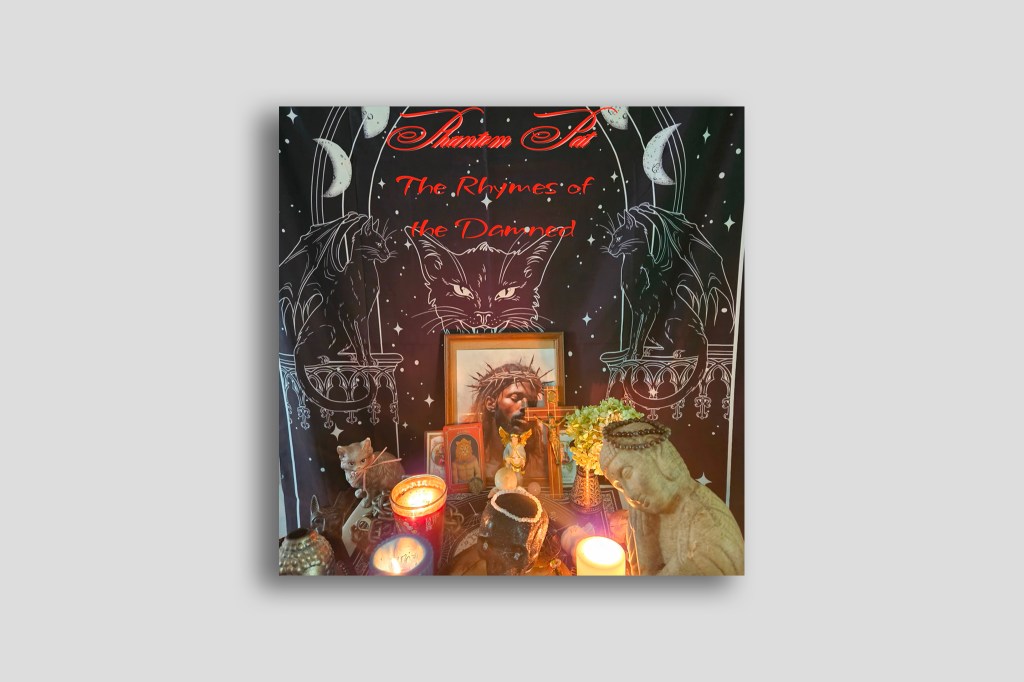
You know how all the facets of night can easily unfold across 11 tracks? That’s exactly what Phantom Pat‘s second album, The Rhymes of the Damned, was designed for. In it, the night reveals all its dimensions. A touch of mysticism, a hint of anxiety, droplets of stars, bright lights—that’s what lies at the foundation of remarkably cinematic music wrapped in the black, stylish packaging of associations.
Each of the 11 tracks conceals a new facet of the black velvet night. In some, it frightens; in others, it gently tingles the nerves; in still others, it struts down the runway of streets, igniting the lights of adjacent genres. But whatever the case, the album cinematically conveys the mood of each track. After all, night is different for each person. In The Rhymes of the Damned, anxiety coexists with hedonism, cosmic emptiness with street energy, and meditativeness with aggression. This is an attempt to create a parallel reality through the prism of a genre that has historically gravitated toward the specificity of urbanistic narratives.
This album sits somewhere between hip-hop and experimental electronics, dream pop and post-industrial music. Such synthesis is risky: it’s too easy to slide into eclecticism for eclecticism’s sake, when form dominates over content. Phantom Pat constructs his own dramaturgy—tracks function simultaneously autonomously and as parts of a unified conceptual canvas.
The album is interesting in its ambitiousness. The attempt to create a soundtrack for an imaginary film through hip-hop is no simple matter, and this already implies going beyond the boundaries of genre expectations. The question remains open: is such an approach capable of holding the attention of a listener accustomed to other narrative formats in rap, or will the conceptuality remain a beautiful idea that dissolves in the process of listening?
Track Breakdown
The opening track, “Mooncat OG,” sets the album’s energetic impulse. An assertive delivery, typical of classic hip-hop, unfolds over a melodic foundation built on repeating synthesizer patterns. The recitative dominates here, enveloping the listener in the dense atmosphere of a nocturnal city. This is a statement of intent, straightforward and audacious. Hip-hop without unnecessary embellishments, but with sufficient production quality to maintain focus.
“UPRD” changes the tonality. Blurred acoustic textures are juxtaposed with insistent recitative. If you mute the vocal part, what remains is almost an ambient composition with elements of dream pop. Phantom Pat bursts into this environment as a foreign element, refusing to dissolve into the softness of sound. The contrast creates tension: the voice struggles with the music for dominance. The effect is futuristic—as if observing a performance against the backdrop of cosmic emptiness. The contradiction between genres becomes a structural device, and the confrontation between blurriness and the clarity of recitative forms the track’s dramaturgy.
The third track, “Doozy,” returns the listener to physical space. Electric guitars, distorted to the limit, displace the acoustic weightlessness of the previous track. The music is tense, the guitar parts aggressive, the vocal delivery harsher than before. At times, crowd sounds break through—sampled or recorded live, amplifying the effect of presence.
“Odyssey of a Ghost” immerses in electronic exotica. The track is built on a minor tonality and atmospheric layers, creating a sense of traveling through unexplored spaces. Samples of metallic surfaces, vinyl crackle, underwater sounds form a retro-futuristic aesthetic—as if this were a soundtrack to a 1970s science fiction film.
“The Estate 1991” continues the theme of mysticism, deepening it through retro aesthetics. Bass parts coming from the lower register create a foundation for the song, over which bright acoustic flashes unfold. The energy here is more restrained than in the opening tracks, but the assertiveness remains. The melodic component intensifies, forming a balance between aggression and beauty. Retro motifs are transferred into a contemporary context, reimagined through the prism of current production.
“Shadow Cats” begins deceptively—keys create the impression of a meditative interlude. Then electric guitars burst in, and the track transforms into rocker hip-hop. Guitars dominate, pushing keys to the background, leaving them only the bridges. Recitative is minimal—the instrumental carries the main dramaturgy. Guitars argue with each other, creating a sense of internal conflict.
“The Gospel” softens the delivery, though the voice’s power is preserved. Hip-hop recedes, yielding to atmospheric music with elements of gospel—a genre traditionally associated with spirituality, here reimagined through the prism of electronics and urbanistic aesthetics. The track plunges into sleepy night but maintains a velvet texture.
The penultimate track, “Stefani,” is the album’s most daring experiment. The unexpected inclusion of jazz orchestration over hip-hop creates an effect reminiscent of a live performance in a luxurious club.
The final track, “Voices from Beyond,” concludes the album with a return to mystical atmosphere. This is a gothic lullaby for those who refuse sleep. The music is lush, saturated, tense. The velvet night ends on a note leaving a sense of incompleteness—as if the story will continue beyond the album.
Verdict
Phantom Pat has taken on an ambitious task—to transform hip-hop into a cinematic experience. The 11 tracks are structured like scenes from an imaginary film, where the main character is night itself in all its manifestations. Does it sound pretentious? Perhaps. But Phantom Pat handles this concept convincingly enough that the album remains engaging from start to finish.
The album’s cinematographic quality has a flip side. Listening to The Rhymes of the Damned means agreeing to a certain distance between yourself and the music. This is a soundtrack to a film that unfolds in your head. The visual sequence is physically absent but implied by the structure of compositions, their atmospherics, their dramaturgy. Such a format works if the listener is inclined to perceive the album as a whole, and to perceive the jumps between genres as a conscious artistic choice, and the contradiction between classic hip-hop and experimental insertions as part of the overall concept.
But it works precisely because Phantom Pat believes in his concept and brings it to logical completion. Rap can accommodate orchestral music, restaurant atmosphere, glamour—and still remain rap.
Phantom Pat has created what is rarely found in contemporary hip-hop—a conceptual project that genuinely follows its own logic from first track to last. There are no fillers for the sake of runtime, and certainly no attempts to please streaming service algorithms. The album exists by its own rules, and this self-assurance reads in the music. For those who want to listen to albums in full, who are ready to immerse themselves in sonic landscapes, Phantom Pat is already here.
*Promoted content. All information provided is prepared in accordance with editorial standards and is intended to offer useful insights for readers.







 Indie Boulevard Magazine