
The new album by Broke Royals titled Campr came out in early 2025 and truly became the absolute opposite of their previous work. This is their sixth release and the first where they consciously abandoned screaming. After Local Support, where Basnight literally screamed into the microphone, the band went in the opposite direction—falsetto, guitar parts with breathing room, a rhythm section that holds the groove instead of pushing the tempo.
Indie rock that was pieced together since 2017. Outcast songs that sat in folders with ridiculous working titles for years until they coalesced into something whole. The title emerged from a joke about Camper Van Beethoven and a 12-string guitar bought during the pandemic. Music that unfolds slowly and lives beyond a single listen. The band talks about restraint as a form of control, about silence as a choice, about how the loudest are usually the least confident. We talked about the process, the decisions, and about how to make music when the industry wants virality and you just want to record a proper album.
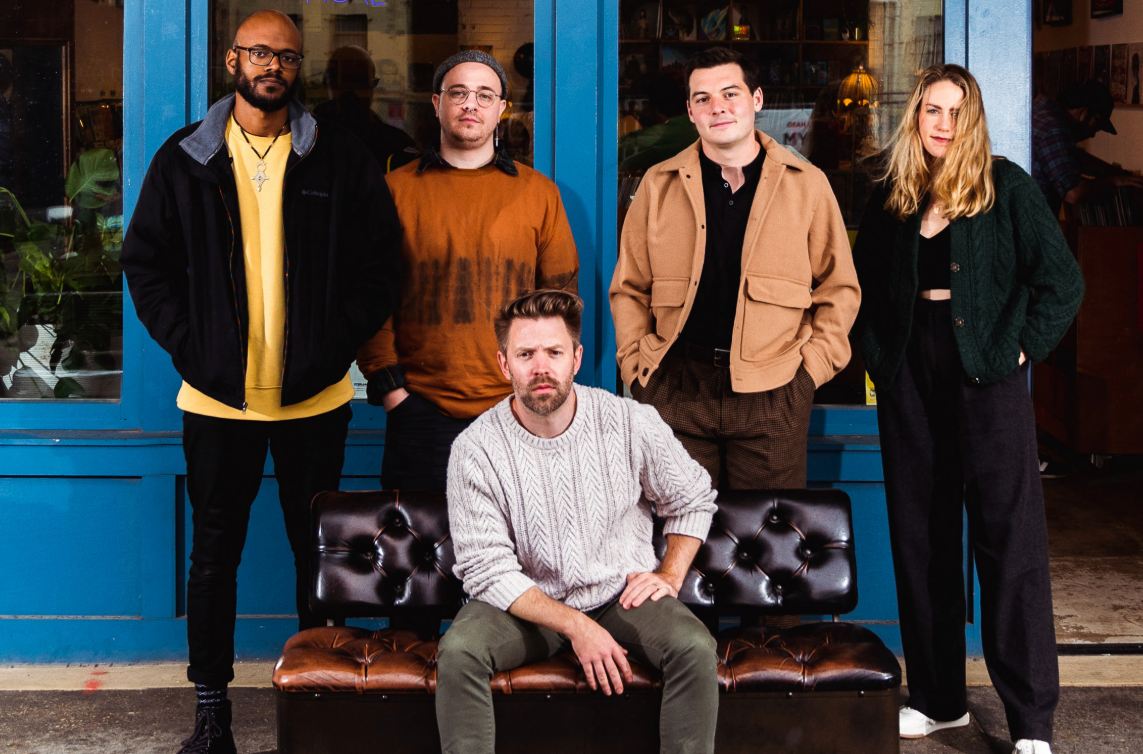
Hey guys! Congratulations on releasing your new album. You call Campr an album about restraint, but restraint in music is often perceived as fear of being heard or an attempt to hide behind safe choices. In your case, restraint sounds like a conscious decision, almost like a rebellion against the culture of constant screaming. When you were working on these tracks, was restraint your goal from the very beginning, or did it come as a natural reaction to what’s happening around you?
Philip Basnight: Our last full-length record, Local Support, involved a lot of literal screaming on my part, and on a musical level, there was a very conscious decision this time around to move away from that. I was much more interested in falsetto and melodic vocal lines, rather than the raspy rock-and-roll delivery that defined a lot of our earlier work. The world itself contains a lot of screaming right now. Talking heads, constant outrage, horrific violence, protests, noise everywhere. The theme of restraint arose naturally. I’m not sure what came first, the literal decision not to scream, or the metaphorical one, but there’s a real synchronicity between those ideas on this record.
Ben Wilson: I think that restraint actually shows a much higher level of control. I think the loudest in the room are those most unconfident with their expression, and are compensating for that with volume. So we definitely decided to go more subtle, BECAUSE we have had time to find our voices and our confidence, and now we can be comfortable with space. So to me, it felt really intentional from the jump.
Colin Cross: No, I think it is really the opposite of fear and hiding behind restraint. It is being willing to let every little detail and every nuance of the music be highlighted and showcased. In our earlier music, we used maximalist production in ways that could hide things. Now we are leaning into subtlety, and that has come very naturally as we have grown up, both as individuals and as a band.
“Better Off” was written during Trump’s first presidential term, and you talk about how choosing words carefully is a form of action, and silence is also a choice. But in 2025, with Trump back in power, does the meaning of this song change for you? Do you feel its message has become sharper, or conversely, has it been dulled by exhaustion?
Philip Basnight: I think the message has become incredibly sharp, sharper by the day, honestly. I’m writing this in early February 2026, and I’m tired. I think a lot of us are tired. But choosing your words carefully is still a choice, and standing behind them is a choice, even when it’s exhausting. If anything, it feels like we’re starting to see the dam break in favor of that restraint.
Ben Wilson: Going back to the previous question, I think that it just enhances our relationship to volume and bravado. There’s something to be found nowadays with subtlety that ends up being counter cultural in a way. It used to be really out there and shocking to be big and loud, but now it’s clear, that’s the way the world operates. So, the song to me feels more of an expression of putting what you want back into the world.
Perhaps the most curious question right now. You named the album Campr, a word that looks like a typo or, rather, like an unfinished thought. Tell me about the moment when you realized the album would be called exactly that. Was this decision connected to what you write about in the songs, about boundaries, about stopping to conform?
Philip Basnight: This one’s fun. The name Campr actually goes back to 2020 or 2021, when I bought a 12-string guitar. When I played it, it reminded me of Camper Van Beethoven songs, which often feature mandolin. I had this passing thought that if Camper Van Beethoven had started in 2020, they’d probably spell it C-A-M-P-R. That idea really tickled me, and it stuck. First as the name of the song, and eventually as the name of the album.
Ben Wilson: There’s this tendency for song demos to have very very silly names (“Real cutz switch” was a demo name for a different track on the record), it gives the song an identity as lyrical and musical content are being formed. But sometimes it just sticks and it becomes so ingrained as part of the song, that you just step back and say “this can’t be anything else”. And we had been calling the first 3 songs the “Campr Suite” and it just became a roadmap for the record, and eventually it became the real name with very minimal conversation.
The album was created over several years, and during that time indie rock as a genre went through several waves of reinterpretation, up to and including attempts to integrate synthetics and hip-hop rhythms. Did you consciously distance yourselves from these trends, or is this simply your own rhythm?
Philip Basnight: What’s unique about this album is that it always existed a bit outside my other work. The earliest demo dates back to 2017, and even then it didn’t fit with the songs that would eventually become Local Support, or the EP we released afterward. These songs were essentially the misfit toys.
Once we started thinking more intentionally about drum grooves, everything began to come together. That’s when the rhythm section really solidified the record. It wasn’t about chasing trends. If anything, the songs lived through too many trend cycles for that to make sense.
Colin Cross: As the drummer, I just want to say thank you.
Ben Wilson: I don’t love chasing a trend, because the industry is so fragmented right now. I just don’t see a need to play to a specific sound, when there is a dedicated audience for any sound. And as a band, while staying in a “rock/pop rock/alternative” lane, I don’t think there is a real sense of us trying to chase that sound just for the sake of chasing it. I just express things as I feel them, sometimes that lands in a modern context, sometimes it doesn’t, and I’m comfortable with both.
You mention friendship, distance, and boundaries in songs like “Campr,” “Still,” and “The Weather.” Were there moments when you decided to leave something off-camera because it was too close?
Philip Basnight: Yes.
The album resists memification and instant gratification. But the music industry is now structured so that algorithms demand hooks in the first 15 seconds, and listener attention is currency. How do you cope with creating music to live with when the entire system is set up for scrolling past?
Philip Basnight: This is something I worried about throughout the process. You don’t want to write for memes or viral sounds, but when you make a full album, you do have the opportunity to go back and identify three or four moments that can work in that context. Not every song on this record lends itself to that, but “The Weather,” “Campr,” and “Carriage” have already emerged as fan favorites for short-form videos. That was reassuring. We didn’t want to write to trends, but we also didn’t want to be oblivious to the world we live in.
Ben Wilson: I think that while the “industry” aspect of it is built like that, I think there is an active resistance from underground bands and artists, and a draw to people that DONT embrace the trends. So I’m fine if someone doesn’t find the song interesting after a few seconds. I’m more interested in the type of person who wants to dive deeper.
Colin Cross: I definitely do not think we, or any artist, should write for memification. At the same time, any song that calls for a catchy hook or a catchy moment has the potential to create that instant gratification. We never structured these songs around how easily they would fit into modern commercial appeal. One of my most pleasant surprises since releasing some of these songs has been how well they have done in the modern attention economy. Some moments that I did not initially think of as instant gratification exist in a very natural way that does not undercut the music.
Many bands talk about how the studio and the stage are two different worlds, and songs transform when you bring them to people. How do you work with this gap? Do you write music already imagining how it will sound live, or do you record what you want and then figure out how to play it at a concert?
Philip Basnight: We work really hard to put on a great live show, but that comes second. First and foremost, we focus on making the best possible record. Once that’s done, we figure out what belongs on the stage and how to translate it live.
Are there tracks that you simply can’t reproduce live, and are you okay with that?
Philip Basnight: Yes. And yes.
Ben Wilson: “Can’t” is a strong word. We could! We would just need 3 auxiliary guitarists, 2 backing vocals, some very expensive synthesizers, 2 drummers, and a dedicated percussionist. That’s all!
When you sit down to write a new song, where does the process usually begin? And does it ever happen that the band comes into the studio with one idea but leaves with a completely different song because the process took you to an unexpected place?
Philip Basnight: I think songwriting is a craft like any other. You have to put in the reps. You write a lot just to find a few great ideas, and you can’t be precious about what you make. Most of the time it’s a numbers game, though occasionally something special announces itself early.
Ben Wilson: I took a lot of the mantle of “arranger” on this record, and I can say that many of these songs ended in very different places. I think that is the main point of being in a “band” vs a solo project. You can’t really assign an identity before everyone has touched it, because we all care so much about so many different things, and that’s going to imprint itself naturally. A lot of my specific tonal instincts are all over this record, in ways that likely would not have happened if I couldn’t stretch, and I’m sure everyone has that feeling about so much of the record. You never know what’s going to inspire someone, and you have to let that play itself out to an extent, and it’s more about knowing when to stop, not about how it started.
Colin Cross: This is a really interesting question. I would say almost no song ends up exactly how we envisioned it in the early stages. Sometimes that means it does not make the cut. Other times, and I would like to think more often, it becomes something we like even more than the initial idea. A beauty of making music is constantly being on the hunt for a little line, a little moment, a little special thing that draws you in and then chasing that no matter what path it takes you down. If you do that, you keep making art that is exciting and fun for you and hopefully for the listener as well.
You say that the songs on Campr are created to live with. But living with music requires returning to it, repeated listens, discovering new layers. What element of the album, whether it’s a lyric, a guitar part, or even a pause, do you consider the most imperceptible on first listen but most important on the tenth?
Philip Basnight: For me, it might be who ended up singing which song. These all started as demos with me, but in most cases, someone else sings because they asked to. That choice usually reflects what they connected with, whether it was a lyric, a feeling, or the overall vibe. I think that reveals itself more over time.
Ben Wilson: I think by a certain point, you are starting to listen to instrumental interplay. You start hearing where things are placed tonally, and the where they ARENT. You find a drum groove stop for one beat, you find a guitar or vocal drop out, etc.
Colin Cross: The first thought that comes to mind is all of the periods where very little is happening, but the song is still somehow moving forward. That is very different from how we used to write songs. We used to move from one hook to the next, one chorus to the verse, one verse to the next chorus. On this record we are not doing that. We are taking long pauses, letting the groove drive things, letting less do more. I am curious to see how that resonates with people over time.
Tour Dates:
2/20 – Norfolk, VA – The Annex
2/21 – Washington, D.C. – Songbyrd
2/22 – Brooklyn, NY – Alphaville
All information provided is prepared in accordance with editorial standards and is intended to offer useful insights for readers. Please note that the opinions, interpretations, and evaluations expressed by the author may substantially differ from the viewpoints of our readers or the general public at large, and we respect the diversity of opinions.






 Indie Boulevard Magazine