
Lewis Jack Inman has released his album “The Squeeze” — ten tracks of alternative rock with pop and folk elements, operating in a tradition that draws from Courtney Barnett and Queens of the Stone Age. The album stands as a fully realized debut statement from an artist working in territory where guitar rock allows itself to be vulnerable, and a measured, unhurried vocal becomes the loudest instrument in a room full of smoking amplifiers.
And that vocal is the right place to start, because it is what defines “The Squeeze” as a project. Lewis Jack Inman has a calm, classically composed voice — calm relative to everything surrounding it: the roaring guitars, the dense drums, the rock arrangements that could function as a self-sufficient wall of sound on their own. And that quiet voice somehow ends up being the first thing you hear. It cuts through the mix the way a conversation started in a half-whisper cuts through a loud party — precisely because the speaker refuses to raise his voice, you lean in closer. Inman holds this dynamic intuitively, and the entire album is built around it: loud on the outside, quiet at the center.
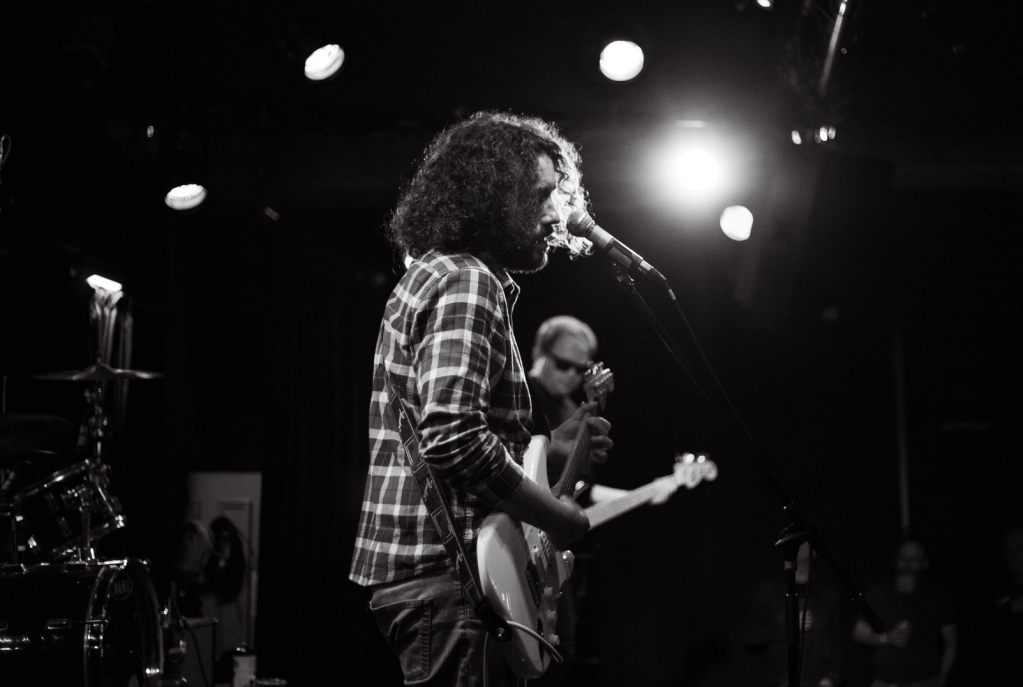
“Daydream” opens the record with direct rock confidence — guitar drive, energy, speed. The track is packed so densely that the first thirty seconds function as a hard reset: whatever you were doing before, you are here now. And in the middle of all that noise, Inman‘s voice — soft, almost contemplative. The contrast registers immediately. You understand the rules of the game from the opening track: the guitars will shout, and the man at the microphone will speak. And he will speak in a way that makes you pay attention.
I could walk through all ten tracks, but that would be a service of questionable value to the album. “The Squeeze” is built as a route, and narrating a route means robbing the listener of the pleasure of walking it themselves. So I will pick three points that define the character of this album better than any full account could.
The first is “Here Now.” The second track, and already Inman is making the move that sets the tone for everything that follows. The rock opens toward lyricism, blues overtones surface, the masculinity of the sound softens at the edges, and you hear the genre literally unbuttoning itself mid-stride. The track closes the distance between rock and pop through emotional honesty — and that honesty lands precisely because it sounds organic and uncontrived. Inman allows himself to be tender inside a heavy sound, and “Here Now” is the moment that tenderness first becomes audible at full strength.
The second point is “Queen Of Nothing.” The fourth track, and, in my view, the best thing on the album. A genre shift happens here that reframes the entire project: folk breaks through the dense rock. Weathered guitars, a campfire atmosphere, feelings that lift toward the sky — and suddenly you understand that “The Squeeze” is considerably wider than it appeared at the start. The folk here serves as a pause — but a specific kind of pause: the one that arrives after long, heavy work, when the body still carries the tension but the mind has already let go. “Queen Of Nothing” relaxes the listener while keeping them grounded, the guitars quietly reminding you of gravity. This track is the key to the whole album: Inman can be many things, and his range is deliberate, calibrated, thought through to the last transition.

The third point is “If You Knew.” Contemplative, minor-key, with an inner heat that conceals itself beneath a composed surface. Rock and pop fuse here to the point where the boundary between them becomes indistinguishable, and the track occupies that in-between space — more anxious than pop, more restrained than rock. It is in this gap that Inman is most fully himself, and “If You Knew” is the proof that the word “alternative” in his case carries real weight.
Between those three points sit seven more tracks, each running at its own temperature. “Inside Your Jar” is basement rock — a shout, a drama, guitars clanging as though the rehearsal lost control of itself. “Bottle Of Wine” is a pulsing track with a rushed, wry humor that makes you want to move faster, do more, live harder. “These Days” closes the album with drive and the sensation of an open road — the exhausting fight is behind you, and ahead is movement that has, by this point, become its own destination.
The album’s title — “The Squeeze” — means pressure, compression, a vice closing from all sides. I think Inman loaded that title with more than it first appears to hold. All ten tracks form a portrait of a person under pressure, reacting differently each time: fighting, dreaming, running, drinking wine with friends, going still, running again. It is an honest portrait — Inman allows his protagonist to be inconsistent, and that inconsistency is exactly what persuades. Across ten tracks, a whole interior landscape passes in front of you — moods, decisions, doubts, impulses — and that landscape looks alive.
If “The Squeeze” carries a vulnerability, it is the album’s tendency to occasionally need a firm shake. Inman switches registers brilliantly, but switches them with a consistent softness of transition. Between “Inside Your Jar” (basement shout) and “Queen Of Nothing” (campfire folk) you want to feel a collision — a hard cut, a sharp edit. Instead, Inman smooths the seam, and the transition lands more gently than it might. “Heads on Fire” by Ava Valianti is one example of what a genre leap can do when it hits on the solar plexus through sheer abruptness. Inman lands fewer blows of that kind than you find yourself wanting — but that is a note about potential still ahead, because “The Squeeze” makes one thing unmistakably clear: the material, the voice, and the thinking are already in place. The next album will show how far he is willing to go with the scissors.
For now — ten tracks, ten ways to exist under pressure, and every one of them earns a full listen.
All information provided is prepared in accordance with editorial standards and is intended to offer useful insights for readers. Please note that the opinions, interpretations, and evaluations expressed by the author may substantially differ from the viewpoints of our readers or the general public at large, and we respect the diversity of opinions.








 Indie Boulevard Magazine